
Before dawn, Mars and Jupiter will form a bright pair in the sky
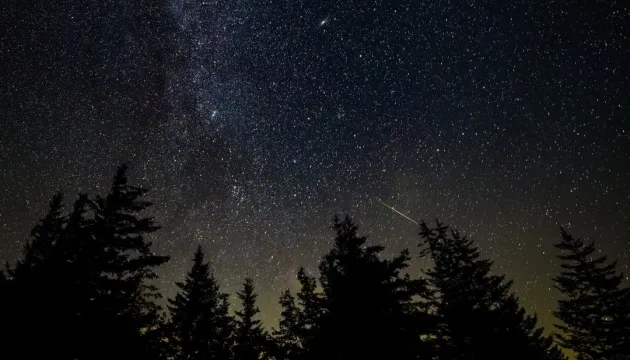
On the night of November 15–16, Mars and Jupiter will appear very close to each other in the sky. The closest apparent distance between the planets will be at 4:04 a.m. Kyiv time. They will be visible to the naked eye, and the bright star Regulus in the constellation Leo will shine nearby.
The best time to observe them is before dawn on November 16. Mars and Jupiter will appear above the eastern horizon around midnight and then gradually rise higher. They will be closest to each other at 4:04 a.m. Kyiv time. At that moment, the apparent distance between the planets will be slightly more than one degree. This means that in the sky they will look like a bright pair, even though they are actually separated by a vast distance in space.
Jupiter will be noticeably brighter than Mars. Mars can be recognized by its characteristic reddish hue. Near the planets will be Regulus—one of the brightest stars in the constellation Leo. Together, the three celestial objects will form a shape resembling an upside-down question mark. It will resemble the outline of Leo’s head, formed by the stars in this part of the constellation. That is why this sighting may be particularly interesting for those who enjoy studying constellations and searching for familiar shapes in the night sky.
Do You Need a Telescope to See the Planets?
No special equipment is needed for this observation. Mars and Jupiter will be bright enough to see with the naked eye. The key is to choose a spot with an unobstructed view of the eastern horizon and, if possible, away from bright city lights. You can also view the planets through binoculars. According to Space.com, they will both fit within the field of view of binoculars with 10x magnification and 50-millimeter objective lenses.
Owners of home telescopes will be able to see even more detail. In particular, using a telescope with an aperture of at least four inches, you can try to make out Jupiter’s Great Red Spot—a massive atmospheric feature that has been observed on the planet for many years.
The exact time of Mars’ and Jupiter’s rise depends on the observation location. You can check it using a special tool on the Time and Date website by selecting your city. For Kyiv and other cities in Ukraine, the time the planets appear above the horizon may vary slightly.
When the Planets Will Be Close Together Again
After November 16, Mars and Jupiter will gradually drift apart in the sky. Therefore, it’s best not to put off observing them if you want to see them as a close pair. The next time these planets will be this close together will be in about two and a half years—in July 2029. At that time, their apparent conjunction will take place in the constellation Virgo.
It’s important to remember that this is specifically a visual convergence. In reality, Mars and Jupiter will not be moving closer to each other in space: due to the planets’ positions in their orbits, it will appear from Earth as though they are close together in the sky. Space.com reports on the upcoming planetary conjunction.
Two rings of planetary debris orbit the newly discovered star. Studying them could help scientists understand how the Solar System will change in the later stages of its existence.
NASA astronaut Anil Menon and Canadian Space Agency astronaut Joshua Kutrik are scheduled to complete the upgrade of the International Space Station’s power system on November 5. During a spacewalk lasting about seven hours, they plan to install the eighth and final iROSA deployable solar panel.




