
A NATO reconnaissance drone was spotted over the Black Sea after taking an unusual route
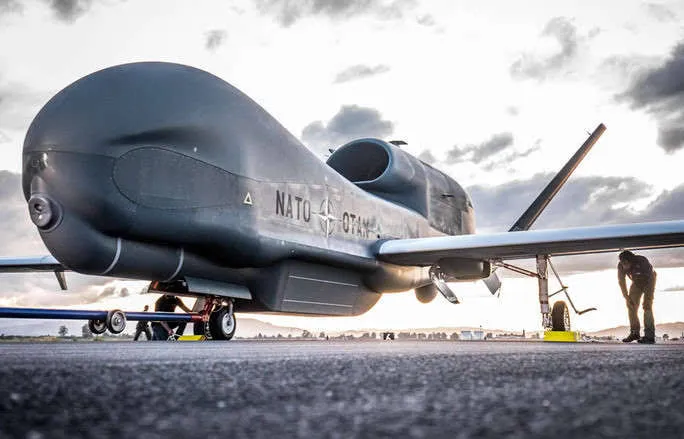
A NATO RQ-4D Phoenix drone with the call sign MAGMA10 reached the Black Sea after taking off from the Sigonella Air Base in Sicily. During the flight, it crossed the Mediterranean Sea, passed through the Balkans, and performed unusual maneuvers over Albania. This mission also drew attention because, in recent times, such Phoenix flights over the Black Sea have rarely been trackable via open-source data.
The RQ-4D Phoenix drone took off from Sigonella Air Base in Italy, on the island of Sicily. According to open-source flight tracking data, the aircraft with registration number MM-AV-SA0015 and call sign MAGMA10 initially flew over the central part of the Mediterranean Sea and then set course for the Balkans.
The drone subsequently reached the Black Sea and began flying over its western part. It was this segment of the route that drew particular attention from observers, as Phoenix reconnaissance flights in this area have recently been harder to spot on public tracking services.
Why the route over Albania drew attention
The most unusual stage of the flight was the segment over Albania. After crossing the Ionian Sea, the drone changed direction and adjusted its route several times before continuing toward North Macedonia and Bulgaria. This trajectory differed from the usual direct route through the region. According to one theory, the aircraft may have been awaiting permission to enter North Macedonia’s airspace. Because of this, it likely had to change course or remain within the area available for flight.
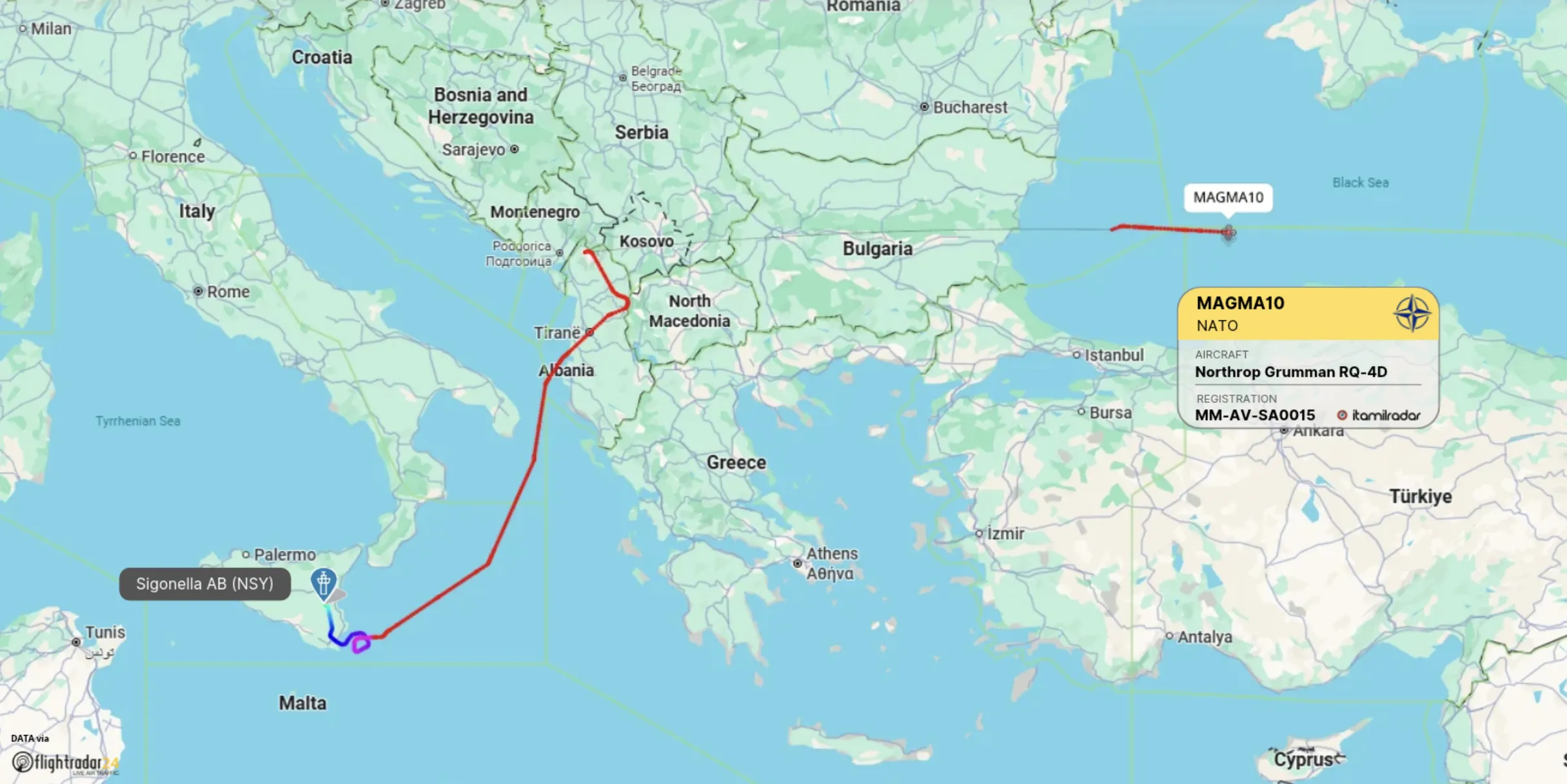
However, this is merely a hypothesis based on flight path data. There is no confirmation that the maneuvers were indeed caused by waiting for overflight clearance. Therefore, it is not yet possible to attribute the course changes specifically to airspace restrictions. After passing through the Balkans, MAGMA10 continued toward the Black Sea. There, its transponder signal became visible again. Publicly available data showed the drone reaching the western part of the basin and beginning operations in that area.
What Makes the RQ-4D Phoenix Special
The RQ-4D Phoenix is a NATO unmanned aerial vehicle (UAV) designed for long-duration reconnaissance missions. It is part of the Alliance Ground Surveillance (AGS) system, which helps the Alliance gather intelligence on large areas. The main advantage of such aircraft is their ability to remain airborne for long periods and monitor large areas of terrain. To do this, they use special sensors and radar equipment. The data collected helps track changes on the ground, the movement of military equipment, and other objects that may be of military significance.
Thanks to its long flight duration, the Phoenix can carry out missions at a considerable distance from its base. This is particularly important for monitoring regions where the situation is rapidly changing or is critical to the security of several countries. The Black Sea remains one such region. Since the start of Russia’s full-scale war against Ukraine, the Black Sea has been of critical importance for monitoring military activity, particularly the actions of Russian forces. Consequently, NATO reconnaissance flights in this region have drawn the attention of military analysts.
Why This Flight Is Considered Rare
According to the authors of the observation, for some time it was not possible to clearly track RQ-4D Phoenix flights over the Black Sea using open-source signals. This does not necessarily mean that the drones have stopped carrying out such missions. Some flights may have remained undetectable by public tracking services or made it impossible to reconstruct the full route. In particular, observers speculate that a similar mission may have taken place as recently as last week. However, the aircraft’s signal was not available for public tracking at that time, so its exact route could not be determined.
That is precisely why the current MAGMA10 flight provided an opportunity to observe the movements of one of NATO’s reconnaissance drones in greater detail. Open-source data made it possible to trace its path from Sicily across the Mediterranean Sea and the Balkans to the Black Sea.
At the same time, the mere fact that the Phoenix was in the region does not allow us to determine exactly which targets it was tracking or what tasks it was performing during this mission. Such conclusions require information that is not available in the publicly available route data. However, the flight demonstrates that the Black Sea remains an area of focus for NATO reconnaissance systems, according to itamiradar.
Two NH90 helicopters from the Paznic Tactical Aviation Squadron of the Spanish Air and Space Forces took off on an emergency mission for the first time as part of a NATO international mission in Romania. They took off from Mihail Kogălniceanu Air Base in response to reports of unidentified drones.




