
November 20, 2026 — Argentina's National Sovereignty Day: The History of the Holiday
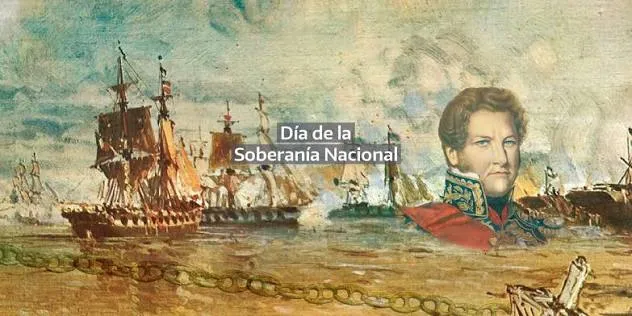
November 20 is National Sovereignty Day in Argentina—a holiday dedicated to the country’s struggle for the right to determine its own future. It is associated with the Battle of Vuelta de Obligado, which took place in 1845 on the Paraná River, when Argentine troops attempted to halt the advance of the British and French fleets. Although Argentina was defeated in that battle, its resistance became a symbol of the defense of its independence.
National Sovereignty Day, or Día de la Soberanía Nacional in Spanish, is observed annually on November 20. It is a national commemorative date dedicated to the events of the mid-19th century, when Argentina resisted the intervention of two European powers—Great Britain and France. At the heart of this story is the Battle of Vuelta de Obligado, which became a pivotal episode in the struggle for control over the country’s rivers, trade, and territorial integrity.
In 2026, this historic date falls on Friday, November 20. At the same time, Argentina’s official calendar lists a rescheduled holiday for November 22 this year. This distinction is important: the historical event itself is always associated with November 20, while the date of the non-working day may vary according to the rules for rescheduling holidays. National Sovereignty Day is one of the national holidays that may be rescheduled to create a long weekend.
What Does National Sovereignty Mean?
Sovereignty is the right of a state to independently govern its territory, enact laws, determine domestic and foreign policy, and manage its own resources. Simply put, it refers to a country’s ability to decide for itself how to live, without coercion from other states. It is this very idea that lies at the heart of the Argentine holiday.
For Argentina, the issue of sovereignty is particularly important because of its history. In the first decades after declaring independence, the country experienced political conflicts, power struggles, and complicated relations with foreign states. Control over the rivers had not only military but also economic significance: it determined who could transport goods, trade with other countries, and influence life in the region. Therefore, the events of 1845 in Argentina are remembered not merely as a single military episode, but as part of a broader struggle for independence.
Why the Battle of Vuelta de Obligado Took Place
To understand the causes of the battle, we must look back at the political situation in South America in the mid-19th century. At that time, Argentina was not yet the stable state it would later become. The country was experiencing internal conflicts between political factions and regions, and its government was trying to maintain control over its territory and trade routes.
Juan Manuel de Rosas, the governor of the province of Buenos Aires, who effectively ruled the Argentine Confederation, played a key role in the politics of the time. His government sought to control navigation on the inland rivers, particularly the Paraná and the Uruguay. This was of fundamental importance, as the rivers were vital transportation arteries through which goods could reach the country’s interior.

Great Britain and France had their own economic and political interests in the region. Both nations sought greater access to trade and navigation on the rivers leading to the interior of South America. They were dissatisfied with the restrictions imposed by the Rosas government, as well as his interference in conflicts in neighboring Uruguay. In 1845, British and French forces launched a joint naval operation, which was accompanied by a blockade of the ports of the Argentine Confederation. This effectively restricted its foreign trade and intensified the confrontation.
In November 1845, a combined Anglo-French squadron sailed up the Paraná River. Accompanying the warships were merchant vessels intended to open a route to the region’s interior. The Argentine authorities viewed this as a threat to their control over the territory and the river routes. Therefore, it was decided to attempt to stop the fleet at a location where natural conditions gave the defenders at least some advantage.
How the battle unfolded and why the Argentines lost
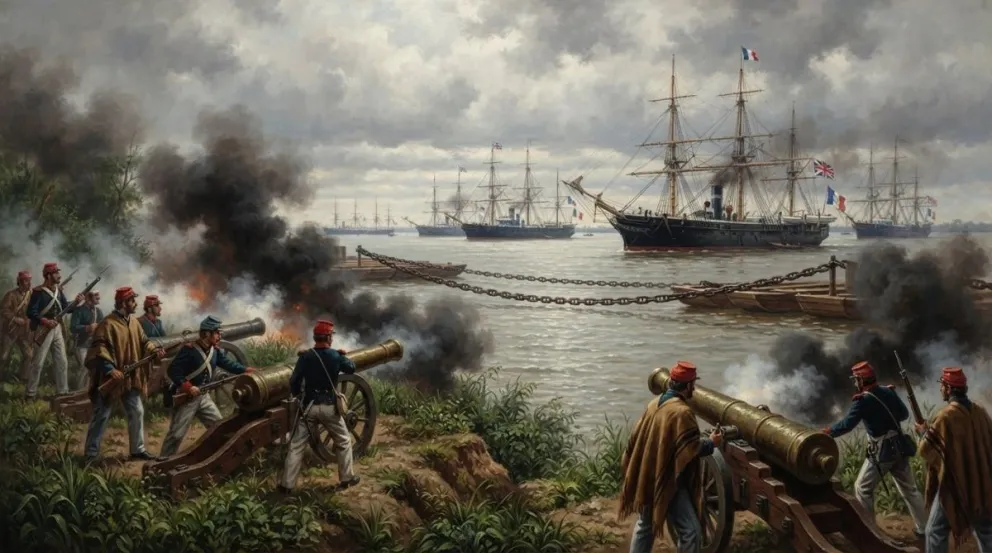
The site chosen for the defense was Vuelta de Obligado—a bend in the Paraná River near the city of San Pedro, in what is now the province of Buenos Aires. At this point, the river narrowed to about 700 meters, and its bend made it difficult for large ships to navigate. The Argentine forces were commanded by General Lucio Norberto Mancilla, who had been appointed by Rosas. To block the fleet’s path, the defenders stretched three massive chains across the river, secured to 24 boats. Four artillery batteries, comprising 30 cannons, were also set up on the bank. The plan was simple: to trap the ships in the narrows and prevent them from passing unhindered into the interior of the country.
On November 20, 1845, British and French ships approached the Argentine positions. Their superiority was evident: the fleet had more modern cannons, a longer range, and more powerful armament. Among the ships were steam-powered vessels, which at that time gave the Europeans a significant advantage in navigation. The Argentine artillery was inferior in terms of accuracy and reloading speed, but the defenders nevertheless opened fire and inflicted casualties on the enemy. The battle lasted several hours. When the Argentine guns began to fall silent due to a lack of ammunition, foreign troops landed on the shore and attacked the defensive positions.
During the battle, General Mansilla was seriously wounded, and Colonel Torno took command of the artillery. Ultimately, British and French troops managed to damage and sever the chains, destroy part of the defensive fortifications, and continue their advance up the river. The Argentine forces lost their positions, and the battle itself ended in their defeat. According to the Argentine Institute of Military History, the defenders suffered approximately 250 killed and 400 wounded, while the allied fleet’s losses amounted to 26 killed and 86 wounded. These figures illustrate just how unequal the forces of the opposing sides were.

Despite the defeat, the historical significance of the battle goes beyond who held the battlefield. Argentine resistance hindered the foreign fleet’s advance, and the ships sustained damage and required repairs. After the Battle of Vuelta de Obligado, the conflict did not end: Argentine forces continued to attack the fleet in other sections of the Paraná River. In particular, on June 4, 1846, a battle took place near Angostura del Quebracho, where the allies again suffered losses. Thus, the Vuelta de Obligado became part of a longer struggle rather than a single clash that determined the outcome of the conflict.
How the Confrontation with Great Britain and France Ended
Following the military clashes, the parties moved on to protracted diplomatic negotiations. The Argentine government sought the lifting of the blockade, the return of the captured ships, and recognition of the country’s right to independently control navigation on its inland rivers. The negotiations were difficult, as Great Britain and France wielded significant military and political influence in the region. However, they eventually agreed to a settlement of the conflict. Argentina secured the return of Admiral Guillermo Brown’s captured squadron and Martin Garcia Island, as well as recognition of its rights to its inland waterways.
One of the symbolic moments was when military ships fired a 21-gun salute to the Argentine flag. This was part of the diplomatic settlement and was intended to demonstrate respect for the state with which European countries had concluded peace agreements. Thus, although Argentina lost the battle in 1845, the subsequent struggle and negotiations enabled it to defend important political and trade rights. That is why, in the national memory, this event has become a symbol not so much of a military victory as of resistance to external pressure.
What Does José de San Martín Have to Do with It?
The history of the Vuelta de Obligado is also linked to José de San Martín—one of the leading figures in the wars of independence in South America. At that time, he was already in Europe but was closely following events in his homeland. San Martín supported Rosas’s position during the conflict with Great Britain and France. It was important to him that Argentina be able to decide matters concerning its own territory independently and not yield to the demands of foreign powers.
In his will, San Martín even instructed that the saber he had wielded in the wars for South American independence be given to Rosas. He explained this as a sign of respect for the way Rosas had defended the republic’s honor against external pressure. The document referred to “the steadfastness with which he upheld the honor of the Republic.” This gesture became one of the most famous symbols of the hero of the wars of liberation’s support for the Argentine resistance.
How the Holiday Came to Be and When It Became a Public Holiday
Despite the battle’s significance, a specific day to commemorate it was established much later. On September 26, 1974, the Argentine Congress passed Law No. 20,770, officially designating November 20 as Sovereignty Day. The law explicitly linked this date to the Battle of Vuelta de Obligado, which took place on November 20, 1845. The law also stipulated that educational institutions across the country must hold themed events. In other words, from the very beginning, the focus was not only on commemorating the military event but also on explaining its significance to future generations.
Over time, the status of the date changed. In 2010, during the bicentennial celebration of the May Revolution, National Sovereignty Day was added to the list of national holidays. This was formalized by Decree No. 1584/2010. Since then, November 20 has become not just a commemorative date, but an official holiday that gives Argentines the opportunity to participate in celebrations and enjoy a day off. The law allows for this holiday to be rescheduled so that it can be combined with other days of the week.
How This Day Is Celebrated in Argentina
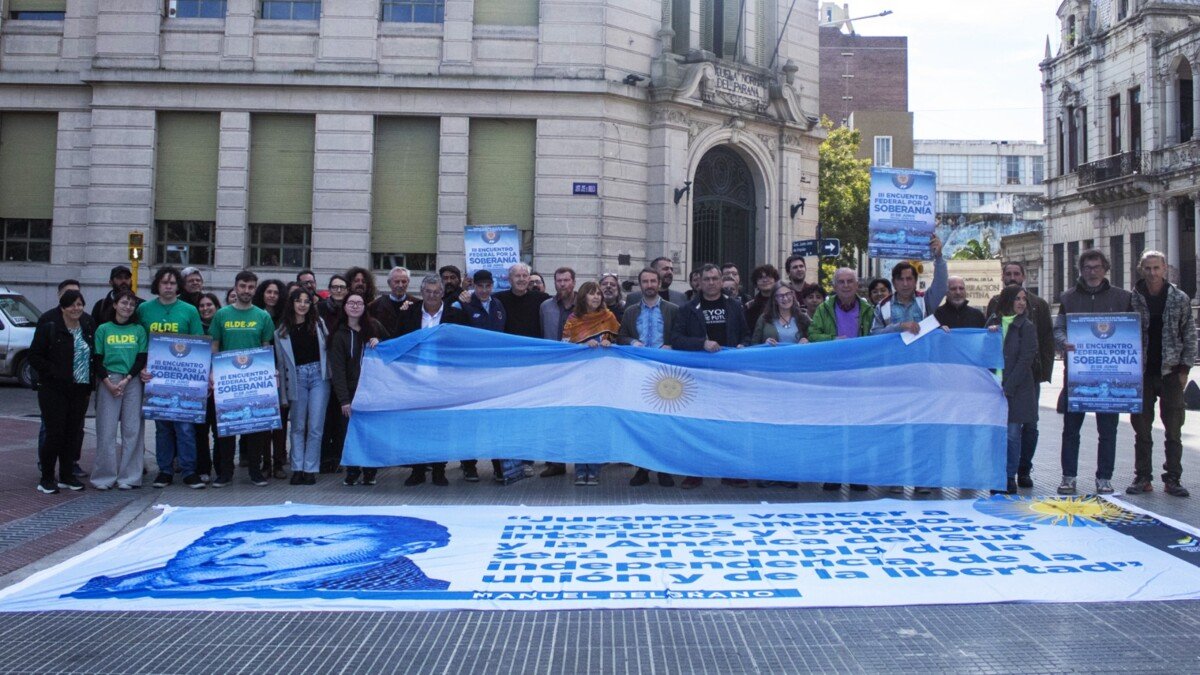
The main celebrations traditionally take place in the province of Buenos Aires, in the San Pedro district, where the battle took place. The historic Vuelta de Obligado memorial is located there, and official ceremonies are held near it. Representatives of local and central government, the military, civic organizations, schoolchildren, and residents of nearby towns may participate in the events. During these events, participants commemorate those who fought in the battle, discuss the country’s history, and reflect on the significance of national independence. Sometimes representatives of the armed forces take part in the ceremonies, and wreath-laying ceremonies and patriotic events are held.
Educational and cultural events are a separate part of the celebration. Schools hold themed lessons, teaching children about the battle, its participants, and the causes of the conflict with European powers. Historical documents, maps, photographs, videos, and interactive materials are used for this purpose. Argentina’s national educational platform, in particular, offers teaching resources on the Vuelta de Obligado, as well as assignments for students of various ages. This approach helps explain that sovereignty is not just a concept from a history textbook, but also the right of society to determine its country’s future independently.

In San Pedro itself, the celebrations often go beyond the official ceremony. Local communities organize concerts, folk performances, fairs, exhibitions, and tours of historic sites. You can see traditional Argentine dances, hear folk music, and get acquainted with local crafts and cuisine. Such events turn this commemorative date into an occasion for the entire community, rather than just an official tribute to the past.
In 2026, the San Pedro district has also planned a multi-day program to mark the anniversary of the battle. According to local media reports, an official ceremony is scheduled to take place at the memorial on November 20 at the historic site, and throughout the holiday period there will be tours, gatherings, musical performances, theater and dance events, fairs, and traditional celebrations. In other words, the local celebration combines historical remembrance with the region’s cultural life.
Where to See Traces of the Historic Battle
One of the most important sites associated with the holiday is the historic Vuelta de Obligado area near San Pedro. It was there in 1845 that Argentine troops attempted to block the Paraná River with chains to prevent the foreign fleet from passing. Today, this site has become a memorial where visitors can learn more about the course of the battle and its participants. A monument commemorating the battle stands there, and ceremonial events are held near it. For Argentines, this is not just a tourist attraction but a symbol of resistance to foreign intervention.
The memory of these events is also preserved in museums, archives, and educational materials. The National Library of Argentina publishes historical accounts of the battle, and state educational resources provide materials for classroom use. As a result, the history of the Vuelta de Obligado is studied not only in the context of military history but also in relation to trade, international relations, and the formation of Argentine statehood.
Interesting Facts About National Sovereignty Day
- The chains across the river were part of the defense plan. The Argentines stretched three massive chains from one bank of the Paraná River to the other. They were secured to 24 boats to block the passage of foreign ships. This detail became one of the most famous symbols of the battle.
- The Argentine forces were outgunned by the enemy. British and French ships had more modern artillery, longer firing ranges, and superior technical capabilities. Despite this, the defenders inflicted damage on the fleet and forced it to spend time on repairs.
- It wasn’t just career military personnel who took part in the battle. Various groups of the local population were involved in the defense, including residents of the region, gauchos, and members of indigenous communities. Historical accounts of the battle also mention the participation of women. Therefore, the memory of the battle is associated with broader societal resistance, rather than solely with the actions of the army.
- After the battle, the fighting continued. The Anglo-French fleet managed to sail up the Paraná River, but this did not mean the end of the conflict. Argentine forces continued to resist in other sections of the river. One of the key episodes was the battle near Angostura del Quebracho in June 1846.
- San Martín supported Rosas. General José de San Martín, who was outside Argentina at the time, endorsed Rosas’s position in the conflict with the European powers. In his will, he even bequeathed his saber to Rosas—as a sign of respect for the defense of the country’s sovereignty.
- The holiday was established nearly 130 years after the battle. The battle itself took place in 1845, but November 20 was not officially declared Sovereignty Day until 1974. It became a national holiday in 2010.
Why This Date Is Important for Argentina Today
National Sovereignty Day reminds Argentines of the country’s right to make its own decisions and defend its own interests. The history of the Vuelta de Obligado shows that the struggle for independence does not always mean victory on the battlefield. Sometimes, sustained resistance, diplomacy, and the ability to assert one’s rights after a military defeat are what matter most. This is precisely the meaning Argentines attach to this commemorative date.
At the same time, historians view the events of 1845 in a broader context. Argentina at that time was experiencing internal political conflict, and the Rosas government had many opponents within the country. Therefore, the battle was not only a clash with two European powers but also part of a complex struggle over what the Argentine state should be and who would determine its policies. Modern educational materials encourage students to view this event in light of all these circumstances, rather than simply as a story of heroic resistance.
For many Argentines, this holiday is also associated with the concepts of freedom, unity, and national dignity. It serves as a reminder that independence is not merely the proclamation of a state, but also the enduring right to independently determine the fate of one’s territory, resources, and future. That is why on November 20, the country commemorates not only those who died in battle but also all those who, at various periods in history, defended Argentina’s right to be an independent nation.




