
In Bavaria, there is talk of an AI tax to support independent media
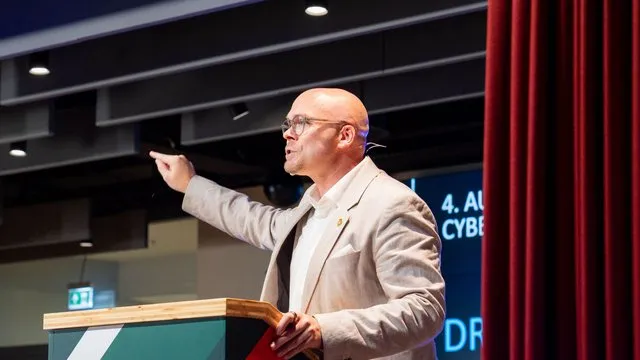
The development of artificial intelligence requires new models for media financing that will help preserve high-quality, verified journalism amid the shift of revenue toward large technology companies. Fabian Merling, Bavaria’s Minister of Digital Technologies, believes that the idea of introducing an “AI tax” is worth considering, and that the media should receive a portion of these funds.
“I don’t want high-quality media in our country to essentially become mere content providers for large ‘hyperscalers’ from the U.S. and China. That is precisely why we need a special levy—to support diversity, a digital levy, or an AI tax (call it what you will)— —but the media must receive a share of the value created by these large platform operators,” Mering stated at one of Europe’s largest media conferences, Medientage, which is taking place this week in Munich.
The Bavarian government representative noted that his colleague at the federal level—Germany’s Minister for Digitalization and Modernization, Karsten Wildberger—had also recently proposed the idea of an “AI tax.”
“A lot is changing, and some people are making huge amounts of money off of it. Why not channel some of this generated value into preparing our society and government institutions for what is currently unfolding?” Merling commented.
He explained how AI-powered searches work today: When you enter a query, you receive a text-based answer, which may be accompanied by a few small links leading to the websites of media companies, publishers, or journalistic organizations—"which, to be honest, none of us will ever click on."
“It is precisely these entities that gathered the information on which the answer is based—yet they are completely overlooked. Think about this: there are media companies, publishing houses, radio and television broadcasters that rent offices, train journalists, and pay them to gather and verify information in accordance with the standards of quality journalism,” the Bavarian minister noted.
According to him, gaining access to information via a digital platform is not a problem in and of itself; the problem lies in the fact that all the added value created in the process currently goes to the large platform operator, while those who actually created the information receive nothing.
“And this has to change… Otherwise, it’s quite clear where this will lead: a diverse media landscape will continue to decline, unable to withstand the growing economic pressure that makes it impossible to maintain quality. The quality of the information used to train artificial intelligence will continue to decline, while all the value created will flow to large foreign corporations,” Mering emphasized.
He also called it unfair that a platform operator with multibillion-euro revenues—a so-called “hyperscaler”—pays less in taxes in Germany than a local carpenter’s workshop.
The Bavarian minister called on the European media, as representatives of 450 million people, to jointly defend their interests and set their own rules.
“We must find the European courage to be something more than just a group that can be summoned—as happened with Ms. von der Leyen (European Commission President Ursula von der Leyen)—to a golf course chosen by Mr. Trump (U.S. President Donald Trump), just to announce another round of tariffs. And if there are companies—for example, those generating over EUR 750 million in profits—then it is entirely fair and appropriate for us to channel 10% of the value they create within our borders back into the very heart of our media system,” Mering noted.
In his view, the media system—like other subsystems—must undergo a transformation amid the large-scale technological revolution of AI, but it must retain its role and mission—to guide society through this great revolution and prepare it for the “AI era”—a time in which European democracy, as well as economic and social processes, will evolve in the future.
In this regard, the minister also emphasized the importance of “digital sovereignty” as a fundamental issue.
“We—as a media system and as a society—must clearly understand: by 2026, digital sovereignty will no longer be merely an IT issue. It has become clear that the answer to the question ‘who owns it’ (that is, who controls the data) determines who will be able to distribute prosperity, freedom, peace, and security in the future,” Mering noted.
He called for ensuring the security of one’s own data and using it independently, as well as adopting technology-neutral solutions.
“Furthermore, we need our own leaders for the age of artificial intelligence—companies whose DNA embodies our European understanding of peace, freedom, prosperity, security, the free market, and data protection… We cannot simply stand on the sidelines and watch in amazement as players from Asia and the United States divide the prosperity and power of the future among themselves,” emphasized the Bavarian Minister for Digital Affairs.
This was reported by a correspondent for the Interfax-Ukraine news agency.
British government advisers have called for the development of domestic AI capabilities — Cyprus Mail.
63% of U.S. voters oppose AI data centers near their homes — CNBC.
AI is already being discussed at the UN Security Council: why artificial intelligence is becoming a new factor in global security.




