
Thunderstorms delay about 900 flights in the UK
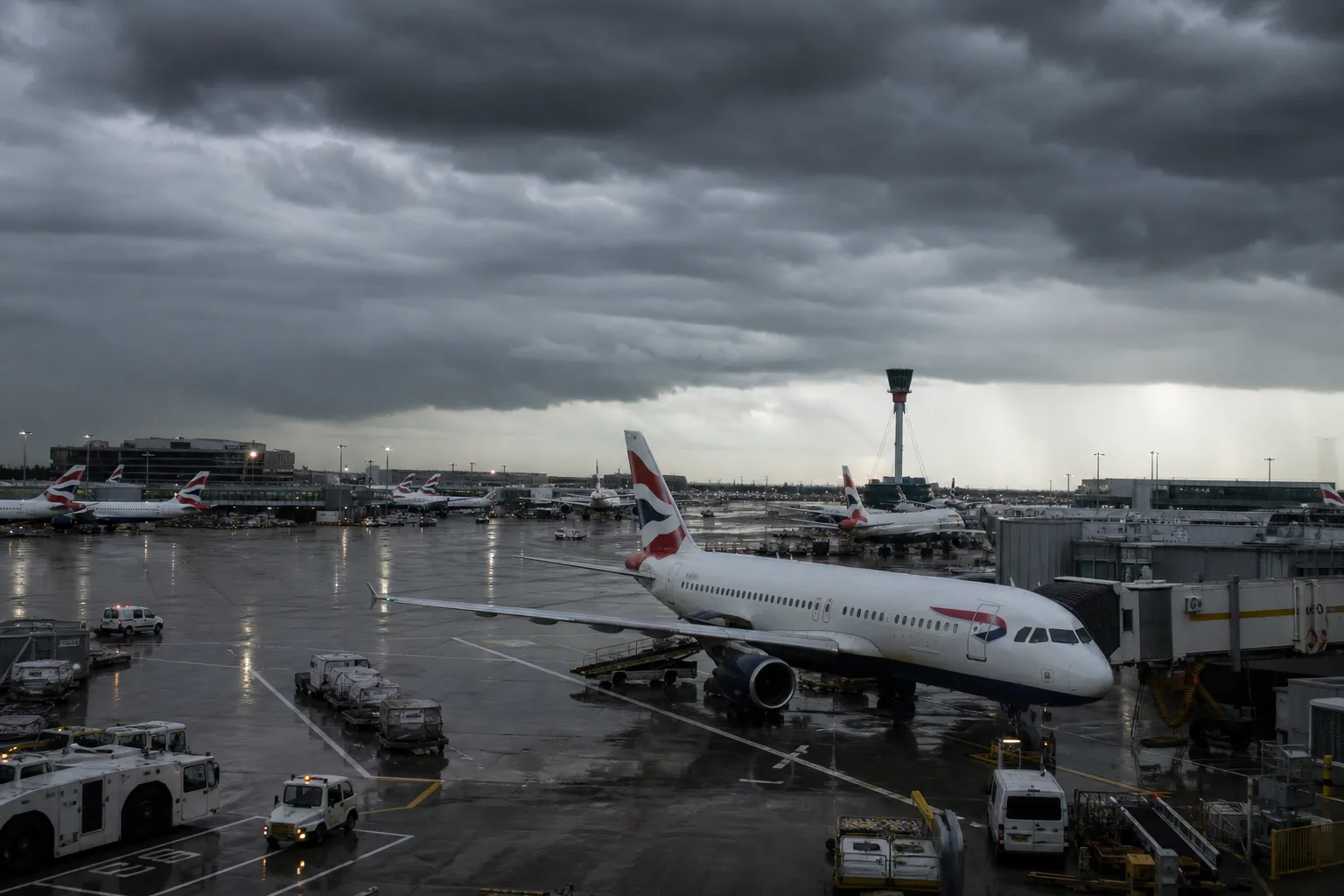
In the United Kingdom, at the end of June, thunderstorms delayed about 900 flights to and from London Heathrow and Gatwick airports, while dozens were cancelled. Some flights were delayed by up to 11 hours because air traffic controllers had to reroute aircraft in congested airspace, BBC News reports.
Experts interviewed by the outlet believe that, due to climate change, unstable weather may more frequently cause delays, flight cancellations and additional costs for carriers, airports and passengers. At the same time, former airline executive Andrew Charlton considers the risk of the worst-case scenario low and emphasizes the industry's ability to respond to emergencies.
Thunderstorms restrict airspace
Thunderstorm conditions reduce the airspace available for flights: aircraft movements must be restricted or directed around the storms. If an aircraft cannot land because of strong winds, it may be diverted to another airport. However, that airport may not have enough parking spaces and infrastructure for additional aircraft and passengers.
Aviation consultant and former pilot Tim Atkinson suggested that simultaneous storms over Heathrow, Gatwick, Luton and Stansted could create serious problems for flights arriving across the Atlantic and from Europe. Under the rules, aircraft must have sufficient fuel reserves to reach an alternate aerodrome and fly for another 30 minutes.
More current news is available on the UA.News Telegram channel Telegram.
Turbulence and flooding risks
Pilots avoid thunderstorm cells whenever possible because of severe turbulence, hail and risks to the aircraft and people in the cabin. Onboard radars make it possible to see weather conditions at a distance of up to 320 nautical miles, but thunderstorms can move quickly. As a result, unplanned route changes often occur during flights and increase fuel costs.
Paul Williams, a professor of atmospheric science at the University of Reading, stated that cases of clear-air turbulence over the North Atlantic have increased by 55% since 1979. This type of turbulence cannot be seen because it occurs at high altitudes without clouds or other visual signs.
Another threat to airports is intense precipitation, flooding and rising sea levels. In April 2024, heavy rainfall caused Dubai International Airport to temporarily close runways, while disruptions lasted for two days: more than 1,200 flights were cancelled. A University of Newcastle study estimates that 269 airports worldwide are already at risk of flooding due to rising sea levels.




