
Analysis in Recife reveals racial and social inequality in water access — Mongabay
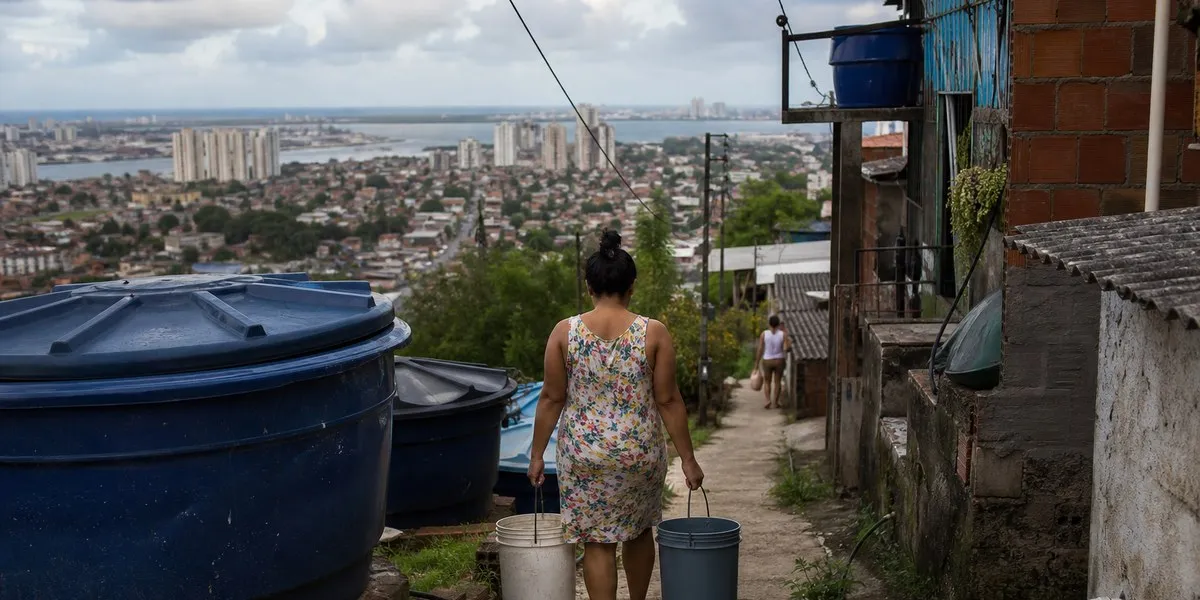
In Recife, the capital of Brazil’s Pernambuco state, an analysis of water supply schedules and census data revealed significant inequality in access to water between the city’s neighborhoods. In peripheral districts, where many Black residents live, piped water may be supplied for only 91 hours per month, while in affluent areas it is available for more than 700 hours, Mongabay reports.
The outlet compared schedules from the Pernambuco Sanitation Company (Compesa) with 2022 census microdata from the Brazilian Institute of Geography and Statistics. Of the 311 locations studied in Recife in July 2026, 236 experience chronic water disruptions. Black women in areas where the average monthly per capita income ranges from 1,100 to 2,300 reais are the most affected.
Water for several hours a day
In the Ibura district, where the average per capita income is 1,116 reais per month, water supply is available for only 91 hours per month — the lowest figure in the city. In some neighborhoods, residents may go without water for up to 15 consecutive days. Under the criteria of Brazil’s National Water and Basic Sanitation Agency, supply should last more than 18 hours per day, or more than 540 hours over 30 days.
In the Linha do Tiro district, water is supplied from 100 to 268 hours per month depending on the sector. At the same time, almost its entire territory is classified by the 2026 civil defense plan as an area at high or very high risk of floods and landslides. Similar risks also exist in Ibura.
More current news is available on the UA.News Telegram channel Telegram.
By contrast, in the affluent districts of Boa Viagem, Apipucos and Espinheiro, where the white population predominates and average incomes range from 7,000 to 16,000 reais, water supply is almost uninterrupted. According to the analysis, homes on the boundary between Apipucos and neighboring Alto Santa Teresinha may have fundamentally different schedules: in the former district, water is supplied for more than 700 hours per month, and in the latter, for about 100 hours.
Scarcity and disputes over the concession
Pernambuco has Brazil’s lowest per capita water availability: 1.27 million liters per year, or 3.6% of the national average, according to the Pernambuco Water and Climate Agency. Engineer Antônio Miranda said that affluent families can drill wells, build private systems or buy water from tanker trucks, while peripheral communities live under a constant rationing schedule.
In April 2026, Pernambuco Governor Raquel Lyra signed an agreement on a partial concession of water services with BASA Saneamento. It provides for projected investments of 17.4 billion reais in 151 municipalities. Anderson Quadros, president of the Compesa workers’ association, said the model could preserve inequality because the private sector is being given water distribution and sewage collection, while the state-owned Compesa retains water extraction and production. BASA Saneamento responded that the contract provides for 15.4 billion reais in investments over 35 years and covers peripheral areas and slopes. The state government also rejected claims that the operator would be able to refuse work in hard-to-reach areas because they are unprofitable.




