
Hera spacecraft captures the Didymos asteroid system up close for the first time — Space.com
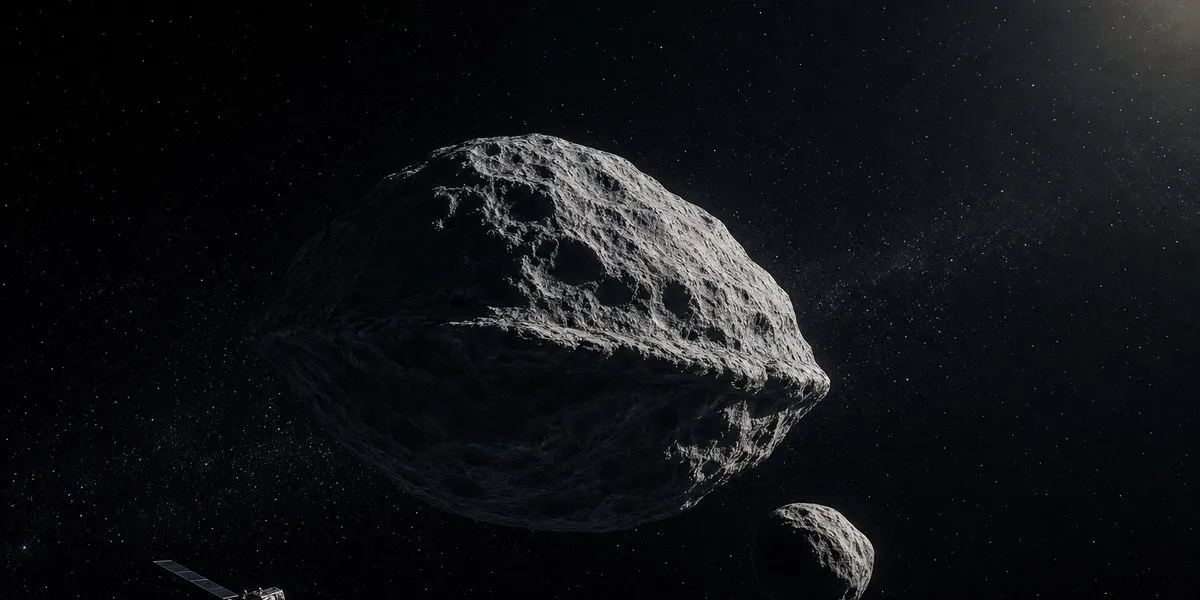
The European Space Agency's Hera spacecraft has photographed the binary Didymos asteroid system up close for the first time, which was struck by NASA's DART spacecraft in September 2022. In the image released by ESA on November 5, the primary asteroid Didymos occupies most of the frame, while its moon Dimorphos is only partially visible below it and slightly to the left, Space.com reports.
The Didymos system
The asteroid Didymos is about 780 meters in diameter, while Dimorphos measures approximately 160 meters across. Hera mission principal investigator Patrick Michel noted that DART's camera showed the other side of Didymos before the collision, so the new image creates the impression of becoming acquainted with a new world.
The Hera mission is to study the system in detail after the DART experiment. On September 26, 2022, NASA's spacecraft crashed into Dimorphos to test whether such an impact could change an asteroid's orbit and help deflect an object dangerous to Earth with sufficient advance warning.
More current news is available on the UA.News Telegram channel Telegram.
Result of the DART impact
Before the collision, Dimorphos orbited Didymos in approximately 11 hours and 55 minutes. After the impact, its orbital period decreased by about 33 minutes. According to the article, the moon is also moving approximately 2.7 millimeters per second slower than before the collision.
Scientists have already noticed that Didymos's equatorial ridge has remained intact, but boulders, craters, and structures resembling grooves or ridges have appeared on the surface. Hera mission scientist Michael Küppers suggested that some of these features may be linked to material ejected during the impact on Dimorphos and transported across about one kilometer of space to Didymos. Hera is to systematically map the identified changes in the system.




