
Astronomers detect a star’s final thermonuclear pulse for the first time — Space.com
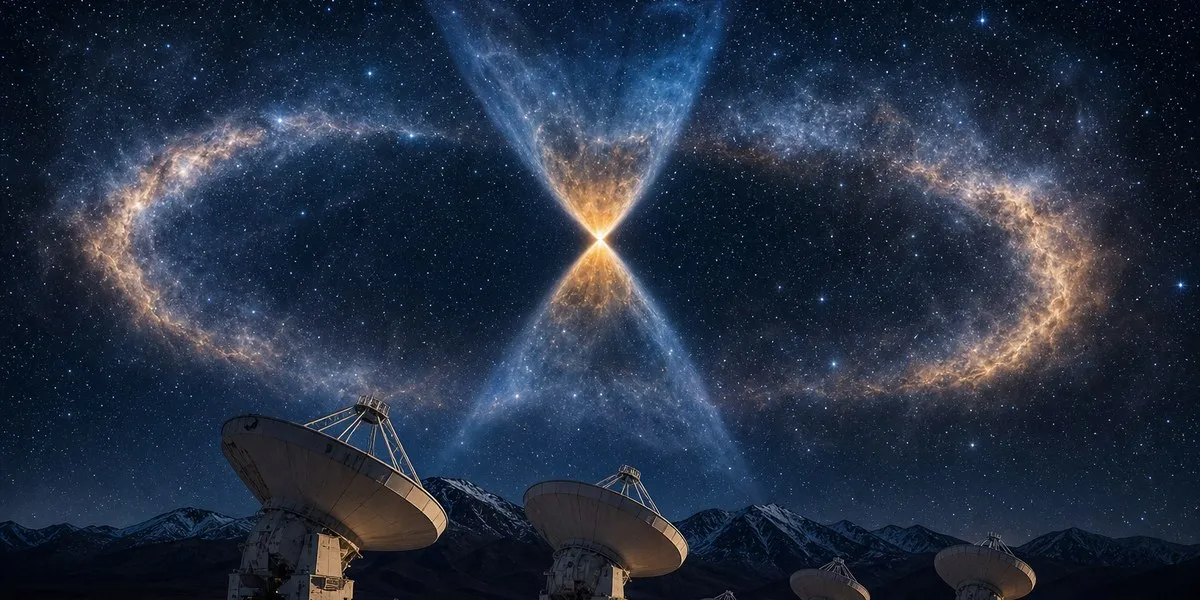
Astronomers using the ALMA radio telescope array in Chile have discovered a gaseous shell around the star IRAS 06530-0213, which researchers consider direct evidence of its final thermonuclear pulse. The star is located about 12,000 light-years from Earth in the constellation Monoceros. As Space.com reports, the observations may refine scientists’ understanding of the final stages in the lives of the Sun and similar stars.
Gaseous trace of the flare
ALMA detected a large ring of molecular gas surrounding a young hourglass-shaped nebula. The researchers determined that the shell is about half a light-year wide and was ejected into space approximately 6,500 years ago.
According to the team’s estimate, after the thermonuclear pulse, the star lost mass more slowly for about 2,000 years. Over the following thousand years, this process intensified sharply, forming an uneven gaseous shell with filamentary structures. The spiral shape of some filaments may indicate the presence of an unseen companion orbiting the star and influencing the gas.
More current news is available on the UA.News Telegram channel Telegram.
Transition to a planetary nebula
Stars like the Sun complete their evolution not with a supernova explosion, but after exhausting hydrogen in their cores. The core contracts and forms a white dwarf, while the star’s outer layers expand during the red giant stage and later cool and disperse. This is how a planetary nebula forms.
In the case of IRAS 06530-0213, the hourglass-shaped nebula began to form about 700 years ago. Scientists also detected an unusually large amount of heavy isotopes of carbon, oxygen and nitrogen — such a chemical pattern does not fully correspond to models of the formation and ejection of elements by stars of this type.
At the same time, ALMA did not detect a compact dust disk, which is often associated with close companion stars and the formation of such nebulae. The study’s authors suggest that such a disk may have existed only briefly, produced a short ejection of fast matter jets, and then disappeared. The results were published on November 20 in The Astrophysical Journal.




