
European-Japanese mission enters Mercury orbit — Nature
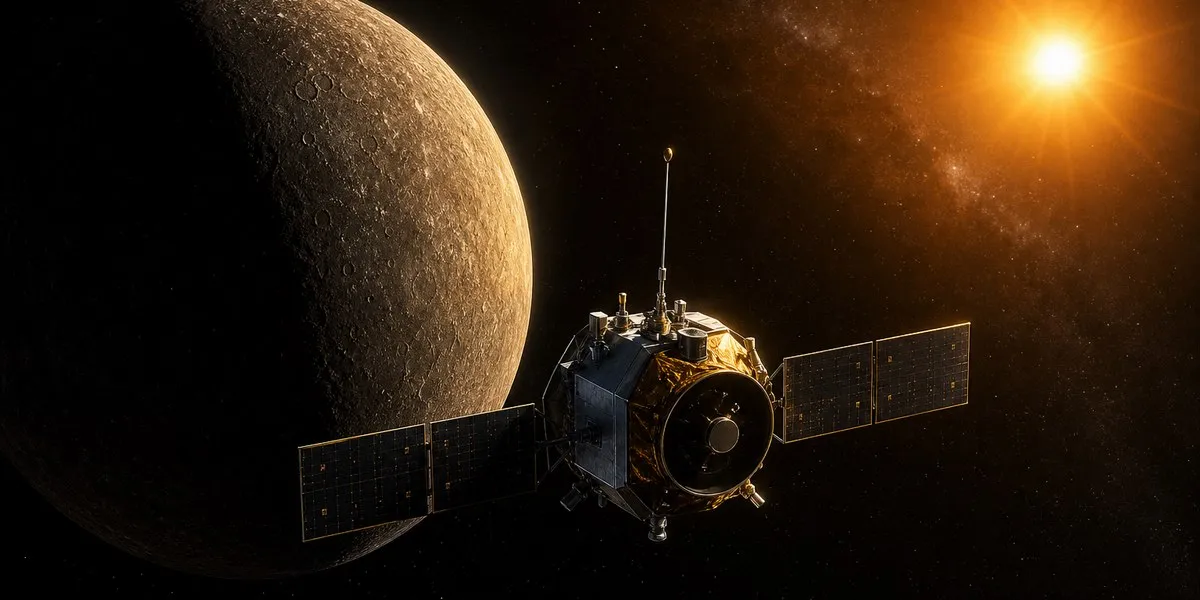
The European-Japanese space mission BepiColombo has entered Mercury’s orbit after eight years of flight. On November 21, the European Space Agency reported that the Europe-built module entered the orbit of the planet closest to the Sun and began a series of maneuvers that will last several months. As Nature reports, this is only the second mission after the U.S. MESSENGER mission in 2011–2015 to enter Mercury’s orbit.
Two spacecraft in different orbits
BepiColombo consists of two scientific spacecraft: one developed by the European Space Agency and the other by the Japan Aerospace Exploration Agency, JAXA. For now, they will remain connected and will later operate at different altitudes above the planet’s surface.
The Japanese MIO spacecraft is expected to reach its designated orbit on December 9. It will travel along an elliptical trajectory at altitudes of between 500 and 11,000 kilometers, studying Mercury’s magnetic field and its interaction with the solar wind.
More current news is available on the UA.News Telegram channel Telegram.
Studying Mercury’s surface
The European Mercury Planetary Orbiter, or MPO, will then gradually descend until March 2027. It is then expected to take up an orbit at an altitude of between 400 and 1,500 kilometers, from where its instruments will continuously study the planet’s surface.
The MPO carries the Mercury Imaging X-ray Spectrometer, or MIXS, an X-ray camera-spectrometer. During the journey, scientists tested the instrument by pointing it at the Crab Nebula, a supernova remnant observed from Earth in 1054. According to Nature, MIXS is the first X-ray imaging device sent on an interplanetary mission.
BepiColombo was launched in October 2018. To fly to Mercury, the spacecraft had to gradually approach the Sun without gaining speed that could have caused it to fly past the planet.




