
James Webb discovers the earliest pair of quasars — Space.com
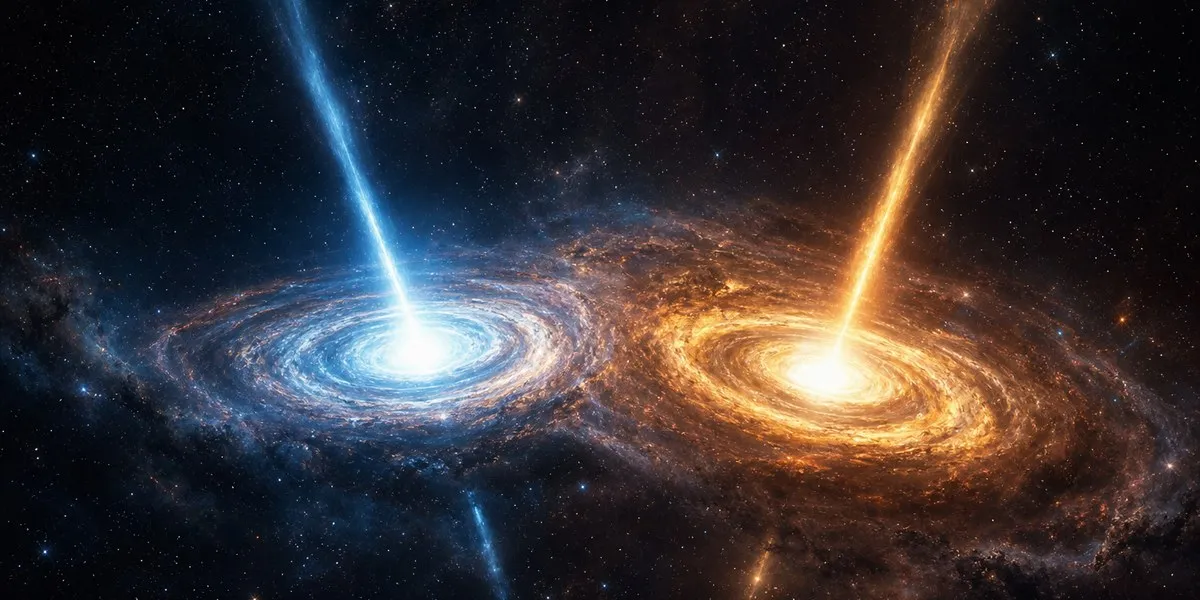
Astronomers using the James Webb Space Telescope have discovered the earliest and most distant known pair of quasars. As Space.com reports, the object was designated J1602+4228AB and named Nāpōwawāʻenakaulua. The pair is observed as it was about 900 million years after the Big Bang.
Two supermassive black holes nearby
Quasars arise when supermassive black holes consume matter from accretion disks — flat clouds of gas and dust orbiting them. Friction in such a disk heats the matter, causing it to glow brightly.
The distance between the black holes in the system is about 18,100 light-years — roughly one-fifth of the Milky Way’s diameter. Their masses are estimated at 1.5 billion and 400 million solar masses. This makes Nāpōwawāʻenakaulua the most compact quasar pair found during the Cosmic Dawn, when the first stars, galaxies, and black holes were forming.
More current news is available on the UA.News Telegram channel Telegram.
According to current models, black holes need at least one billion years to grow through the consumption of matter and mergers to masses of millions or billions of Suns. Therefore, the existence of two such objects in the early Universe poses a problem for existing explanations of supermassive black hole growth.
How the system was found
The system was discovered in data from the Aether survey, which is conducting a census of objects in the early Universe using the James Webb Telescope’s NIRSpec instrument. The survey detected 200 quasars — nearly half of all early-Universe quasars currently known. Observations by the Gemini North telescope made it possible to separate the two closely located sources.
Research team leader Silvia Onorato of NOIRLab said that there is no definitive theoretical explanation for the existence of even one such giant quasar at such an early stage of the Universe’s development, “let alone two.” The team’s results were published in The Astrophysical Journal Letters.




