
Quantinuum claims quantum error correction record — Live Science
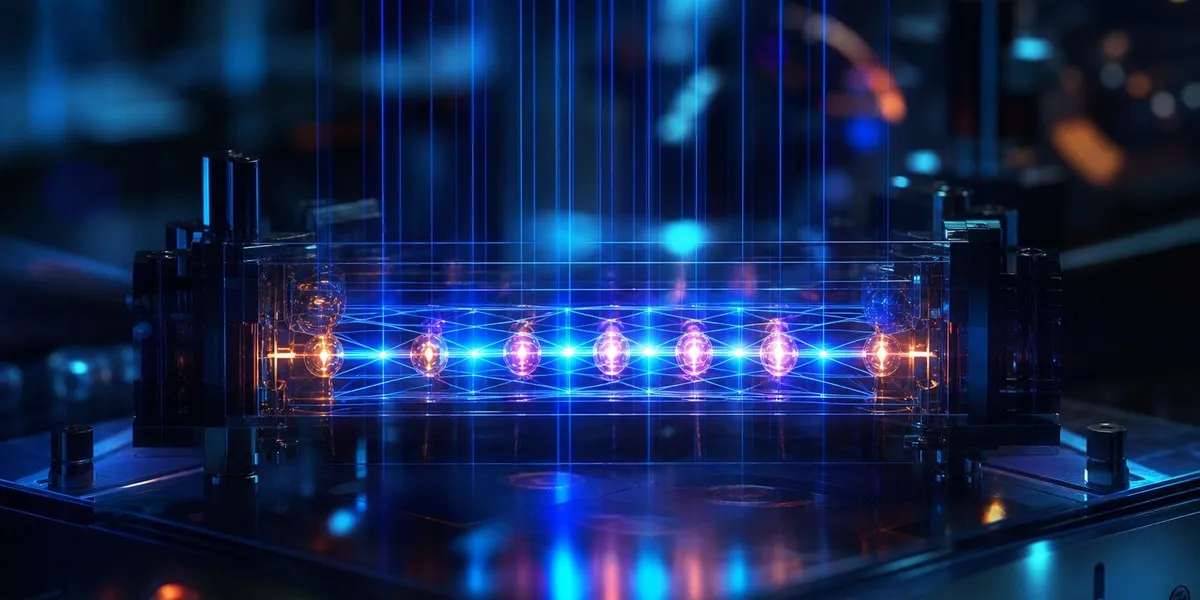
Quantinuum said that its 98-qubit Helios quantum system achieved an uncorrectable error rate of 0.0005% during quantum memory testing. This corresponds to approximately five uncorrectable errors per million error-checking cycles, Live Science reports.
According to the provided data, the result exceeds the previous benchmark set by Google’s 105-qubit Willow processor in comparable tests. Willow was estimated to have 772 uncorrectable errors per million cycles, or 0.0772%. According to the researchers, the result brings the system closer to a mode in which it can perform more than one million operations without an error.
How error correction works
Qubits are sensitive to heat, vibrations and other environmental influences that can disrupt their quantum state during computations. To protect information, researchers distribute it among several physical qubits, creating a logical qubit. This redundancy makes it possible to correct some errors, but increasing the number of qubits simultaneously creates more opportunities for new errors.
More current news is available on the UA.News Telegram channel Telegram.
Unlike the Willow processor based on superconducting circuits, Helios uses electrically charged barium ions that can be moved dynamically. This makes it possible to connect the required pairs of qubits without transmitting information through several intermediate qubits. The team also used a leakage recovery method: short laser pulses return qubits that have left the information-storage state to a usable state.
Testing results
To test error correction, the scientists used a color code with three levels — code distances of 3, 5 and 7. They can correct one, two and three physical-qubit errors, respectively. As the code distance and number of qubits increased, the probability of an uncorrectable error decreased by approximately 12 times at each stage. At code distance 7, the system achieved about one uncorrectable error per 200,000 cycles.
The paper was uploaded to the arXiv preprint server on October 16 and has not yet undergone peer review. Quantinuum representatives estimate that a future trapped-ion system could support 100 logical qubits with approximately 30,000 physical qubits. In their estimate, a competing superconducting system would require about 900,000 physical qubits.




