
Meteorite from Mali preserves traces of water interacting with Mars’ crust — Space.com
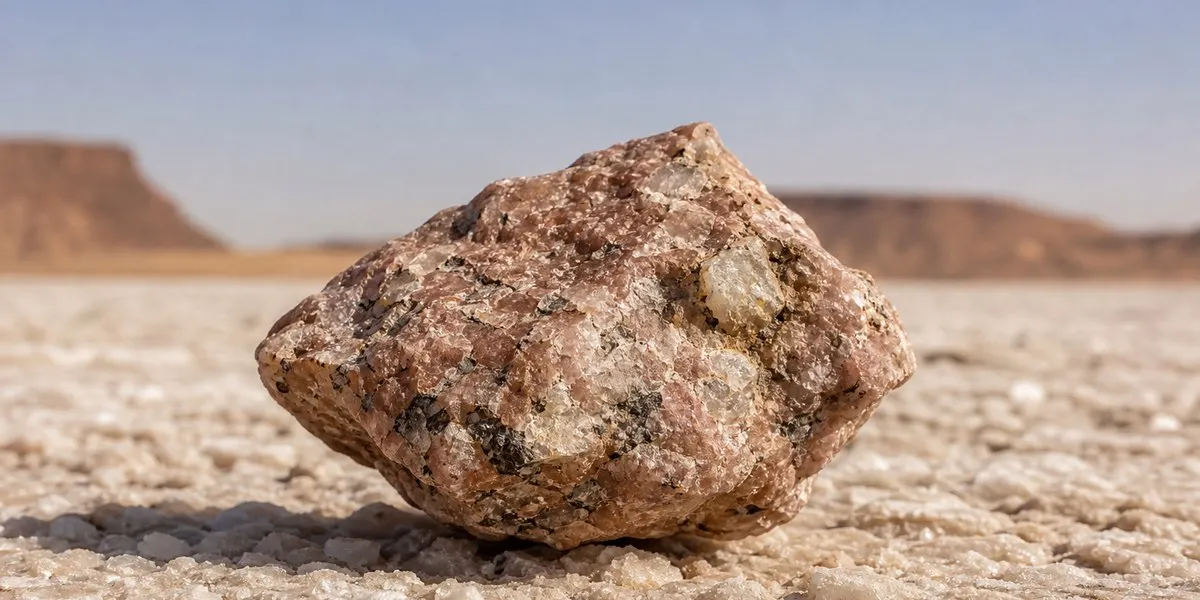
A Martian meteorite, Teghaza 001, which formed more than 4.1 billion years ago, was studied in the Sahara in Mali. Analysis of its minerals and chemical composition showed that the rock was affected by water about 4.1 billion years ago. This makes it possible to study the formation of the early Martian crust and its interaction with liquid water, Space.com reports.
One of the oldest samples from Mars
The meteorite, weighing about 800 grams, was found in 2022 on the Teghaza salt flat in Mali, after which it was named. According to researchers, Teghaza 001 is one of the three oldest Martian meteorites discovered on Earth. The rock was ejected from Mars as a result of an impact and later reached Earth.
The sample’s Martian origin was initially established through oxygen isotopes. To determine its age, scientists studied tiny zircon crystals inside the rock and applied rubidium-strontium dating to individual mineral grains on its surface. According to Space.com, this method was used for the first time to analyze an ancient Martian meteorite.
More current news is available on the UA.News Telegram channel Telegram.
Possible traces of an ancient water cycle
Teghaza 001 contains a combination of igneous minerals and textures that preserved information about the rock’s complex geological history. Its mineralogy is similar to materials recorded by NASA’s Mars Reconnaissance Orbiter in the southern highlands of Mars.
Researchers have not established the meteorite’s exact place of origin on Mars, but identified 13 possible areas where it could have formed. Mineral and chemical data, according to scientists’ assessment, point to a dynamic water cycle on early Mars, when liquid water interacted with the planet’s crust. The results of one study were published on October 29 in the journal Science, while a separate paper on the meteorite’s water content was published on June 10 in Science Advances.




