
Starfish may support coral diversity — ScienceDaily
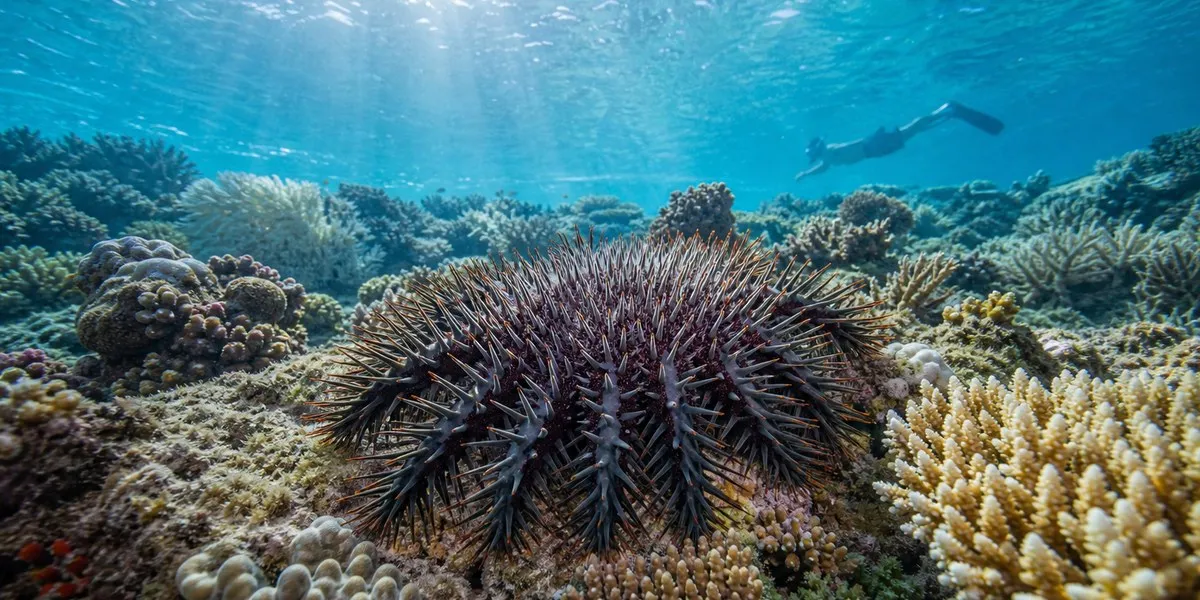
Researchers at the University of Sydney in Australia found that at low numbers, crown-of-thorns starfish may help preserve coral diversity on the Great Barrier Reef. As ScienceDaily reports, these predators eat corals but do not always destroy an entire colony and may limit the spread of the fastest-growing species.
Corals often survived after starfish feeding
The study, published in the journal Ecology and Evolution, was conducted at the One Tree Island Research Station on the Great Barrier Reef. Scientists examined starfish feeding scars and living tissue that remained on corals.
The study sites are located in protected areas with healthy fish populations that help keep the numbers of these starfish in check. The team led by Dr. Shovna Foo found that living coral tissue remained after nearly 75% of recorded feeding events.
According to Foo, at One Tree Reef, starfish appear to consume a relatively consistent amount of coral at a time and move on rather than destroying the entire colony. As a result, living fragments of tissue often remained on corals.
More current news is available on the UA.News Telegram channel Telegram.
Space for slow-growing species
Some coral species grow quickly and can occupy large areas, limiting space for slow-growing species. Researchers note that starfish feeding on fast-growing corals may create conditions for the preservation of other species.
Surviving fragments of fast-growing corals from the Acroporidae family did not recover in damaged areas. Instead, regrowth was mainly recorded in slow-growing corals of the genera Montipora and Porites. According to the researchers, this may increase the diversity of coral communities.
Control after a population outbreak
Scientists emphasize that mass population outbreaks of crown-of-thorns starfish remain a serious threat to reefs. Since the 1960s, four major outbreaks have been recorded on the Great Barrier Reef, approximately once every 15 years. A decline in the numbers of natural predators, including tritons and several species of reef fish, has made ecosystems more vulnerable to such events.
The authors of the study believe that after an outbreak is suppressed, the goal of control does not necessarily have to be the complete eradication of starfish. They note that population control should be combined with the protection of natural predators to keep populations at a level that does not lead to long-term reef decline.




