
NASA to launch UVEX ultraviolet telescope in 2031 — Space.com
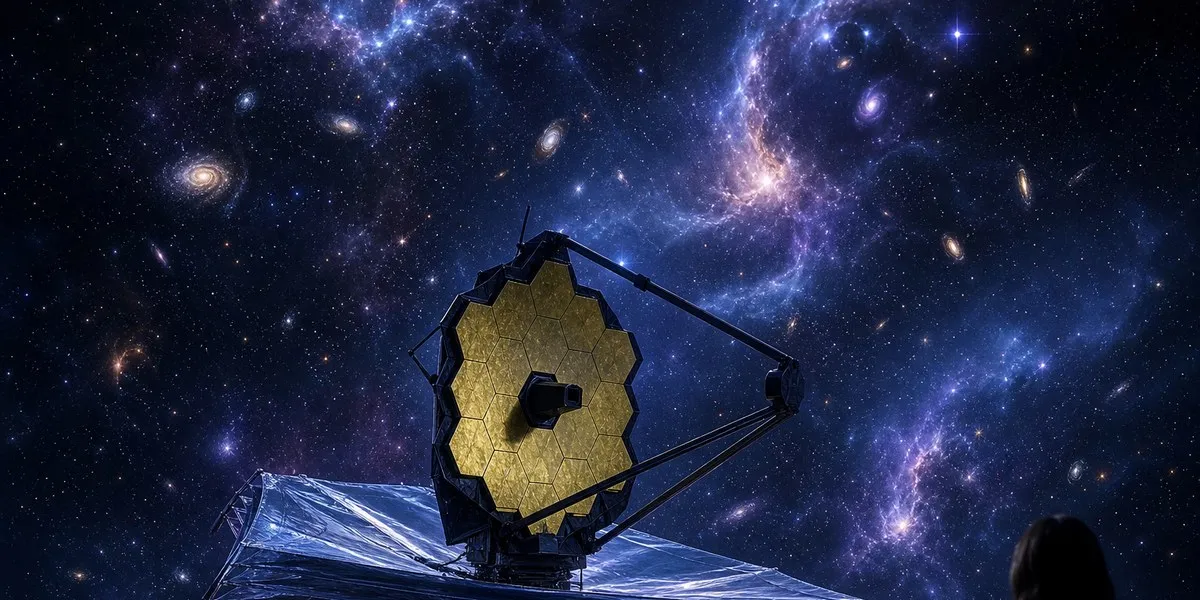
NASA, together with the California Institute of Technology, is developing the Ultraviolet Explorer, or UVEX, space telescope, which is scheduled to launch in 2031. The spacecraft will operate in the ultraviolet range and is intended to create deep maps of the entire sky. This was reported by Space.com.
Ultraviolet maps of the sky
UVEX will become the first mission designed for a deep survey of the entire sky in ultraviolet light. It will complement other astronomical surveys: NASA's SPHEREx mission, which studies space in the infrared range, and the Vera Rubin Observatory, which maps the southern hemisphere of the sky in visible light.
The mission costs $590 million. Its principal investigator, California Institute of Technology physics professor Fiona Harrison, said that UVEX will help study both the smallest galaxies and the aftermath of neutron star mergers and other cosmic explosions.
Supernovae and neutron star mergers
Ultraviolet observations are expected to make it possible to study supernova explosions, which occur at the end of massive stars' lives, as well as neutron star collisions. Heavy chemical elements, including gold, silver and platinum, may form in the environment created during neutron star mergers. Such events are currently detected through gravitational waves, after which their electromagnetic radiation is observed in different ranges.
More current news is available on the UA.News Telegram channel Telegram.
UVEX's maneuverability will allow the telescope to be quickly directed at such short-lived phenomena soon after they occur. According to mission team member Mansi Kasliwal, this will make it possible to conduct ultraviolet observations of events associated with gravitational waves at early stages, which is more difficult for the Hubble telescope.
Search for small galaxies and stripped stars
The telescope will receive sensors developed at the California Institute of Technology based on CMOS technology, which are expected to increase sensitivity to ultraviolet radiation. UVEX is expected to be able to detect millions of nearby small and faint galaxies with young stars that shine brightly in ultraviolet light.
The mission will also search for blue stars whose outer hydrogen layers were stripped away by companion stars. Such objects make it possible to study the internal structure of stars, usually hidden beneath their outer envelopes. Astronomer Kareem El-Badry expects UVEX to discover hundreds of such stars.




