
ASTRA robot autonomously assembles structure in space — ScienceAlert
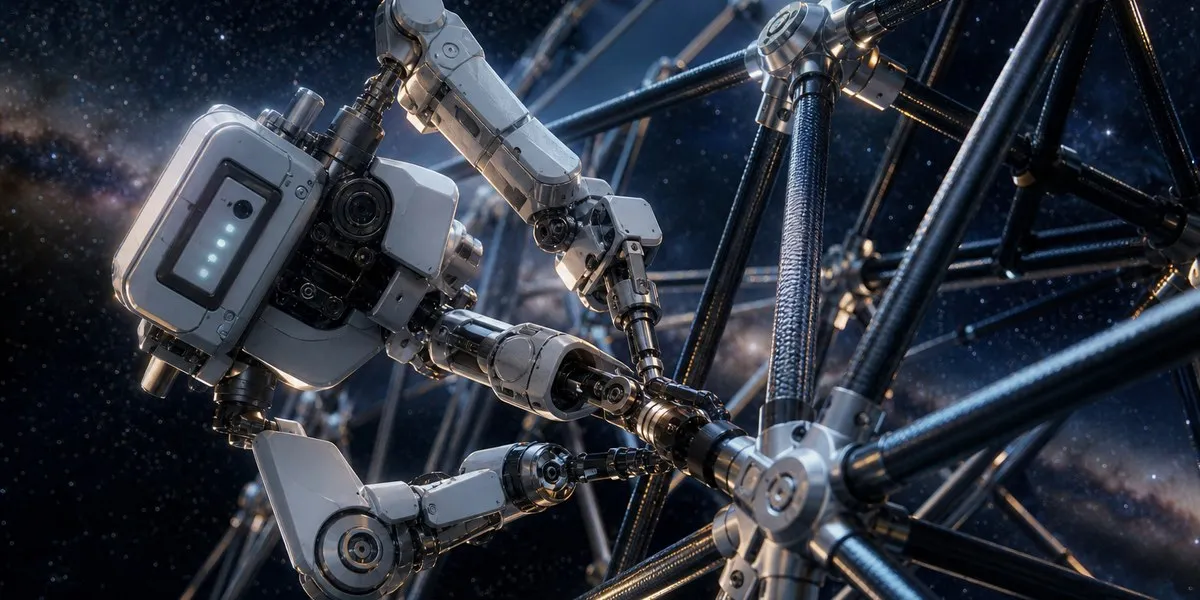
The Autonomous In-Space Tensioned Reflector Assembly robot, or ASTRA, independently assembled part of a reflector antenna structure in space without the help of astronauts. It sequentially connected composite fiber tubes and aluminum nodes, forming one section of the future antenna measuring about 1.4 meters.
ScienceAlert reports on the result. ASTRA was developed by researchers at the California Institute of Technology, Caltech, with funding from the U.S. Defense Advanced Research Projects Agency, DARPA.
Assembly from compact components
Materials and construction elements are compactly packed for transportation, after which the robot assembles them directly in space. Once an element is ready, it is attached to the already assembled structure, and then the next one begins to be assembled.
So far, only the first part of the antenna has been completed. The developers describe the demonstration as confirmation that this approach works and believe it can be scaled up for larger objects. ASTRA team leader, aerospace engineer Sergio Pellegrino, noted that creating such a complex payload in a short period was a major task for a small team.
More current news is available on the UA.News Telegram channel Telegram.
Prospects for large structures
Previously, structures for space were either delivered as separate parts for subsequent assembly or folded compactly inside a rocket and deployed after launch. ASTRA technology offers a different approach: constructing structures directly in space from delivered components.
At Caltech, researchers believe the method could be useful for astronomy, astrophysics, communications systems, and creating large solar arrays for space-based solar power. The developers' long-term goal is to assemble structures hundreds of meters or kilometers long.
ASTRA was created under DARPA's NOM4D program, launched in 2022 to develop orbital and lunar manufacturing technologies. Another project under the program is expected to launch by the end of the year: a team from the University of Illinois Urbana-Champaign plans to send an installation to the International Space Station to test manufacturing capabilities in orbit. ISS astronauts will test a method for converting liquid materials into solids, which could reduce the volume of cargo that needs to be launched by rockets.




