
Caltech robot autonomously assembled part of a structure in space for the first time — ScienceDaily
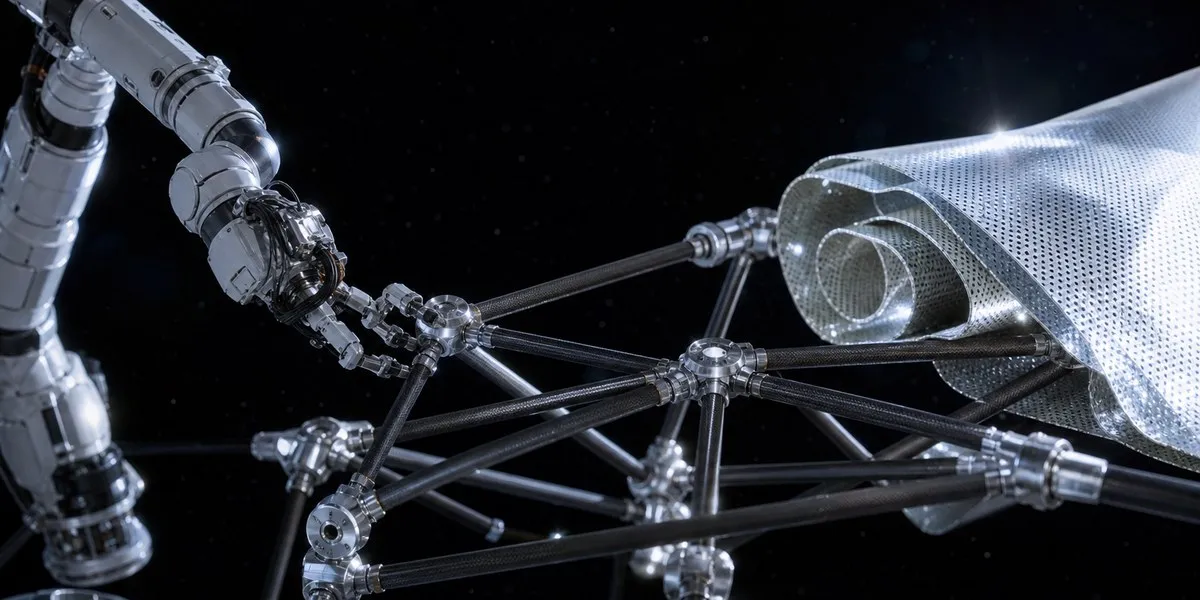
The ASTRA robotic system, developed in the United States by researchers at the California Institute of Technology, autonomously assembled an initial part of a structure in low Earth orbit without astronaut involvement. This is the first case of autonomous construction of a structure in space, ScienceDaily reports.
The development was funded by the U.S. Defense Advanced Research Projects Agency, DARPA, under the NOM4D program. Its goal is to test technologies that could eventually make it possible to manufacture and assemble large structures directly in space.
How the ASTRA system works
A robotic arm retrieves composite tubes and aluminum connectors from dispensers, then forms repeating truss sections. During the experiment, the system deployed two preassembled sections and independently created a third. The structure is intended for a reflective antenna with a diameter of 1.4 meters.
The full project calls for 11 connected sections with a lightweight reflective surface made of Kapton polymer film. The team was unable to complete the assembly of the entire antenna because of technical difficulties and schedule constraints, but the first assembled section confirmed the viability of the approach in orbital conditions.
More current news is available on the UA.News Telegram channel Telegram.
Control from Earth
ASTRA was delivered to orbit on March 30, 2026, aboard the SpaceX Transporter-16 mission. The system was housed on Momentus Inc.'s Vigoride 7 orbital vehicle and occupied about one cubic meter. Engineers sent commands through the vehicle's onboard computer and monitored the process using photographs transmitted from orbit.
To troubleshoot faults, the team used a backup ASTRA unit in a Caltech laboratory. Communication with the system was available approximately seven to eight times a day, with each window lasting about 15 minutes.
DARPA believes such technologies could in the future be used to build large space telescopes, radio antennas, and solar arrays. The NOM4D program is focused on structures ranging in length from hundreds of meters to kilometers.




