
AI model performed laser interaction simulations in milliseconds — ScienceDaily
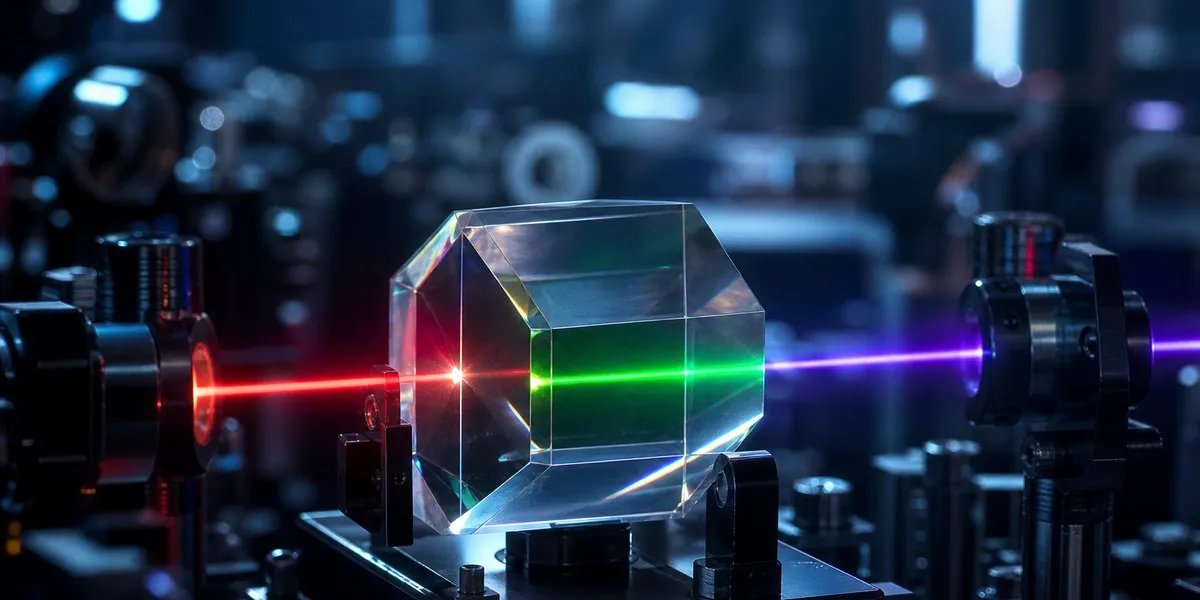
Researchers from Stanford University, the University of California, Los Angeles, and the SLAC National Accelerator Laboratory have developed an artificial intelligence model for rapidly simulating complex processes in high-power laser systems. During batch processing on graphics processors, the average time for one simulation was several milliseconds, ScienceDaily reports.
Modeling light conversion
The development concerns second-order nonlinear optics processes, or χ² processes. In special crystals, light waves exchange energy, making it possible to change the frequency of light and control the shape of laser pulses.
Such calculations are needed, in particular, for the laser systems of the Linac Coherent Light Source II facility. There, infrared light is sequentially converted into green light and then into ultraviolet light. The ultraviolet pulse hits a cathode, releases electrons, which are accelerated and used to generate powerful X-ray pulses.
The shape and exact arrival time of the ultraviolet pulse affect the properties of the electron bunch and, consequently, the characteristics of the X-ray radiation. Therefore, accurate prediction of light frequency conversion is important for tuning the system.
More current news is available on the UA.News Telegram channel Telegram.
A neural network instead of repeated calculations
Conventional simulations are based on solving the nonlinear Schrödinger equation using the split-step Fourier method. It repeatedly converts the pulse description between time-domain and frequency-domain representations and requires substantial computing resources. In the full simulation studied, this stage accounted for approximately 95% of the processing time.
The new model is based on an LSTM recurrent neural network and works with a compressed description of light's frequency characteristics without constantly performing conversions between the two representations. It was tested on noncollinear sum-frequency generation, in which three light fields interact simultaneously in a crystal.
The model reproduced changes in laser pulses over time and frequency, including for signals with pronounced gaps in the spectrum and significant variations in optical phase. The authors of the work, published in the journal Advanced Photonics, are considering combining separate trained models to predict the operation of an experimental laser system in real time and create its digital twin.




