
237-million-year-old marine amphibian found in China — ScienceDaily
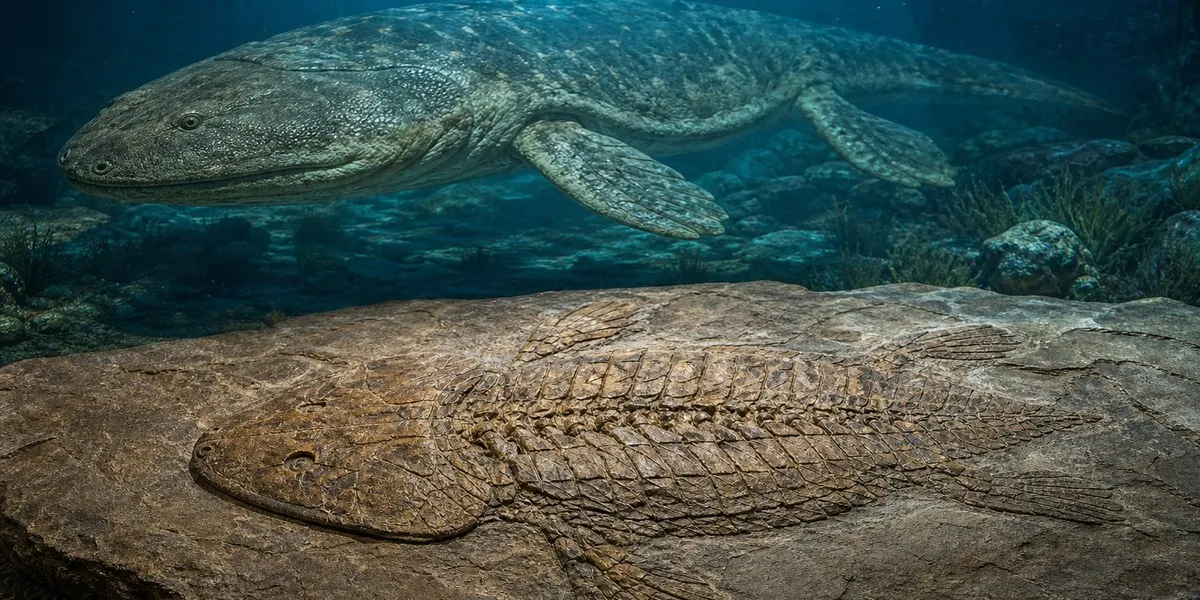
Two well-preserved skeletons of the ancient amphibian Gerrothorax maritimus, which lived about 237 million years ago, have been found in China’s Guizhou Province. As ScienceDaily reports, the study by an international group of scientists from the University of California, Davis, Peking University and the Guizhou Geological Museum was published in the journal Nature Ecology & Evolution.
The remains date to the Late Triassic period. The area where they were found was then part of an ancient ocean and lay far from major landmasses. Researchers believe these finds are the first convincing fossil evidence of an amphibian that may have spent its entire life in a marine environment.
A flat predator with bony armor
Gerrothorax maritimus reached nearly 90 centimeters in length and was roughly comparable in mass to a modern giant salamander. However, the animal had very different proportions: its body was broad, flat and disc-shaped, with a thick bony armor covering its upper side.
The structure of its skull and heavy protective covering indicate that this amphibian was likely an ambush predator. It may have lain on the seafloor and sucked in prey that approached it. Its armor may also have protected it from large marine predators, including ichthyosaurs.
More current news is available on the UA.News Telegram channel Telegram.
How an amphibian could live in salt water
Modern amphibians are generally unable to live permanently in seawater because of their permeable skin, through which they absorb water and exchange gases. Of more than 8,000 modern amphibian species, none spends its entire life in the sea, and fewer than 2% can tolerate salinity.
The authors of the study suggest that the large bony armor restricted the movement of water through the skin of Gerrothorax maritimus. This may have allowed the animal to obtain water through its digestive tract, while gills, present in members of the genus Gerrothorax, could have expelled excess salt.
The preservation conditions of the remains also point to a marine lifestyle. The skeletons were found in deposits from a deep marine environment, and even their toes were preserved—delicate parts that could have been lost during prolonged transport of the body. Additional evidence came from an analysis of strontium isotopes: their composition matched that of Late Triassic seawater.




