
280 Paleolithic Engravings Found in a Spanish Cave — ScienceAlert
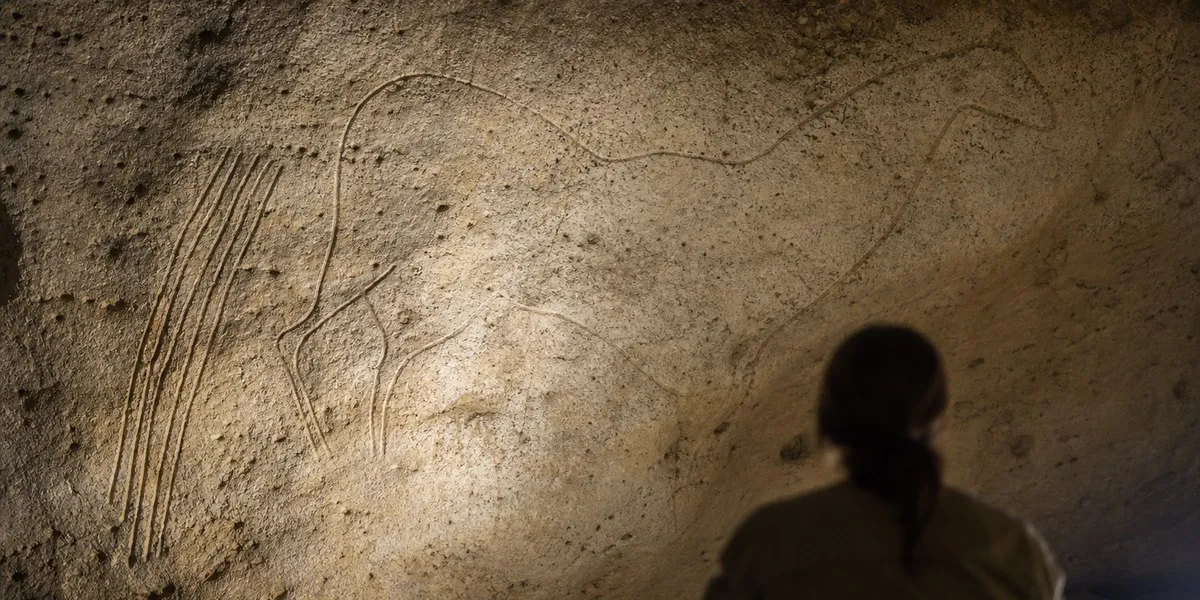
In the Cova de la Font Major cave in Catalonia, northeastern Spain, researchers documented 280 Paleolithic motifs engraved on the walls of the Gatoneres de Cal Pallettes chamber. The discovery was made in 2019 by Josep Maria Vergès, a researcher at the Catalan Institute of Human Paleoecology and Social Evolution, who noticed a series of parallel lines. This was reported by ScienceAlert.
Animal depictions and abstract signs
Vergès and archaeologist Miriam Salas-Altés recorded 55 animal depictions among the findings. They include horses, deer, goats, cattle, an aurochs and a bear; some figures could not be identified. The walls also feature rows of vertical parallel lines and complex loop-shaped compositions. The researchers note that the age of the latter has not yet been established.
According to the scientists, Cova de la Font Major has the third-largest known collection of Ice Age rock art in Mediterranean Iberia. Salas-Altés noted that approximately 75% of known complexes along the Mediterranean coast of the Iberian Peninsula contain no more than five zoomorphic figures, while more than 90% contain no more than 20.
More current news is available on the UA.News Telegram channel Telegram.
Dating is still to be carried out
The study authors suggest that the engravings may be older than the Magdalenian culture, although this is an assessment that still needs to be verified. They plan to conduct uranium dating of calcite deposits on one of the animal depictions. In their view, certain artistic features of the figures, including Y-shaped endings and heads with three lines, support the possibility of a pre-Magdalenian origin.
The cave was rediscovered in 1853, and after its entrance was cleared in 1957, it was regularly visited by speleologists, Bronze Age artifact seekers and tourists. Before the images were recognized as Paleolithic, people had walked past them for decades, leaving modern inscriptions and dates on some surfaces. Access to Gatoneres had been restricted since 1993, and the area with the engravings is now closed to visitors to prevent further damage. The study was published in the journal Antiquity.




