
Remains of a Hellenistic-era mosaic found in Turkey — Korea Herald
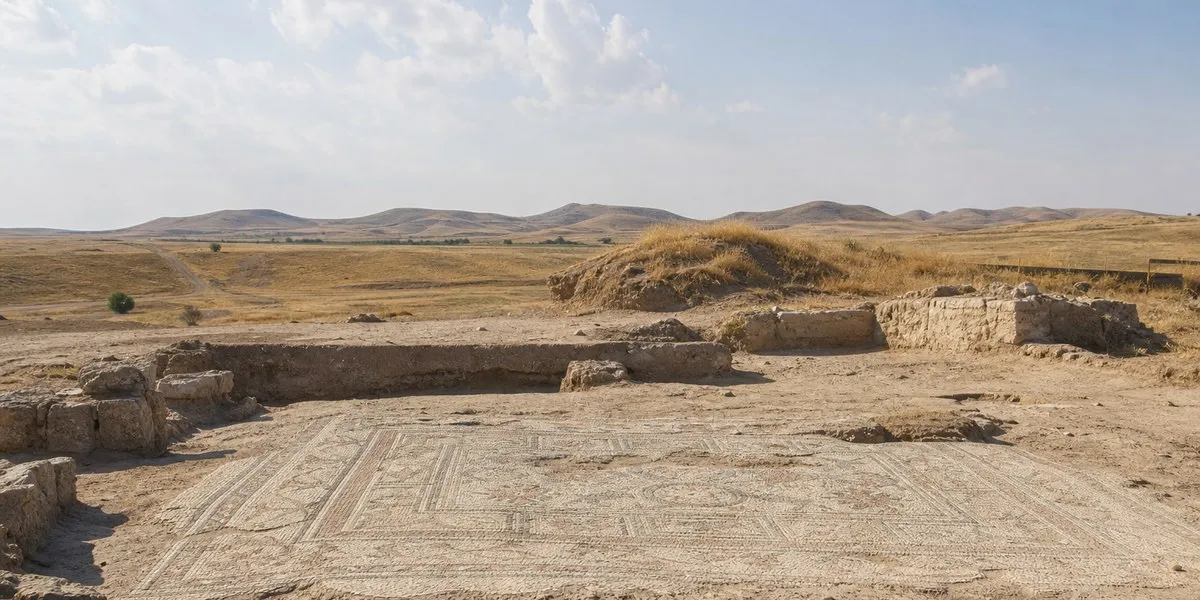
A joint South Korean-Turkish expedition has discovered the remains of a Hellenistic-era mosaic at the Kültepe archaeological site in central Turkey. Researchers believe they were part of a building’s floor. This was reported by The Korea Herald.
The discovery was announced by representatives of South Korea’s National Research Institute of Cultural Heritage, Turkey’s Ministry of Culture and Tourism, and Ankara University.
The first discovery of its kind
The mosaic is dated to the Hellenistic period, which lasted from 323 to 30 BCE. The discovered fragment measures 163 centimeters from east to west and 165 centimeters from north to south.
Kim Dae-young, a curator at the National Research Institute of Cultural Heritage who took part in the excavations, noted that, given the conditions surrounding the find, the mosaic’s original dimensions may have exceeded 250 centimeters in length and width.
More current news is available on the UA.News Telegram channel Telegram.
The discovery was the result of approximately two years of joint work. It is the first evidence of a mosaic floor reflecting Hellenistic-era construction techniques found since excavations at Kültepe began in 1948.
Further research and exhibition
Along with the mosaic, archaeologists identified four cultural layers dating to different periods of the Hellenistic era. They recorded overlapping remains of structures, floors, walls, water channels and entrance structures.
Excavations are scheduled to resume in May–July 2027. The team intends to determine more precisely when the building was constructed and its relationship to adjacent spaces, as well as examine the bones of cattle, sheep and wild boars. Researchers will also carry out 3D measurements of the artifacts and prepare measured drawings.
South Korea and Turkey are also preparing a joint exhibition on Kültepe, planned for around August 2027 to mark the 70th anniversary of diplomatic relations between the countries. The exhibits are expected to include clay tablets illustrating trade and daily life in ancient Anatolia.




