
Austria tests error-estimation method on 51-qubit simulator — ScienceDaily
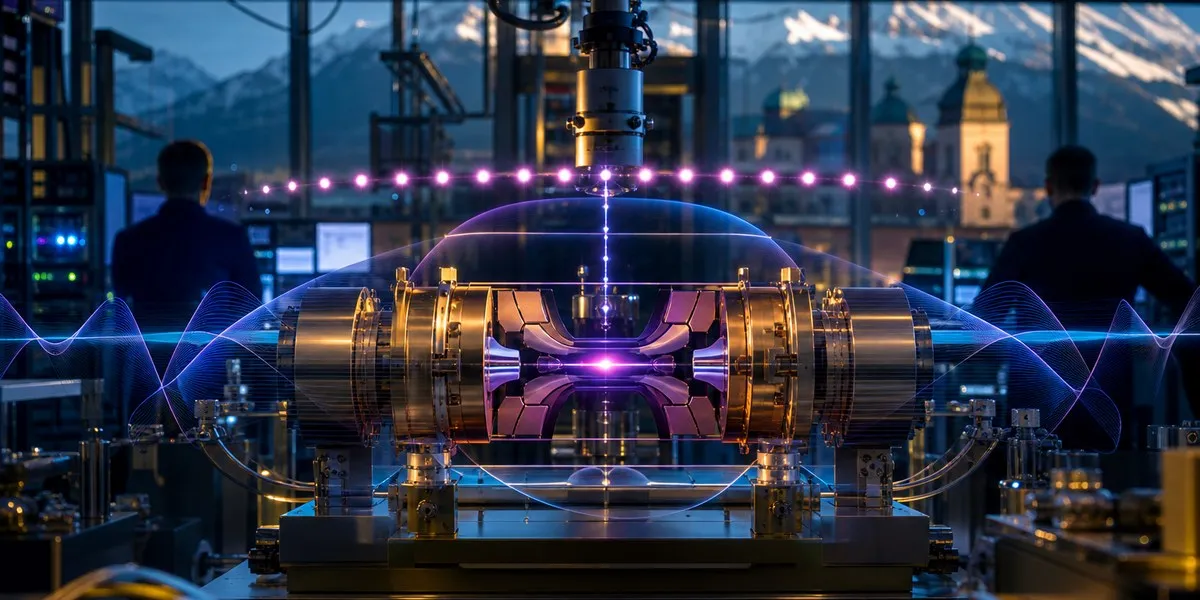
An international group of researchers in Innsbruck, Austria, demonstrated a method for assessing the accuracy of quantum simulations on a 51-qubit system. The approach makes it possible to calculate error bounds for results when directly verifying them with conventional computers becomes practically impossible, ScienceDaily reports.
How accuracy is assessed
The method was developed by an international team led by Tristan Kraft of the Technical University of Munich and Peter Zoller of the University of Innsbruck and the Institute for Quantum Optics and Quantum Information of the Austrian Academy of Sciences. Barbara Kraus of the Technical University of Munich also took part in the work.
The researchers use experimental measurements to reconstruct the actual behavior of a quantum system. They then calculate how uncertainty in the reconstructed model affects the simulation result. This makes it possible to account for possible deviations in interactions, environmental effects, fluctuations, noise and uncertainty in the measurements themselves.
As a result, a quantum simulator can provide not only a single numerical value but also a result with error bounds that characterize its accuracy. Quantum simulators are specialized physical systems designed to reproduce the behavior of other quantum systems, including systems with large numbers of interacting particles.
More current news is available on the UA.News Telegram channel Telegram.
Testing on trapped ions
The method was first tested on a system of ten trapped ions. Its behavior can still be calculated on a classical computer, so the team compared the reconstructed models and calculated error bounds with independent measurements.
The researchers then applied the method to a chain of 51 trapped ions. The experiment was conducted by a group led by Manoj Joshi and Christian Roos using an ion quantum simulator in Innsbruck. The demonstration showed that the approach can also work with significantly more complex quantum systems.
Next stage
The team is adapting the method for two-dimensional quantum simulators. Such systems can model more complex interactions between particles, but as the number of particles increases, classical calculations for independently verifying the results become substantially more difficult. The study was published in the journal Physical Review X.




