
Fingerprints on China’s Terracotta Warriors point to involvement of women and children — South China Morning Post
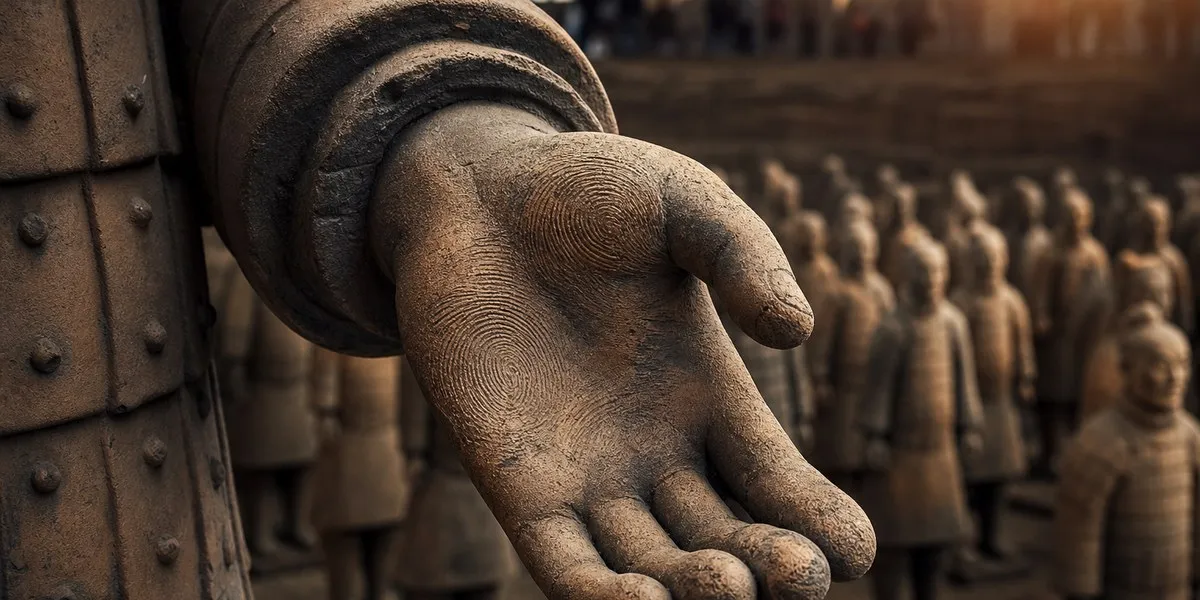
A study of fingerprints on the Terracotta Warriors from the mausoleum of China’s first emperor, Qin Shi Huang, near Xi’an has shown that not only adult men, but also women and minors, may have been involved in producing some of the sculptures. South China Morning Post reports.
Analysis of 79 fingerprints
A research group led by Shen Jinyi, an associate professor at the School of Archaeology of Shandong University, analyzed 79 well-preserved fingerprints found on 36 figures from area T23 in the first pit of the mausoleum. Each sculpture had between one and five distinct prints left on the head, hands, armor, collar and feet.
Seventy-three prints were formed during the shaping, casting and assembly of the figures, while another six appeared when pre-made decorative elements, including armor rivets and belts, were pressed onto the surface. The scientists photographed the traces and measured the average width of friction ridges, which increases with age.
To assess the composition of the workforce, the researchers used a Bayesian mixture model that analyzes the collection of fingerprints rather than determining a person’s sex from each individual trace. They also compared the ancient prints with modern data from people of different ages and sexes.
More current news is available on the UA.News Telegram channel Telegram.
Assessment of the artisans’ composition
According to the researchers’ calculations, about 45% of the fingerprints could have belonged to adult men, nearly 32.7% to adult women, and 22.3% to minors under the age of 15. Under the laws of the Qin dynasty, 15 was the age of adulthood.
Previously, it was believed that large-scale craft production under the Qin dynasty’s rule in 221–207 BCE was carried out exclusively by adult men. At the same time, inscriptions on lacquerware and legal documents from that period indicated the participation of women and children in craft labor under state supervision.
Limitations of the conclusions
The authors stressed that area T23 is only a local part of the first pit. Therefore, the results may reflect the organization of labor of a particular production group or a specific stage of work, rather than the entire project. The Terracotta Army, buried with Qin Shi Huang after his death in 210 BCE, was discovered in 1974 by local residents digging a well.




