
New family of octocorals discovered near Costa Rica — ScienceAlert
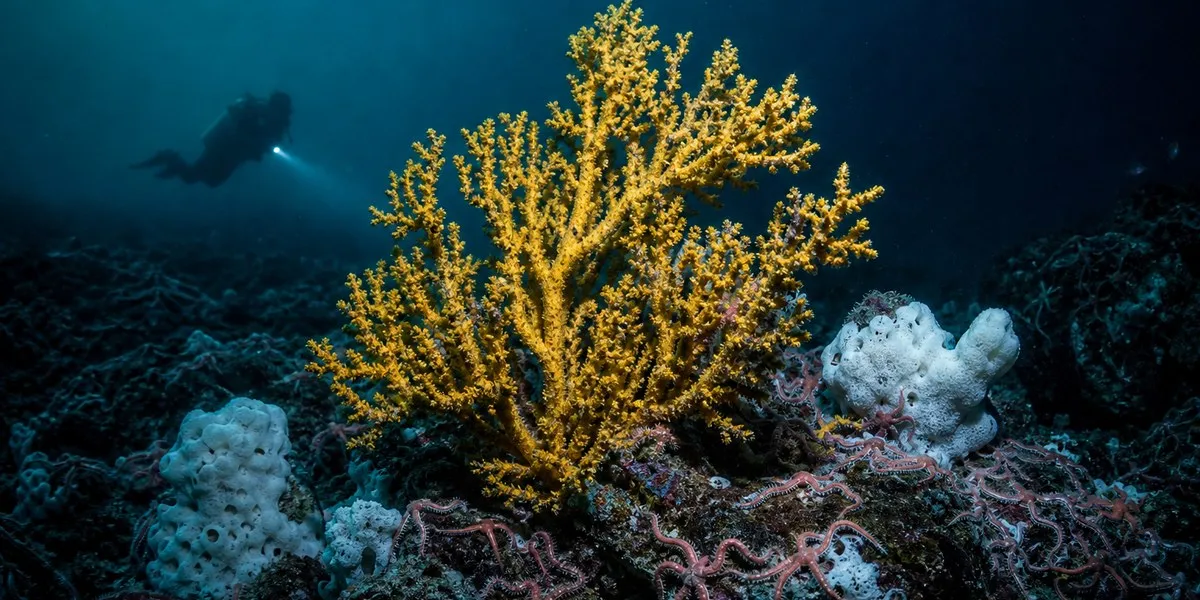
On a seamount off the coast of Costa Rica, researchers described a new species of octocoral, Laurinque elenya, and established a new family for it — Laurinqueidae. The corals were found at depths of 360 to 529 meters during dives in 2019 and 2023, ScienceAlert reports.
Unusual colony structure
Colonies of this coral grow to more than one meter in height and up to 1.2 meters in width. They have a densely branching structure covered with unusually elongated polyps — the small animals that make up a coral colony. The polyps can partially retract into the branches, while the sclerites — the coral’s microscopic skeletal structures — are distinguished by a range of shapes.
Such a combination of features had not previously been recorded in a single species of octocoral. The new taxon was named Laurinque elenya; the name comes from Tolkien’s Elvish language Quenya and means “golden tree of stars.” The golden coral branches grow above a bottom almost completely covered with pink brittle stars.
More current news is available on the UA.News Telegram channel Telegram.
Genetic analysis determined the family
Initially, an analysis of three genetic markers did not produce an unambiguous result. One mitochondrial gene indicated a relationship with the family Incrustatidae, another with Eunicellidae, while a ribosomal DNA marker did not help determine its taxonomic position.
After collecting new samples, the scientists analyzed hundreds of genetic regions. They established that the coral is most closely related to Eunicellidae, but differs sufficiently from this group to form the separate family Laurinqueidae. This is the first known representative of this family.
Life in low-oxygen waters
The coral gardens grow at temperatures of 8 to 11 degrees Celsius in waters with extremely low oxygen levels. Despite these conditions, the colonies form complex three-dimensional structures that may serve as shelter and feeding grounds for other deep-sea animals. The researchers also reported possible, but not yet confirmed, observations of this coral near Panama and the Galápagos Islands.




