
Study: crows made decisions about dot movement in 235 ms — Live Science
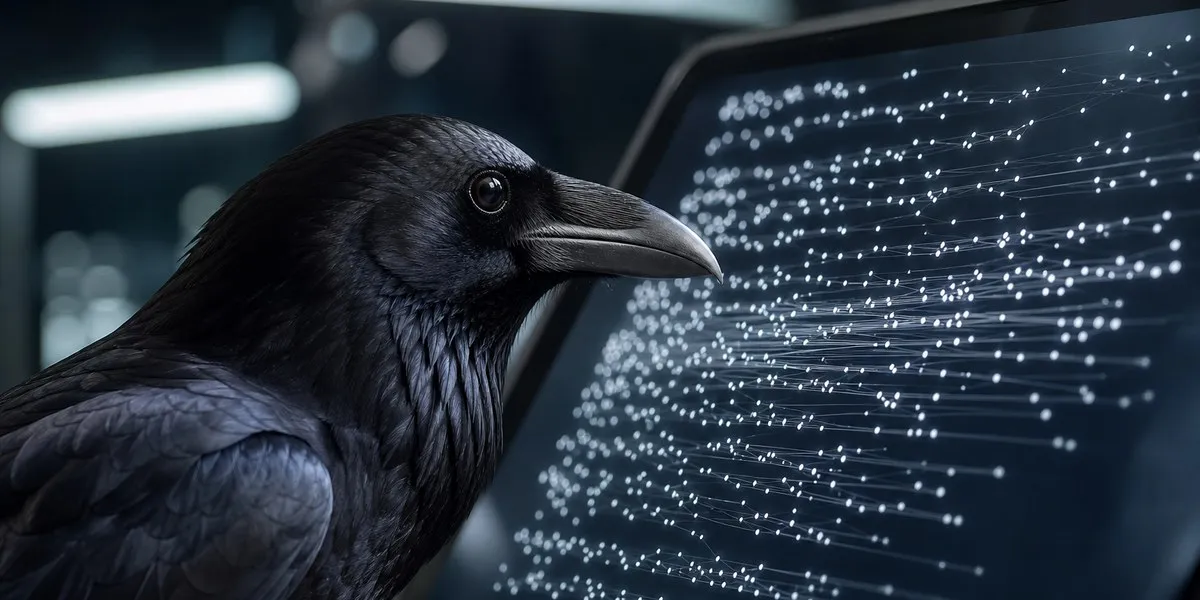
Two carrion crows (Corvus corone) determined the dominant direction of dots moving on a screen during an experiment in an average of 235 milliseconds — less than a quarter of a second. As Live Science reports, previous studies of humans and primates in similar self-paced tasks indicate decision times approximately twice as long.
Task with moving dots
Scientists trained the birds to perform a task on a touchscreen. The crows watched white dots on a black background: some moved left or right, while others moved randomly. The birds had to determine the direction in which most dots were moving and peck the corresponding target on the screen. They received a mealworm for a correct answer.
Researchers varied the proportion of dots moving in one direction, making the task easier or more difficult. When the movement was clearly pronounced, the crows demonstrated nearly 100% accuracy. Across different rounds of the experiment, the birds maintained high accuracy, which, according to the authors, indicates that speed was not achieved at the expense of poorer assessment of visual information.
More current news is available on the UA.News Telegram channel Telegram.
Neuron activity
The team also recorded the activity of 248 neurons in the caudolateral nidopallium, a region of the avian brain considered functionally comparable to the prefrontal cortex of humans and primates. In primates, neurons accumulate sensory information, and their activity rises until a threshold is reached, after which the brain makes a decision. The study’s results suggest that crows may use a similar process.
Based on neuronal activity, researchers could predict a crow’s future choice as early as about 70 milliseconds after the dots appeared — roughly 170 milliseconds before the bird pecked the screen. At the same time, the study included only two crows and did not involve a direct comparison with humans or monkeys in an identical task.




