
Orbital Matter reports printing a half-meter beam in space — TechCrunch
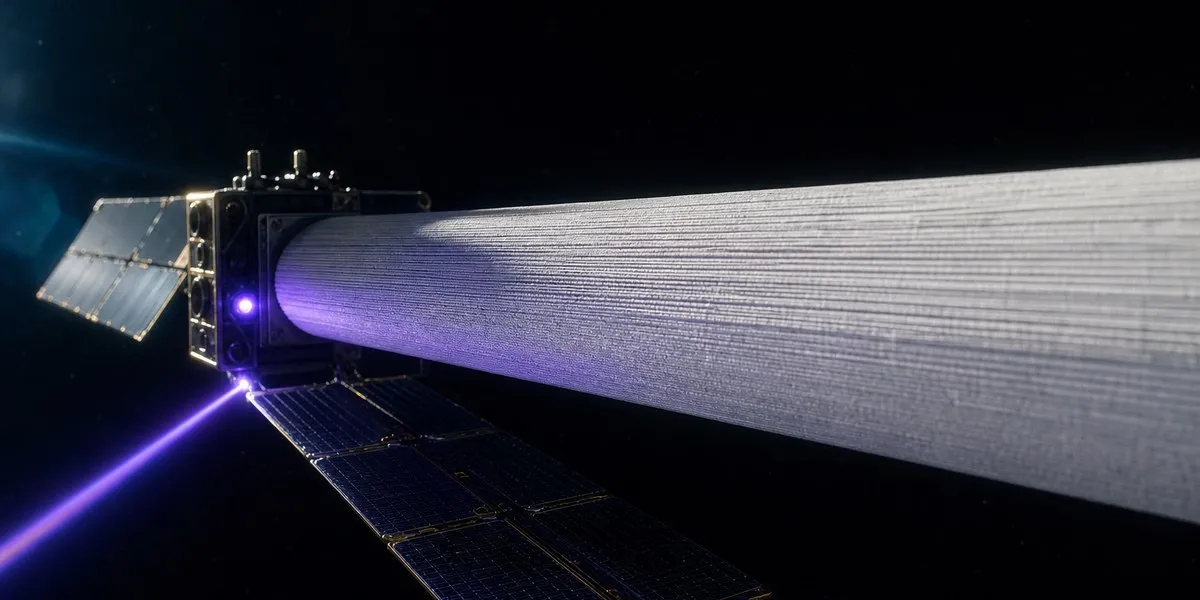
German startup Orbital Matter said that its Replicator-2 satellite printed a rigid cylindrical beam half a meter long in the vacuum of space. The company called it the first such result for an autonomous spacecraft in orbit. TechCrunch reports.
Four 3D printers on a satellite
Replicator-2 was launched this summer as part of a SpaceX rideshare mission. Four Orbital Matter 3D printers were placed aboard the small satellite. Each of them can create a rigid cylindrical beam by extruding spools of a special resin cured by ultraviolet light.
Two printers were intended to deploy a flexible solar array. One of them failed due to an anomaly, but the produced beam successfully deployed the solar array. Previously, attempts at 3D printing in microgravity were limited to the sealed environment of the International Space Station.
More current news is available on the UA.News Telegram channel Telegram.
Applications for large structures
The technology could simplify the creation of large structures in orbit, including solar arrays, antennas, and other spacecraft components. Currently, large structures such as solar arrays or telescope mirrors are folded for rocket launch and then deployed in orbit.
The length of the printed beam is currently limited by the resin supply on the satellite. Orbital Matter engineers consider it possible to manufacture beams up to 100 meters long. For comparison, the solar arrays of Starlink V2 Mini satellites are 20 meters long.
Orbital Matter is working with the European Space Agency and satellite manufacturer Thales Alenia. The company plans to launch its next demonstration mission in 2028: it is expected to test a larger version of the printer on a larger satellite. The company expects to deploy a 5 kW solar array. Orbital Matter is also working with satellite manufacturers considering the use of its PADS system to deploy panels, antennas, and other components.




