
Swiss researchers have taught a humanoid robot to climb ladders with a success rate of over 90%
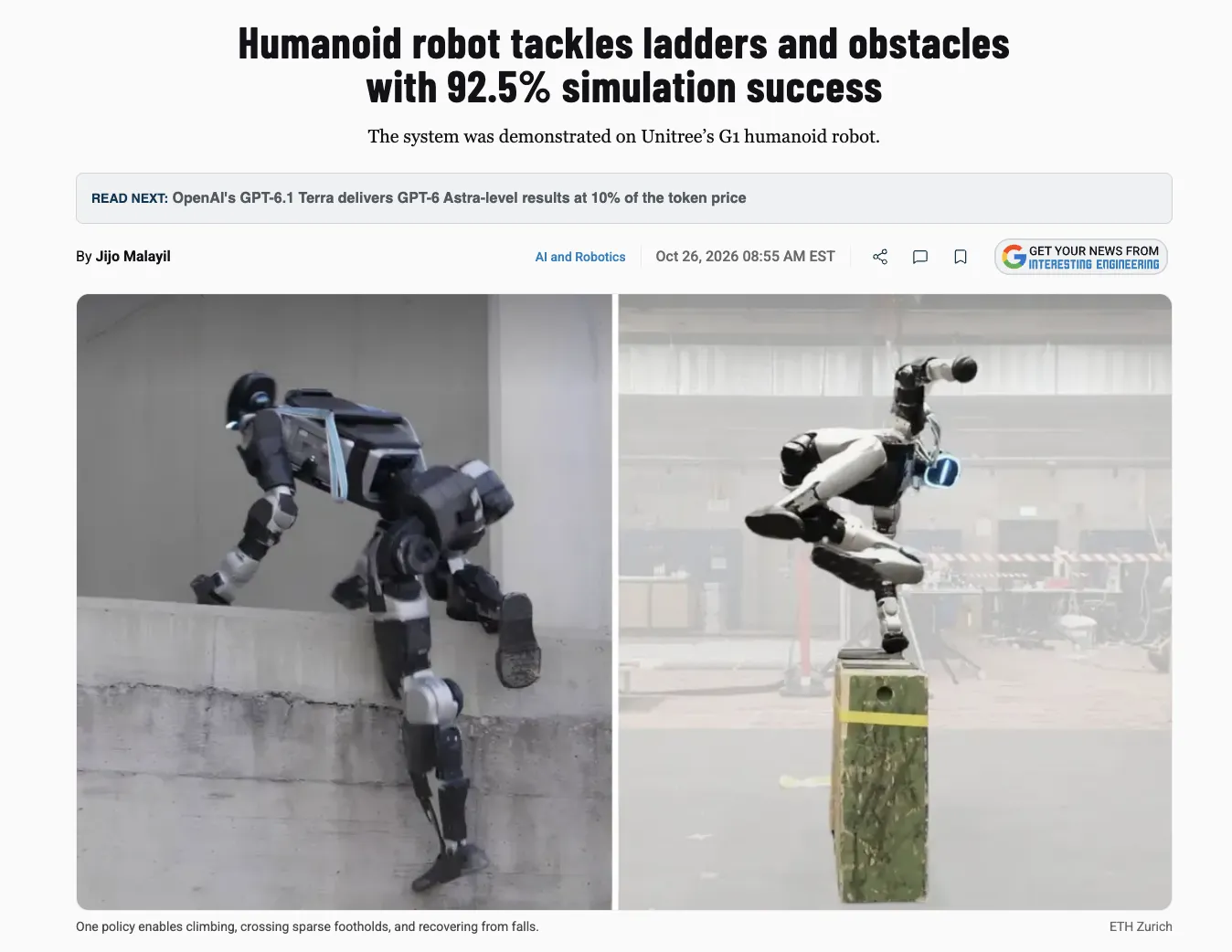
A team of researchers at ETH Zurich has developed a control system that helps a humanoid robot navigate complex obstacles. The robot can climb a ladder and regain its balance after falling by using contact with surrounding surfaces.
The system was demonstrated on Unitree’s G1 humanoid robot, showing how a single approach can support a variety of complex movements.
In simulations, this approach achieved higher success rates than the comparison method on eight obstacle courses, highlighting its potential to improve the mobility of humanoid robots.
The technology, called “Attention-Based Contact Planning” (ACP), helps the robot decide where to position its arms, legs, knees, elbows, and pelvis relative to its environment. The system was tested on Unitree’s G1 humanoid robot, demonstrating how contact planning and reinforcement learning can help robots adapt their movements to varying terrain without adhering to predefined motion sequences.
ACP combines reinforcement learning with motion imitation to address whole-body robot control challenges. Reinforcement learning allows robots to improve through repeated trials and feedback, while motion imitation teaches them to perform recorded movements. However, reinforcement learning can struggle with complex coordination, and imitation-based systems can struggle to adapt to unfamiliar obstacles.
According to the team, instead of generating a complete sequence of body movements, ACP identifies relevant contact points on the surrounding terrain. A separate controller then coordinates the robot’s joints to reach these points.
For example, when climbing a ladder, the robot must identify appropriate footholds and handholds. Its controller then coordinates the movements of the arms, legs, and torso between these points while maintaining balance. This approach allows the robot to adapt its movements without adhering to a fixed climbing sequence.
The contact planner uses an attention-based neural network to process information about the terrain, the robot’s internal state, and the user-specified goal. Its input data includes joint positions, joint velocities, and body orientation. The system plans contacts for nine body parts: two arms, two elbows, two knees, two legs, and the pelvis. This allows the robot to use its upper body for support when walking is insufficient.
The researchers say that training took place in three stages. First, the full-body controller was trained to execute contact plans using 13.2 minutes of human motion data adapted to the robot’s body structure and physical constraints. Next, the researchers trained the contact planner and the controller together. Finally, reinforcement learning helped the system adapt to procedurally generated environments that went beyond the scope of the initial demonstrations. Successful trials provided additional training examples.
In real-world conditions, G1 was demonstrated climbing ladders and stairs, navigating over rocks, crawling, jumping over obstacles, and recovering from falls. In simulations, the system achieved an average success rate of 92.5% on eight composite obstacle courses, compared to 58.8% for the baseline MGMT, an approach based on motion generation and tracking. These figures reflect simulated performance rather than actual success rates, according to Interesting Engineering.
Previously, a humanoid robot capable of coordinating its entire body during physical exertion was developed in Korea
Meanwhile, in Denmark, supermarkets are testing humanoid robots to stock shelves.
The Chinese company JAKA has unveiled two new industrial robots—the wheeled humanoid Kargo50 for transporting cargo and the Zu50 manipulator with a lifting capacity of up to 50 kg.




