
Salt marsh in the Netherlands lost 7 mm of sediment after storm test — ScienceAlert
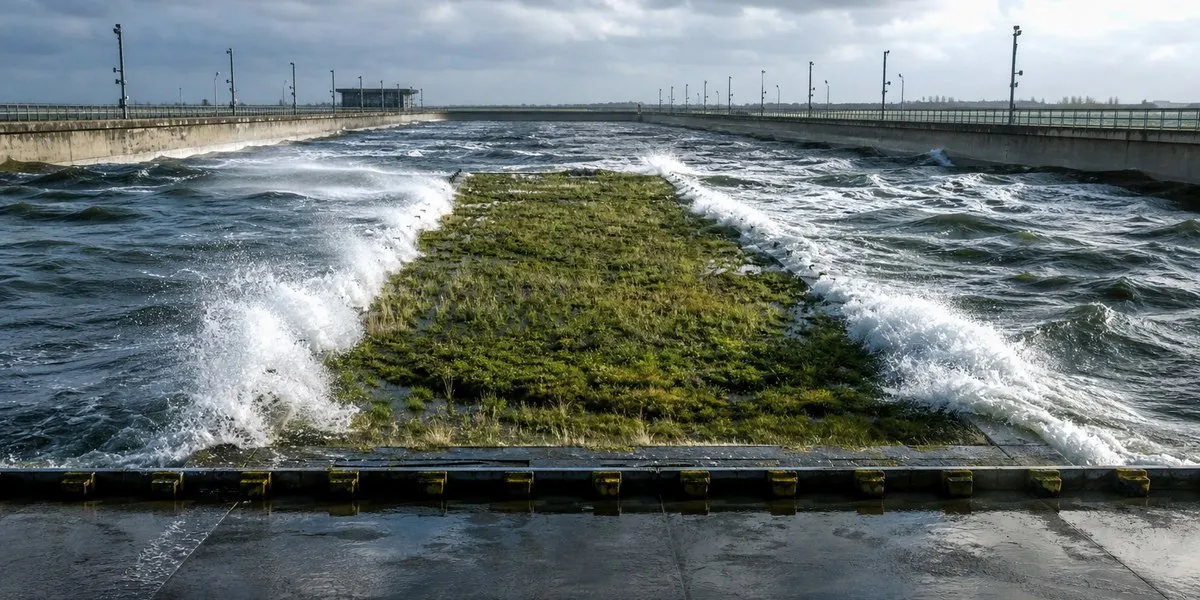
In Delft, the Netherlands, scientists tested the resilience of a natural salt marsh to extreme storm waves in the world’s largest wave channel, Delta Flume. For the experiment, researchers moved 306 square meters of salt marsh from the Wadden Sea coast. After 21 hours of continuous wave exposure, the salt marsh section lost only 7 millimeters of sediment, ScienceAlert reports.
Salt marsh transported from the Wadden Sea coast
Salt marsh blocks were excavated in the Peazemerlannen nature reserve in September and October 2023. Each block weighed between 3 and 6 tonnes and contained a soil layer 0.4 to 0.7 meters deep along with vegetation.
The vegetation was dominated by Elymus athericus; the blocks also contained species of the genus Atriplex and Aster tripolium. They were transported 250 kilometers to Delta Flume in a covered truck to prevent wind from damaging the blocks. The researchers also monitored their weight to ensure they did not dry out during transport.
More current news is available on the UA.News Telegram channel Telegram.
Water resources engineer Pim Willemsen explained that such conditions are difficult to study in a natural environment. According to him, Dutch dikes are designed for storms that statistically occur once every thousands of years.
Vegetation weakened the waves
In the channel, wave height was gradually increased from 0.75 to 2 meters. Above-ground vegetation was damaged: 33% of its biomass was lost after the first wave-exposure cycle, and approximately 20–25% of the initial above-ground biomass remained after the entire test. Stem length decreased by 47%.
According to the researchers, the salt marsh was most effective at wave heights of up to 1 meter, reducing their energy by up to 50%. At wave heights above 1 meter, the reduction did not exceed 10%. The authors of the study, published in Nature, believe that preserving and restoring salt marshes can be combined with dikes and sea walls as part of hybrid coastal protection.




