
Earth-mass planets may have stable orbits in 70 Ophiuchi — ScienceAlert
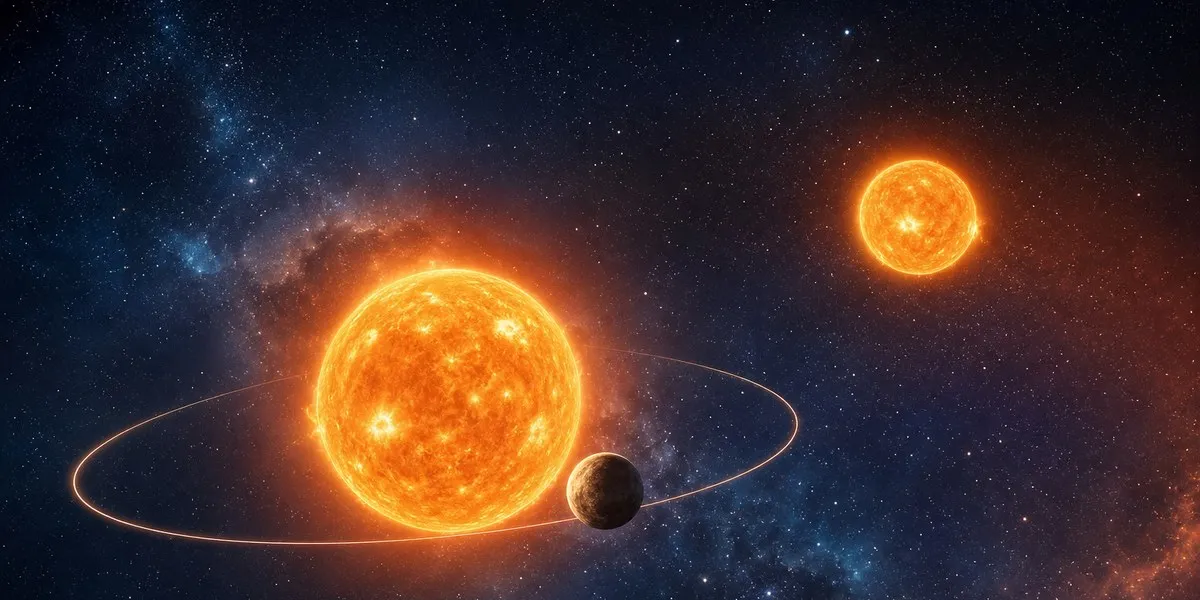
A research team has found that in the binary star system 70 Ophiuchi, located about 16 light-years from Earth, an Earth-mass planet could potentially maintain a stable orbit in the habitable zone around the primary star. ScienceAlert reports this, citing a study published in The Astrophysical Journal.
Stable orbits around the primary star
The 70 Oph AB system consists of two K-class stars that are smaller, cooler, and dimmer than the Sun. The team estimates that their masses are about 88% and 73% of the Sun's mass, while their age may reach around 3 billion years.
Scientists modeled the orbits of Earth-mass planets at 2,000 different distances from the primary star and tracked them for 10 million years. The calculations showed that stable S-type orbits are possible within the habitable zone, in which a planet orbits one star in a binary system. The presence of the second star does not necessarily disrupt such a trajectory.
More current news is available on the UA.News Telegram channel Telegram.
Constraints on gas giants
For the analysis, the team used modern and archival radial velocity measurements of both stars. For the primary star, the researchers used data from eight instruments collected over an observational period of about a century and achieved accuracy better than one meter per second.
The authors also ruled out the presence near the system's stars of gas giants with a mass of Jupiter or greater at distances of up to about five astronomical units from the primary star. In 1855, British astronomer William Jacob claimed that a possible planet existed in the 70 Oph AB system, but this hypothesis did not withstand subsequent verification. A later signal that could have been explained by a Jupiter-sized planet was likely related to stellar activity.
At the same time, Earth-mass planets remain below the detection threshold of the available data. The modeling identified areas where such planets could exist and maintain stable orbits, which may help future studies of binary star systems.




