
Facial reconstruction of a roughly 315,000-year-old Homo sapiens created in Morocco — ScienceAlert
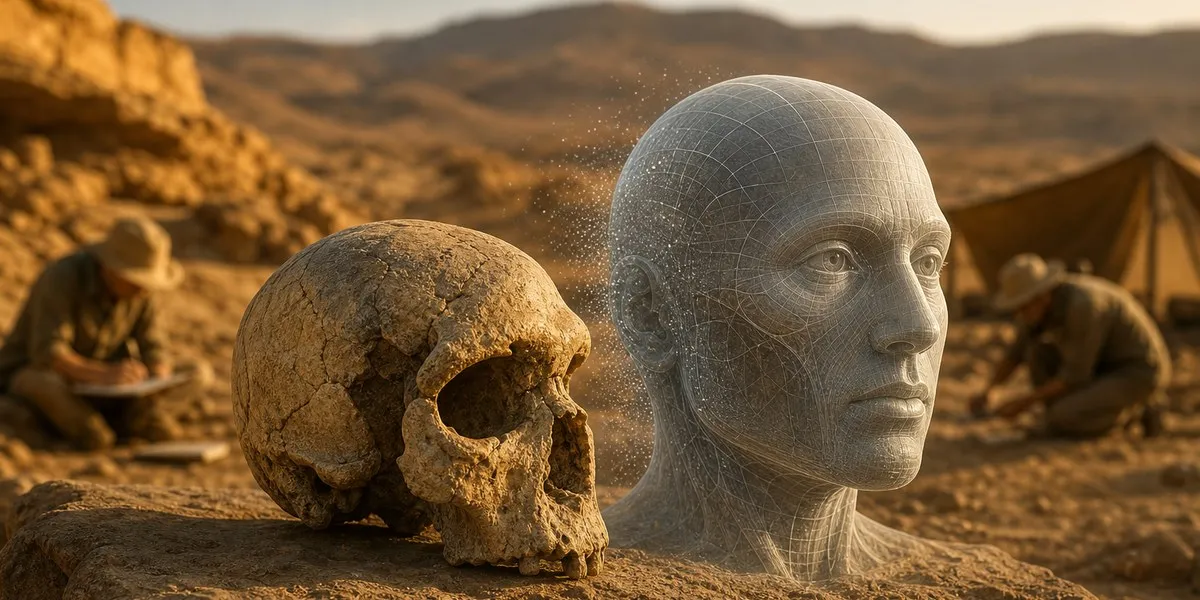
Using fossil remains from Jebel Irhoud in Morocco, researchers created a digital reconstruction of the face of early Homo sapiens who lived approximately 315,000 years ago. As ScienceAlert reports, the reconstruction shows a face with distinct features and a protruding jaw that, despite its archaic traits, would not look entirely unfamiliar among modern people.
Remains from Jebel Irhoud
A skull was first discovered at Jebel Irhoud in the early 1960s during mineral extraction. Initially, scientists believed it belonged to an African Neanderthal who lived about 40,000 years ago. Subsequent excavations uncovered other human remains and stone tools.
In 2017, two studies identified the finds as remains of early Homo sapiens. The age of the fossil-bearing layer was estimated at approximately 315,000 years, with a margin of error of about 34,000 years. This pushed the known history of the species back by approximately 100,000 years, and the remains from Jebel Irhoud were called the oldest known Homo sapiens fossils.
More current news is available on the UA.News Telegram channel Telegram.
Composite skull and limits of the reconstruction
There was no complete skull from a single individual available for the modelling. Scientists at the Max Planck Institute for Evolutionary Anthropology combined several fossil specimens into a digital skull model. Most of the braincase and upper face came from the Irhoud 1 skull, while the lower jaw and dental material were taken from other remains from the same archaeological layer.
A team led by 3D designer Cicero Moraes created a three-dimensional model using images and videos of the composite skull released alongside the 2017 studies. They then used a CT scan of an anonymous modern adult to estimate soft tissues: the person's digital skull was altered to the shape of the ancient model, and the tissues transformed along with it. The reconstruction was refined using measurements of tissue thickness in modern humans.
The cranial cavity volume of the model was 1,364 millilitres, close to the previous estimate of 1,375 millilitres based on a CT scan of the fossil. The resulting image is not an exact portrait of a specific individual because the skull parts belonged to different people. Skin colour, hair and facial hair cannot be determined directly from fossils, so the colour version contains more artistic interpretation. The grey images primarily show the estimated shape of the face. The study was published in the journal Heritage.




