
At Home in Space opens in Washington as museum renovation is completed — Ars Technica
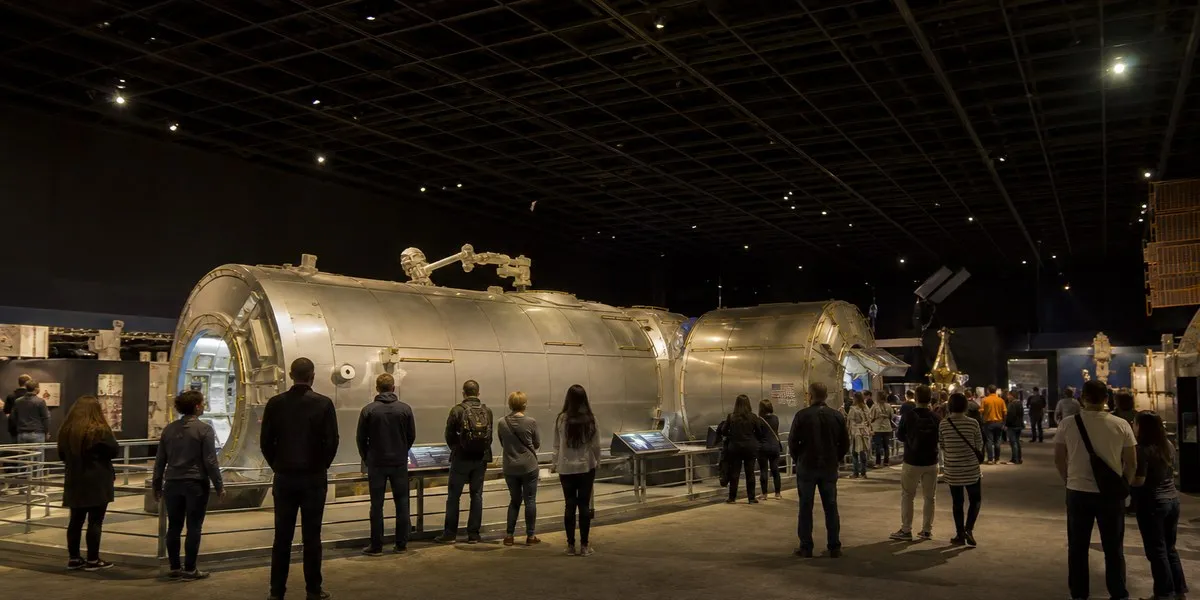
On October 30, the Smithsonian National Air and Space Museum in Washington, US, opened the At Home in Space gallery — the final space exhibition within the large-scale renovation of the main building. The work lasted seven years and cost nearly $1 billion, Ars Technica reports.
The new gallery is dedicated to the more than 50-year history of how people learned to live and work in space for extended periods. The exhibition covers the space shuttle era, the International Space Station, and the next steps, including preparations for establishing bases on the Moon and Mars.
Exhibits about life in space
Among the exhibits are a shuttle main engine, a prototype of the humanoid robot Robonaut 1A, and an EMU spacesuit for spacewalks. According to curator Jennifer Levasseur, this is the first and possibly the only fully flight-used set of such equipment displayed to the general public. The spacesuit does not have a functioning life-support system, as all such backpacks are still needed for use.
More current news is available on the UA.News Telegram channel Telegram.
The gallery also displays the flight clothing of Guy Bluford — the first African American astronaut — and Sally Ride, the first American woman in space. Recovered fragments of the Challenger and Columbia shuttles are presented separately: an elevon hinge and a piece of wiring from Challenger, as well as a reinforced carbon-carbon panel from Columbia's right wing.
ISS module mock-up and Artemis I
Visitors can walk through a full-scale mock-up of the US Destiny laboratory module on the ISS. It features interactive elements and items related to crew daily life, including coffee cups for use in microgravity. The gallery also displays the first 3D printer used in space: in 2014, it produced hundreds of items, from astronauts' tools to parts for repairing the station.
At the end of the exhibition, space has been reserved for the Artemis I capsule, which flew to the Moon without a crew in 2022. Until NASA transfers the original spacecraft to the museum, it is replaced by a scale model of Orion from Lockheed Martin. Admission to the museum is free, but visitors must obtain a timed-entry pass in advance.




