
Robot dog with a chip based on living neurons created in Australia — ScienceAlert
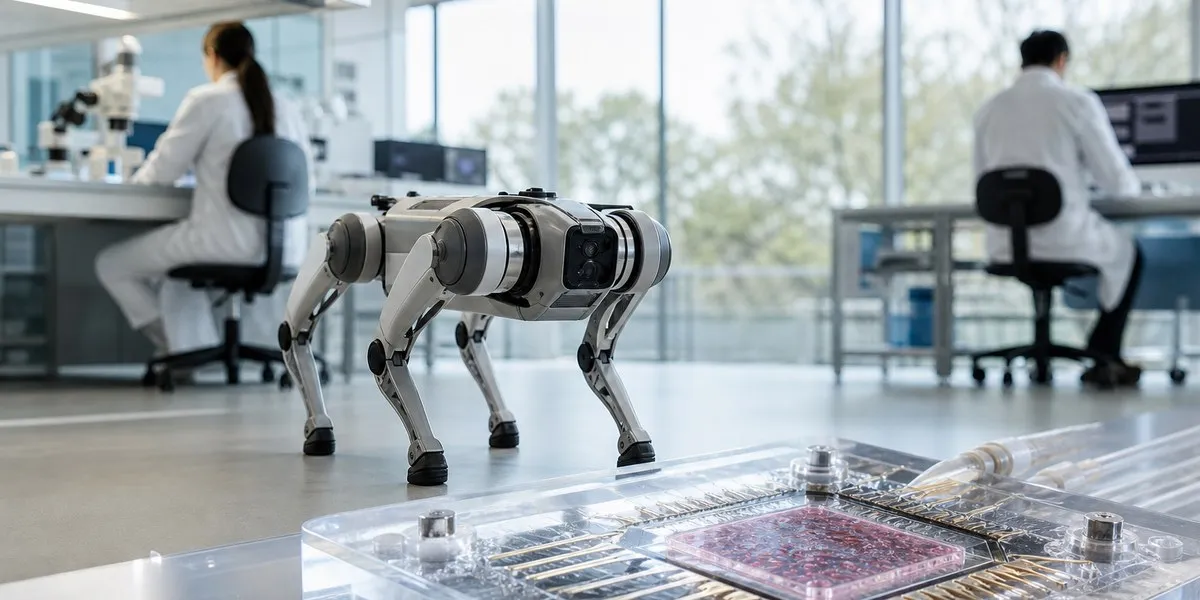
Australian company Cortical Labs has demonstrated a robot dog controlled by a chip with living neurons grown in a laboratory. A small group of neurons guided the robot to a target on a simple navigation layout, ScienceAlert reports.
How the system works
The neurons were grown directly on a chip equipped with electrodes for two-way exchange of electrical signals. The activity of the cells was converted into movement commands for the robot dog. To direct the machine toward a target, researchers used feedback loops: electrical signals stimulated the neurons, and the chip sent signals in response.
Cortical Labs co-founder and CEO Brett Kagan called the robot dog a simple demonstration of the possibility of applying biological systems in the real world. According to him, this approach could eventually be useful for robots and autonomous systems that need to make decisions in unpredictable conditions.
More current news is available on the UA.News Telegram channel Telegram.
Previous tests and limitations
Cortical Labs had previously demonstrated that clusters of neurons can perform computer tasks, including playing Pong and Doom. The company also conducted a similar experiment with Honda Research Institute Europe in a virtual environment: a neural chip guided an agent through a grid in search of a reward.
During more than 4,000 hours of interaction between the chip and the agent, the team tested nearly 1,300 signal combinations. The researchers acknowledge that the technology is not yet either fast or efficient. The next step is expected to be scaling up the chips for more complex tasks, as well as studying how such systems store information. The navigation study has not yet undergone peer review, but it was presented at the NeurIPS 2026 conference, and the work itself is available on arXiv.




