
Berezhna Honored the Memory of the Victims of Stalinist Repression in Transcarpathia
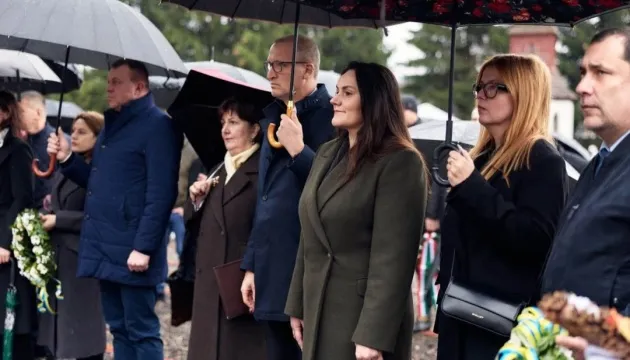
In Svalyava, in the Zakarpattia region, a memorial service was held to honor the local residents who died during Stalin’s repressions in Soviet camps. Deputy Prime Minister and Minister of Culture Tetiana Berezhna and Hungarian Minister of Culture Zoltán Tarr took part in the commemorative events on November 22. During the meeting, the parties also discussed joint cultural projects, the preservation of historical memory, and support for the Ukrainian and Hungarian communities.
On November 22, an event was held at the Svalyava Memorial Park to honor the Transcarpathians who fell victim to Stalinist repressions. These were people who died at the Svalyava assembly point for interned civilians and prisoners of war, as well as in other Gulag and GUPS camps throughout the Soviet Union. Deputy Prime Minister for Humanitarian Policy and Minister of Culture Tetiana Berezhna took part in the commemorative events. She was joined by Zoltán Tarr, Hungary’s Minister of Social Affairs and Culture, and representatives of the Memorial Park Committee.

During the ceremony, Berezhna emphasized the importance of preserving testimonies about the fates of families who suffered under Soviet repression. According to her, special attention must be paid to the stories of Hungarian and German families in Transcarpathia so that future generations may know and remember them. “It is our duty to preserve the testimonies collected by families, researchers, and the community of Svalyava, because it is very important that the fates of Hungarian and German families in Transcarpathia be known and remembered. This is part of our shared history,” Berezhna said.

One of the highlights of the event was the presentation of the original resolution of the Verkhovna Rada of Ukraine recognizing the mass repressions carried out by the Soviet authorities against the civilian population of Transcarpathia in 1944–1946 as crimes of the communist totalitarian regime. The document was signed by Ruslan Stefanchuk, Chairman of the Verkhovna Rada. It was presented to Zoltán Tarra and the leadership of the Memorial Park in Svalyava.
The Hungarian minister thanked the Ukrainian parliament for condemning the crimes of the communist regime against Hungarians in Transcarpathia. He also emphasized that Ukrainians and Hungarians are united by their shared experience of historical tragedies. “We, the residents of Central and Eastern Europe, are united far more strongly by our shared suffering and trials than by our shared joys and successes. They shape us and teach us to value peace and mutual understanding,” Tarr noted. After the memorial ceremony, participants unveiled commemorative plaques. A Hungarian minister also took part in the event.
What Ukraine and Hungary Agreed Upon
A separate part of the visit was a bilateral meeting between Tetiana Berezhna and Zoltán Tarr. Also joining the talks were Fedir Sandor, Ukraine’s ambassador to Hungary; István Balog, a representative of the Ukrainian Ministry of Foreign Affairs in Uzhhorod; and representatives of the regional authorities. The parties discussed ways to strengthen cooperation between Ukraine and Hungary in the fields of culture, education, and humanitarian policy. Potential areas of collaboration include joint cultural projects, support for book publishing and translations, and the development of Ukrainian studies programs at Hungarian universities. Another important issue is the preservation of the linguistic and cultural identity of the two communities: Ukrainians in Hungary and Hungarians in Ukraine.

Berezhna emphasized that cultural cooperation can help strengthen mutual trust between societies. The Ukrainian side is interested in establishing regular contacts between cultural institutions in both countries and creating more joint projects. “Culture is a space where mutual trust between societies is formed. The Ukrainian-Hungarian cultural and educational dialogue continues. We are interested in taking this cooperation to a systematic level, developing direct partnerships between cultural institutions, and creating new opportunities for joint projects,” the minister noted.

The meeting participants also discussed the preservation of cultural heritage. The Ukrainian side provided an overview of the work of the Ukrainian Cultural Heritage Fund and invited Hungary to join its activities. Separate discussions focused on joint historical research, preserving the memory of tragic events of the past, and countering Russian disinformation. In particular, the parties drew attention to the manipulation of historical facts used to spread false claims. Following the meeting, Ukraine and Hungary expressed interest in continuing the dialogue and expanding practical cooperation in the cultural and humanitarian spheres. This was reported by the Ministry of Culture of Ukraine.
The Ukrainian Ministry of Culture is considering ways to support movie theaters and the entire film industry, which are suffering losses due to the full-scale war, Russian attacks, and ongoing air raid alerts. Specifically, this involves compensating for operating costs and losses resulting from canceled screenings.




