
The Khimprom drug cartel planned to make half a million dollars a week
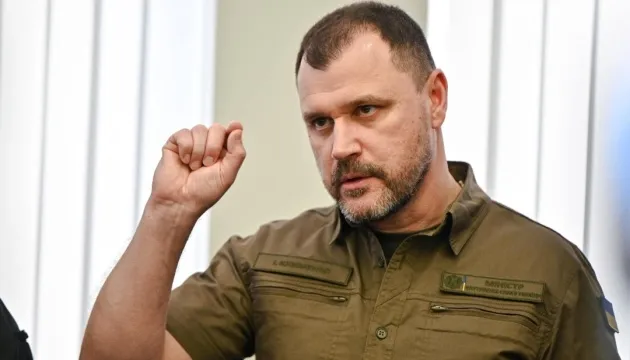
Members of the “Khimprom” drug ring planned to make up to half a million dollars a week in Kyiv. To do so, they intended to exploit loopholes in the law that allowed them to alter the chemical formula of a synthetic cannabinoid and sell it disguised as souvenir merchandise. This was stated by National Security and Defense Council Secretary Ihor Klymenko, who also spoke about threats against him and pressure on law enforcement leadership.
The National Police had already released some of the recordings featuring “Khimprom” members during a briefing in April 2026. In these recordings, as noted by the NSDC Secretary, a man nicknamed “The Mexican” threatened police officers, particularly the leadership of the Department for Combating Drug Crimes. The threats were directed not only at law enforcement officers but also at officials working to ban the group’s products.
“The conversation in those recordings also touched on replacing the head of the department, the Minister of Internal Affairs—who was me at the time. Because we were drafting a resolution to ban souvenirs containing the chemical formula U420. And the criminals wanted to exploit this loophole in the law,” Klymenko said.
According to him, “The Mexican” threatened to create a political crisis and force the dismissal of officials. He allegedly expected that after a change in leadership, it would be possible to reach an agreement with the new people in charge. Klymenko also revealed the potential scale of the group’s earnings in the capital. “If I recall correctly, they wanted to make up to half a million dollars a week in Kyiv,” the NSDC secretary stated.
How the U420 Scheme Worked
According to Klymenko, criminal proceedings regarding activities related to U420 were opened in September 2025. Operational work and the investigation lasted more than half a year. During this time, law enforcement conducted investigative actions and forensic analyses, as well as gathered information about the group’s activities.
One of the main challenges was the ability to constantly alter the chemical formula of the synthetic cannabinoid. Because of this, the products could technically avoid being banned, even if they were substances with narcotic effects. “At the same time, we worked to prevent drug rings from exploiting loopholes in the law by constantly changing the chemical formulas of this synthetic cannabinoid,” Klymenko explained.
He reported that on February 5, the government adopted a corresponding resolution. Klymenko proposed it to prevent the sale of such products after yet another change to their chemical formula. “I proposed it so that criminals would not be able to alter the chemical formula and, consequently, would not be able to sell it in stores,” he noted.
Raids and Closure of a Chain of Stores
At the same time, law enforcement officials inspected stores that were selling the products under the guise of souvenirs. According to Klymenko, such retail outlets began appearing en masse in Kyiv and other regions. In April, the National Police conducted several hundred searches. The Secretary of the National Security and Defense Council states that following these measures, the chain of stores ceased operations and none of these outlets have reopened since then.
“We worked in parallel with law enforcement agencies in other countries. As a result, such a network no longer exists today. I’m referring to these stores and this opportunity to make money. We dismantled all of this back in April,” Klymenko stated. According to him, international cooperation was also part of the efforts against the group. However, he did not provide any details about the actions of law enforcement agencies in other countries. Klymenko told reporters about the group’s plans.
Former Prosecutor General of Ukraine Yuriy Lutsenko stated that the “Khimprom” drug syndicate, which was exposed in 2018, was completely dismantled during his tenure, and its leaders were in custody; but after the change in leadership at the Prosecutor General’s Office, the suspects were released.
The leader of the Russian “Khimprom” drug syndicate, Yegor Burkin, nicknamed “The Mexican,” discussed the possibility of bribing then-Minister of Internal Affairs Ihor Klymenko through his inner circle. In this way, the group’s members sought to prevent the initiation of a ban on the chemical compounds they used to manufacture narcotics.




