
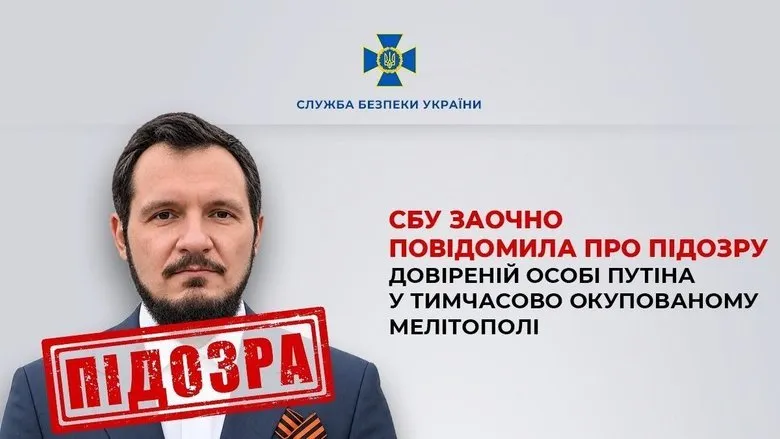
The SBU has charged Artem Sharlay, Putin's representative in Melitopol, with a crime

The Security Service of Ukraine has documented the crimes of Artem Sharlay—the head of the so-called “department for working with religious organizations” of the Russian Federation’s occupation administration in the temporarily occupied part of Zaporizhzhia Oblast. According to the investigation, he is involved in organizing repression against local religious communities that oppose the Kremlin regime or refuse to join the dioceses of the Russian Orthodox Church.
According to the case file, in 2024, Artem Sharlay became Vladimir Putin’s so-called “trusted representative” in the temporarily occupied city of Melitopol during the Russian presidential election.
As law enforcement officials determined, the suspect also participated in organizing the persecution of local religious communities that resist the Russian occupation or refuse to come under the control of the Russian Orthodox Church.
According to the investigation, Sharlay was authorized by the local Gauleiter to compile lists of parishioners with pro-Ukrainian views for the FSB. Russian security forces subsequently used this information to conduct raids against the clergy in question and their parishioners.
During such raids, according to the SBU, Russian occupiers abducted people right in the middle of the street or from their own homes. The detainees were then imprisoned in occupation jails.
“In these dungeons, they are subjected to brutal torture: ranging from regular beatings to suffocation by placing plastic bags over the victims’ heads. In this way, the enemy attempts to coerce members of religious communities into supporting Russian imperialism,” the SBU explained.
The investigation established that Artem Sharlay had supported Russian-controlled terrorist groups in eastern Ukraine as early as 2014. After the start of Russia’s full-scale invasion, he joined the occupation administration in Melitopol.
Currently, investigators from the Security Service of Ukraine have notified Sharlay in absentia of his status as a suspect under Part 1 of Article 438 of the Criminal Code of Ukraine—war crimes.
The SBU reported that comprehensive measures are underway to bring the suspect to justice.
The charge is a procedural status and does not in itself imply a finding of guilt: the final decision in the case must be made by a court.
This was reported by the SBU press center.
As a reminder, according to the investigation, in July 2026, the woman was looking for work via Telegram and came to the attention of Russian intelligence services. After being recruited, she—according to law enforcement—photographed military and infrastructure facilities at the request of a Russian handler. She has been notified of the suspicion of treason.
In Dnipro, a 17-year-old girl was passing the coordinates of military facilities to Russia.
The Counterintelligence Directorate of the Security Service of Ukraine thwarted an attempt by Russian intelligence services to carry out a terrorist attack in the Odesa region. In the Bilhorod-Dnistrovskyi district, a Russian agent was detained who was planning to blow up an administrative building of a state institution in Izmail.
Earlier, in the Kyiv region, the SBU foiled a contract killing of a well-known public figure, which, according to the investigation, was organized by a Russian intelligence agency. A 19-year-old resident of Mykolaiv was detained while preparing for the crime.
In Kropyvnytskyi, the Security Service of Ukraine detained a local resident suspected of collaborating with the FSB and coordinating Russian missile and drone attacks on fuel, energy, and logistics infrastructure. During his arrest, two hunting knives were seized from the man, which, according to the investigation, he carried with him to potentially resist law enforcement officers.
Earlier, the SBU exposed and detained a Russian agent in Kharkiv who was helping the enemy target facilities of the Ukrainian Armed Forces. The detainee was accused of coordinating Russian attacks on the city’s military facilities.
As a reminder, fires broke out at industrial facilities in the Kyiv region as a result of an attack by the Russian Federation.
Russia also launched a massive attack on Kyiv, killing and wounding civilians.
Later, rescue workers showed the aftermath of the strikes on Kyiv.




