
The Guardian reported on Putin's intention to render Ukrainian cities uninhabitable
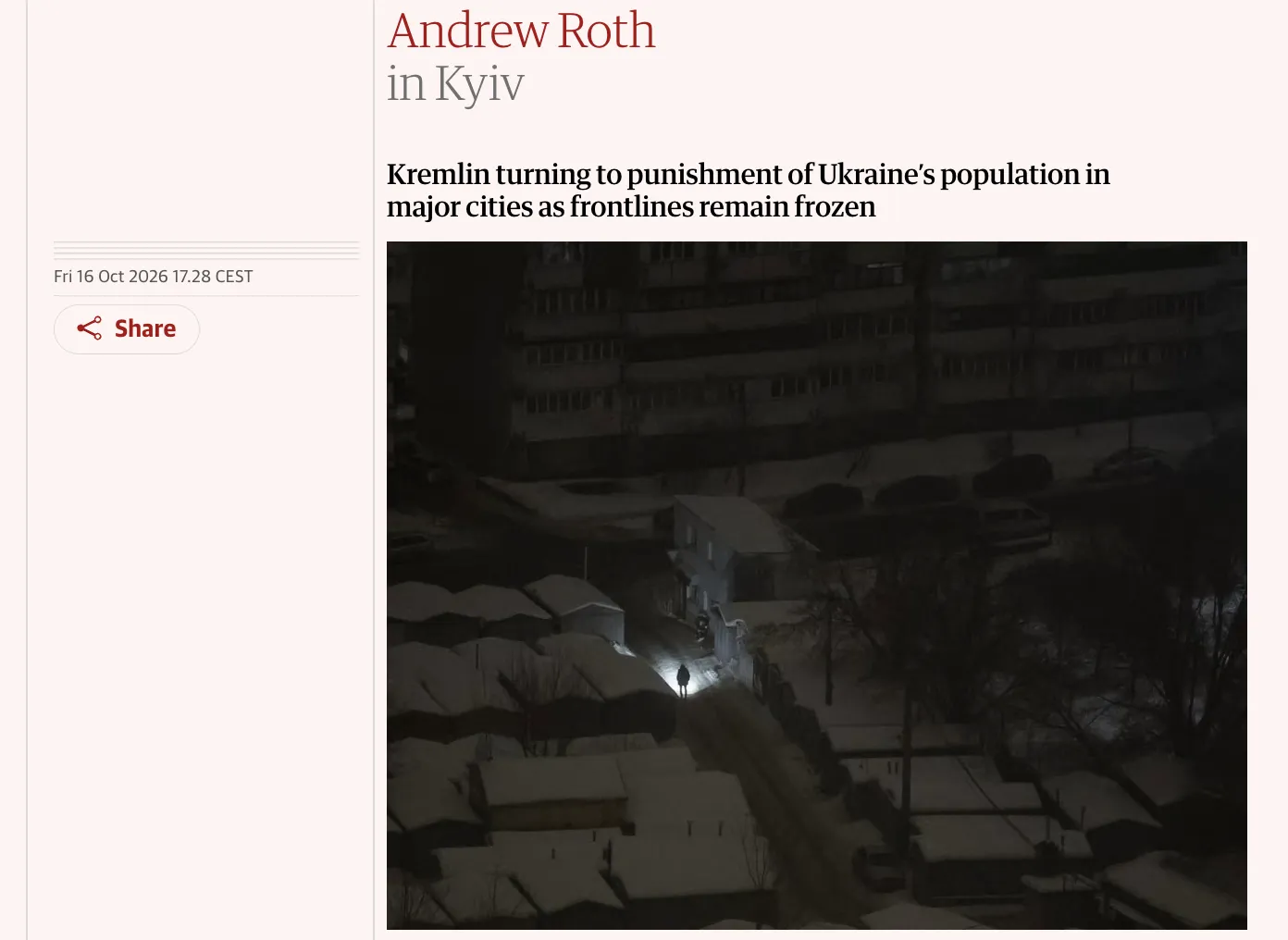
Russia continues to carry out systematic strikes on Ukraine’s energy infrastructure, despite the “energy ceasefire” between Moscow and Kyiv announced by U.S. President Donald Trump. According to The Guardian, these attacks are part of a strategy to put pressure on the Ukrainian population, aimed at forcing the country to surrender.
Reportedly, the potential targets of this Russian campaign—which, according to Ukrainian intelligence, was intercepted last month—range from “deteriorating the quality of life” for Ukrainians through power outages to a complete cutoff of water supply.
The Guardian withheld some specific details of the military assessment at the request of the Ukrainian Ministry of Energy, as they could assist Russia in future strikes against the country.
“These are two extensive documents—written very dispassionately and very clearly, with tables specifying the number of weapons needed to destroy each facility,” Ukrainian Energy Minister Denys Shmyhal said last month. “The types of weapons range from ballistic missiles to jet-powered and conventional drones. We understand how they will operate.”
This secret plan, which officials say was intercepted by Ukrainian intelligence, has several objectives. These include the destruction of power generation, heating, water supply, and sewage systems—in such a way as to make life in Ukrainian cities unbearable. The destruction of just one power generation facility, as stated in the document, will lead to a “significant decline in the population’s quality of life.”
To this end, the document specifies the types of weapons to be deployed—namely, “Geran 4/5” jet-powered drones, as well as hypersonic and cruise missiles—to destroy key infrastructure. This includes thermal power plants, substations, water pumping stations, and much more.
Regarding strikes on the backbone of Ukraine’s water supply, sewage, and heating systems, the document notes that this would cause a “large-scale crisis in public infrastructure.”
Several European officials familiar with the document noted that it was most likely prepared by analytical units linked to the Russian military or intelligence services. According to them, copies of the document had been circulating in Ukraine in previous years as well.
This year, however, Russia appears to be putting these plans into action. Recently, for example, Russian strikes hit three major power plants in the Kyiv region—CHP-4 and CHP-5, as well as the Trypilska Thermal Power Plant in the Kyiv region. They also struck a major electrical substation that transmits electricity from the country’s two main nuclear power plants to the capital.
These facilities, along with other substations that are part of the “Kyiv Energy Ring”—which helps deliver electricity from across the country to the capital—have all become targets of Russian attacks. If the plan succeeds, it could lead to a humanitarian catastrophe in a city with a population of three million people.
This could cut off more than 90% of the electricity allocated to Kyiv for each winter, the document predicts. And that would plunge the city into darkness and cold. According to experts’ forecasts, in the worst-case scenario, power outages could last up to 20 hours a day—until the damaged equipment is repaired.
Russia is increasingly shifting to a strategy of “punishing the population of Ukraine’s major cities” as the front lines have stalled.
“Last year, we were truly on the brink,” said Ukrainian political analyst Volodymyr Fesenko. “But this year, the risk will be even greater—which is why the plan [to attack Ukrainian infrastructure] seems realistic. There is a very high probability that Russia will try to break us this winter.”
While the Kremlin may have once believed in the possibility of a purely military victory, it may no longer consider that feasible—and is now focusing on destroying what remains of Ukraine’s infrastructure rather than attempting to capture it.
Source: The Guardian
As a reminder, throughout the day on October 16, Russia attacked Ukraine with more than 300 strike drones of various types, including jet-powered drones, as well as 15 S-8000 “Banderol/Dan-T” missiles.
Russian troops attacked Dnipro on the evening of October 16. A fire broke out in the suburbs, and a man was killed as a result of the strike.
On the evening of October 16, Russian terrorist forces attacked the main power grid in the Rivne region. As a result, a large number of people in Rivne and the surrounding region lost power.




