
A Su-57 fighter jet exploded in Russia; the Main Intelligence Directorate has revealed details
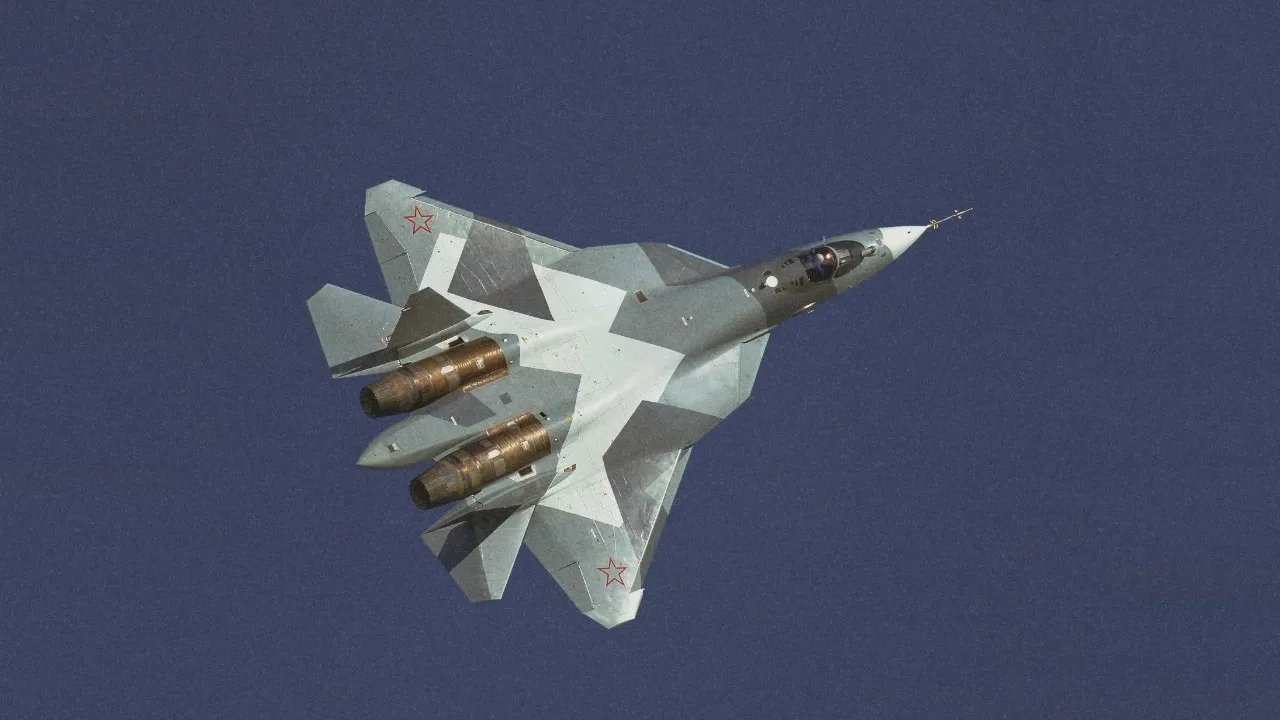
A Su-57 fighter jet, valued at approximately $150 million, exploded at the Russian Akhtubinsk airbase. The incident occurred on October 29 while the engines were being started. Ukraine’s Main Intelligence Directorate speculates that one possible cause could have been the poor quality of aviation fuel, which Russia is forced to import due to a decline in its own production.
According to intelligence reports, the incident occurred at the Akhtubinsk military airfield in Russia’s Astrakhan Oblast. The Su-57 is a Russian fifth-generation multi-role fighter jet. It is designed to engage air, ground, and sea targets. It is one of Russia’s most expensive combat aircraft, with an estimated cost of approximately $150 million. According to the Main Intelligence Directorate, the aircraft exploded while the engines were starting up. Intelligence officials point to possible issues with aviation fuel, as its quality directly affects engine performance.
Why the Su-57 Exploded
The Su-57 fighter is equipped with an AL-41F1 turbojet engine, also known as “Product 117.” According to the Main Intelligence Directorate (GUR), one of the reasons for the failure of engines of this type could be the use of substandard fuel. At the same time, intelligence does not claim that the fuel itself was the direct cause of the explosion. This is one of several possible explanations for the incident.
The GUR links the situation to problems in the Russian oil industry. Due to Ukrainian strikes on oil refineries and fuel infrastructure, Russia is facing a decline in its own production of aviation fuel. As a result, the country is becoming increasingly dependent on foreign supplies. Intelligence also released data on the route by which aviation fuel is transported from India to Russia.
How Russia Imports Aviation Fuel from India
According to the Main Intelligence Directorate (GUR), Russia uses maritime transport and ship-to-ship transfers to import fuel. This method allows for the delivery of large shipments of petroleum products to Russian ports. One of the sources of supply is the Nayara Energy refinery in Vadinar, India. Nearly half of the company’s shares—49.13%—are owned by the Russian state-owned oil company Rosneft. At the same time, Nayara Energy is one of the major buyers of Russian crude oil. The Main Intelligence Directorate cited a specific example of such a shipment.
On August 22, 2026, the tanker GRIF—which intelligence agencies classify as part of Russia’s “shadow fleet”—loaded nearly 40,000 metric tons of JET A-1 aviation fuel from the Nayara Energy refinery. In the first ten days of September, the cargo was transshipped to another tanker—the HALCYON. The operation took place off the eastern coast of Malaysia, near the Strait of Singapore. This area is one of the key hubs of international maritime trade, where oil and petroleum products are regularly transshipped from one vessel to another.
On September 23, the HALCYON delivered over 37,000 metric tons of jet fuel to the Russian port of Nakhodka. It was unloaded at the “RN-Morskoy Terminal Nakhodka,” which is part of Rosneft’s logistics infrastructure. Thus, according to data provided by the Main Intelligence Directorate, a large shipment of aviation fuel traveled from an Indian oil refinery, via transshipment at sea, to the Russian port.
Who Supplies Fuel for the Su-57
Ukrainian intelligence is paying particular attention to the company “RN-Aero.” It operates Rosneft’s aviation refueling business and supplies fuel to the Russian aviation industry. According to the Main Intelligence Directorate (GUR), this company supplies aviation fuel to the United Aircraft Corporation, which is involved in the production of Su-57 fighter jets. “RN-Aero” is subject to sanctions imposed by a number of countries, including Ukraine, European Union member states, the United Kingdom, Switzerland, and Japan.
The intelligence report also noted that in the summer of 2026, Russian authorities authorized the concealment of information regarding the activities and shipment volumes of “RN-Aero” and a number of other “Rosneft” entities.
What Makes JET A-1 Fuel Special
JET A-1 is an aviation fuel used in gas turbine engines. According to the GUR, it is suitable for use in a number of Russian military aircraft and can replace TS-1 and RT standard fuels used in Russia. Among the aircraft for which JET A-1 can be used, intelligence sources list the Su-30SM, Su-34, Su-35S, Su-57, MiG-29, and Su-24M. It can also be used to refuel certain jet-powered strike drones.
In addition, the Main Intelligence Directorate reports that this fuel is being used in Russian Il-76MD-90A military transport aircraft. These aircraft are used, in particular, to transport military equipment and weapons. Intelligence sources emphasize that Russia continues to seek opportunities to supply its military aviation with fuel despite sanctions and attacks on oil infrastructure.
At the same time, there is currently no confirmation that it was specifically the fuel imported from India that caused the Su-57 explosion. The Main Intelligence Directorate cites its potentially low quality as one of the factors that could have led to the engine failure. The final cause of the incident has not been determined in the published report. The Main Intelligence Directorate of the Ukrainian Ministry of Defense reported the explosion on November 2.
On October 29, 2026, a Su-57 fighter jet exploded at the Russian military airfield “Akhtubinsk.” This was reported by the Main Intelligence Directorate of the Ukrainian Ministry of Defense.
Earlier, the General Staff reported record losses among Russian troops in 2026.
In October, the Ukrainian Armed Forces liberated 96.2 square kilometers of Ukrainian territory, which is 10.4 square kilometers more than the area captured by Russian occupation forces during the same period.
In the Samara region of the Russian Federation, drones attacked an oil pipeline station, causing a fire.




