
A soldier from the Khmelnytskyi region, after 248 days on the front lines, escorted a prisoner through the no-man's-land
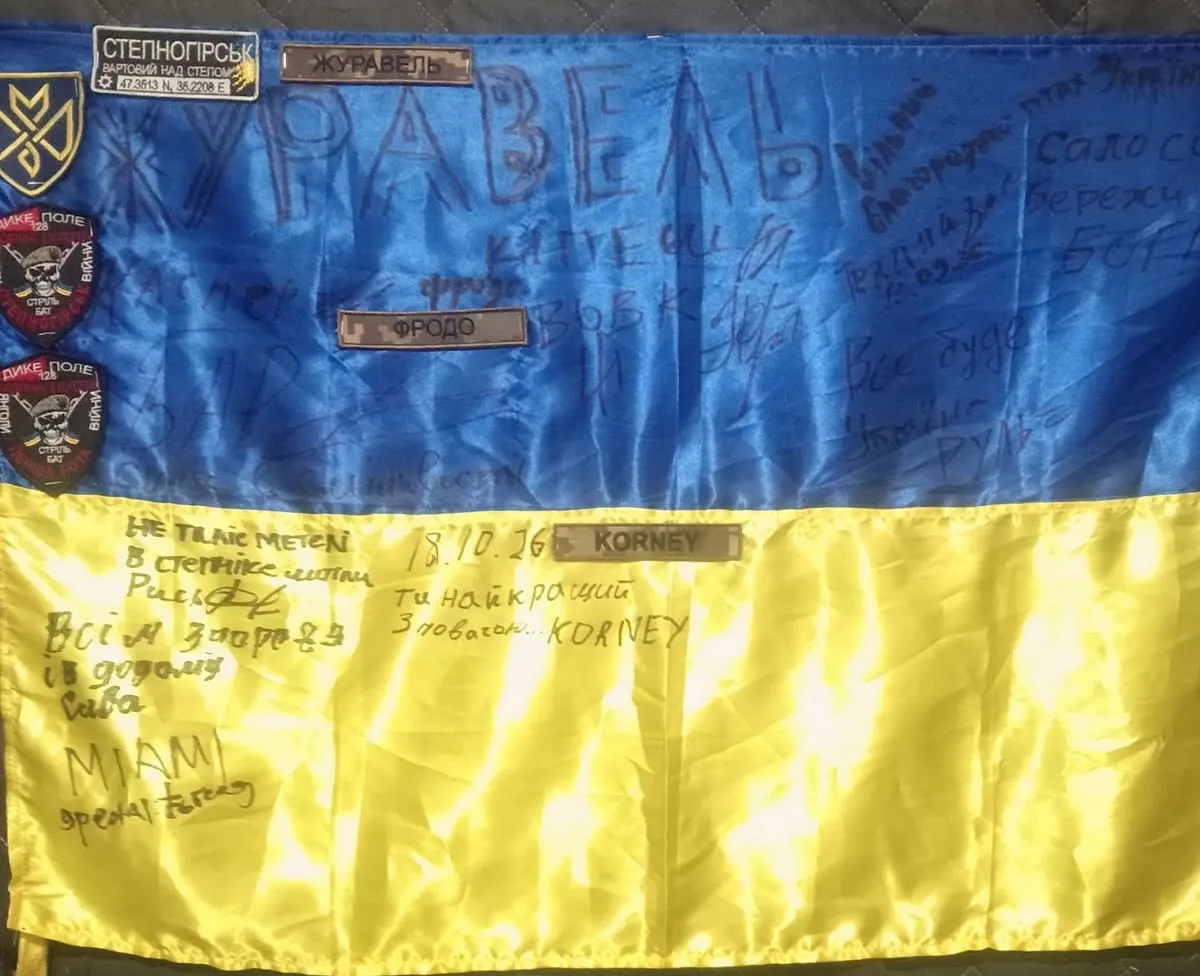
A soldier from the Khmelnytskyi region, who had been a farmer before enlisting, spent 248 days on the front lines in Stepnogorsk and was wounded four times. Despite his hatred for the prisoner, he led him through the no-man’s-land, according to the 128th Separate Heavy Mechanized Brigade “Dyke Pole,” which published the soldier’s story on Facebook.
Andriy is 45 years old. He has lived his entire life in the Khmelnytskyi region, where he worked in construction and as a farmer. He has a family and two children.
In 2023, he decided to join the military because he did not want to stand idly by while his country was at war.
At that time, recruitment wasn’t yet widespread, so Andriy was assigned to the infantry, which was carrying out combat missions in the Kupiansk sector.
At first, he served in the “Black Infantry.” According to him, assault teams carried out attacks, while the infantry held their ground in the captured positions. Russian troops also repeatedly attempted to storm their lines.

“The ‘Black Infantry.’ The assault troops ‘poured in,’ and we held our ground. There were Russian assaults. In less than a year—four wounds,” the soldier recounts.
Andriy sustained his first injury while returning from his positions: a mine explosion left him with two shrapnel fragments. As soon as he recovered, he set out on another combat mission. However, he was wounded a second time shortly thereafter.
“We moved into position, began to secure our ground, and then the shelling started—Russian artillery. And just a moment ago I was there with my weapon, among my comrades, when suddenly I opened my eyes—and it turned out I was ‘in Adam’s costume’ again, naked, lying in a hospital in Kharkiv,” Andriy laughs.
After his third injury, the soldier even refused hospitalization. A fragment from a 152-mm shell had only grazed his neck and, as Andriy thought, hadn’t damaged anything vital. However, a few days later, he sustained a fourth injury—another piece of shrapnel struck his leg.
After treatment, he was sent home to recover. Later, he learned that he had been placed on the reserve list.
He disagreed with this, as he did not consider himself a draft dodger, so he decided to continue his service in the 128th Brigade “Dyke Pole.”
“They treated me back then and sent me home to recover. After a while, I found out that I had been registered as a draft dodger. That’s when I joined the 128th Brigade ‘Dyke Pole,’ because I definitely didn’t consider myself a draft dodger,” he says.
Given his combat experience, Andriy was offered the position of squad leader.

Over the past year and a half, the nature of the war has changed significantly, particularly due to the widespread use of drones. At the same time, the basic rules of survival for infantry have remained the same.
“In 2023, drones didn’t react to one or two soldiers; now they pounce on even a shadow. But the main thing hasn’t changed: if the infantry digs in—they survive,” the soldier noted.
Andriy is convinced that everyone is afraid in war, and he doesn’t trust those who claim otherwise. The experiences he’s been through now help him train new recruits.
“I tell them: your eyes, legs, and ears must always be on the alert, just as your belief that you must live—you must know this. And no matter what happens, you must always remain human,” the soldier said.

What helped Andriy hold his ground were constant communication with his commanders, care packages from “Babushka,” and supplies delivered every night by “vampire” drones. Conversations with his family were also a vital source of support; even from a distance, they gave him the strength to hold on.
“Even from our positions, via radio, through the guys at the command post—but the connection was there. Our families could hear us, and we could hear them. I told my family that everything was fine, and they told me that everything was fine. It might not seem like much, but it gave us a huge morale boost,” the soldier said.
More than anything, Andriy wants all his comrades to return home alive. He hopes that the soldiers who are missing in action are also alive. Even if they’re being held captive, there’s still a chance for a prisoner exchange.
That hope sustained him during one of the special operations in Stepnogorsk. After his comrades had eliminated a group of Russian soldiers, one occupier surrendered. He had to be transported to territory controlled by Ukraine, passing through the contact line.
“I was shaking with hatred for him. He’s 20 years old, and he came all the way here to kill us in our own country. He kept saying he didn’t come to kill, but just to make some money. We’ve been told so much about how rich Russia is, yet there’s no other way to make money there than to go kill people in another country,” the soldier noted.
The soldier understands that after the exchange, the Russians may send this prisoner back to the war—such cases have already occurred.
However, Andriy had a different perspective: thanks to this exchange, at least one Ukrainian prisoner of war will be able to return home. Perhaps it will be one of his comrades, or perhaps someone he doesn’t know at all.
Source: “Dyke Pole”
Ukrainian Airborne Forces destroyed the occupiers’ positions and equipment in the Kupiansk sector.
Video: A soldier from the 141st Separate Mechanized Brigade, Chapa, spent 97 days at his positions.
The Ukrainian Armed Forces advanced in the Sumy and Donetsk regions and repelled Russian offensives, according to the ISW




