
The Russian authorities are recording the executions and killings of Russian soldiers as "deaths in action" — a leak from the Rosstat database
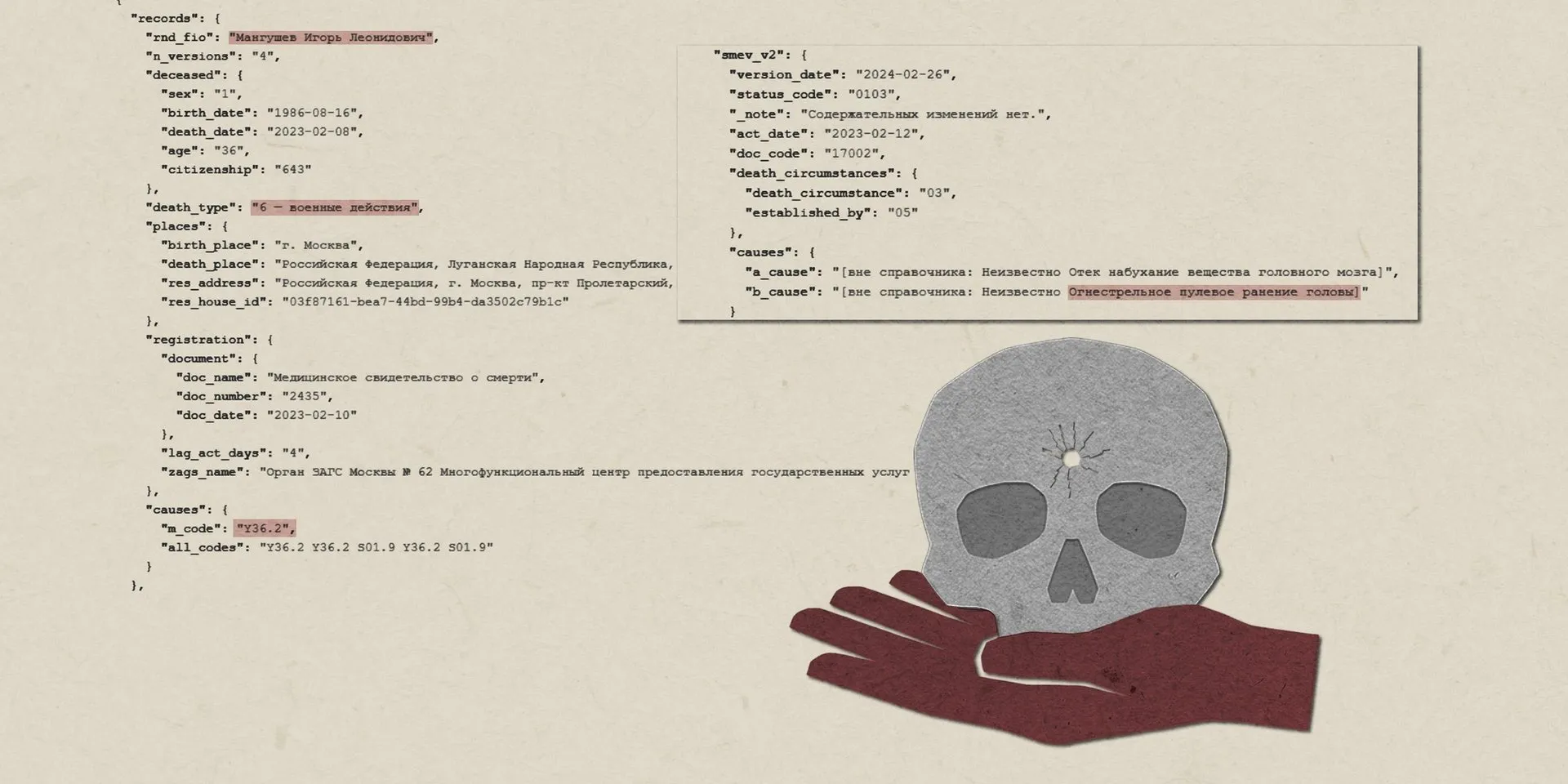
On November 27, 2026, the publication “Important Stories” published an investigation into how Russia may have covered up the killings of military personnel who were inconvenient for the authorities and the command. Journalists analyzed a leaked Rosstat database and found entries in which deaths from gunshot wounds were recorded as deaths in combat or from explosions. Among them were well-known Russian “Z-activists,” commanders, and military personnel who had clashed with their superiors.
Journalists from “Vazhnye Istorii” gained access to the leaked Rosstat database after the agency was hacked by groups called Silent Crow and “Cyberpartisans.” While analyzing the documents, they found several cases where the official cause of death did not match the known circumstances of the individuals’ deaths.
In the documents, some deaths are marked with the code Y36.2. According to the International Classification of Diseases, this code refers to injuries resulting from military operations, specifically from explosions or shrapnel. However, in some entries, gunshot wounds are listed alongside this code. This may indicate attempts to pass off murders as combat casualties, although the data itself does not establish who was responsible for these deaths.
The Death of the “Father” of the Z Symbol
One such case is the death of Igor Mangushev, known by the call sign Bereg. In early February 2023, he was taken to a hospital in Stakhanov, Luhansk Oblast, with a gunshot wound to the head. He died a few days later.
Before the full-scale war, Mangushev was an active supporter of the Kremlin. He founded the ultra-nationalist movement “Svitla Rus,” worked for the “League for a Safe Internet,” and later established his own private military company, “E.N.O.T.” He also took part in combat operations in Donbas, Syria, and the Central African Republic, organized provocations against the Russian opposition, and assisted Yevgeny Prigozhin with his “troll factory.”
Mangushev also claimed to be the originator of the idea to use the letter Z as the main symbol of the Russian invasion of Ukraine. However, there is no evidence to confirm his authorship. After the start of the full-scale war, he joined the ranks of the so-called “LPR” and held an officer’s rank. Mangushev gained widespread notoriety after a speech in Donetsk at the Limonov Readings. At that time, he held a real human skull in his hands and threatened to “destroy everyone who considers themselves Ukrainian.” His wife claimed that it was the skull of a Ukrainian soldier.
On the night of February 4, 2023, Mangushev was taken to the hospital with a gunshot wound to the head. Z-blogger Volodymyr Grubnyk reported that he had been shot with a 9-millimeter pistol. According to the description of the injury, the bullet entered the back of the head from above at an angle of approximately 45 degrees. Journalists note that this could indicate a shot fired at a person who was kneeling, though it is impossible to definitively establish the circumstances of the attack based on this information.
There were various theories about what happened. Z-correspondent Roman Saponkov speculated that the murder might have been linked to Mangushev’s conflict with the occupying administration or the military command. His wife directly called the incident an execution. She also stated that no investigative actions were taken and no criminal case was opened.
In Rosstat documents, Mangushev’s death was recorded as a combat casualty. The cause of death was listed not as a gunshot wound, but as injury due to an explosion or shrapnel—code Y36.2. At the same time, the same record mentions an open head wound. Additional causes of death listed include cerebral edema and a gunshot wound to the head. It was precisely this discrepancy that caught the attention of journalists.
The commander of “Española” was initially believed to be alive
Similar questions arose regarding the death of Stanislav Orlov, known by the call sign “Español.” He commanded the 88th “Español” Brigade, which was formed from soccer ultras and members of neo-Nazi circles. Orlov died on December 4, 2025, under unexplained circumstances. Shortly before that, in October, his unit had unexpectedly ceased to exist. In early December, the commander stopped responding to communications. At first, not even his close relatives knew of his death.
On December 9, pro-government Russian media outlets reported that Orlov was allegedly alive. Later, claims emerged that he had been detained along with Z-blogger Alexei Zhivov on suspicion of arms trafficking. However, Zhivov himself spoke with journalists and said he knew nothing about such an arrest. Sources at RTVI, in turn, claimed that Orlov had been killed during his arrest.
Based on a leak from Rosstat, journalists determined that Orlov had already been dead for several days at that point. The publication Astra also released surveillance footage from near his home in the Flotsky dacha community in Sevastopol. The video shows armed men getting out of cars with Ministry of Defense license plates. Orlov’s death was not officially recorded until 14 days later. Initially, the documents listed the cause of death as a gunshot wound from a handgun, but with undetermined intent. This code is used both when a person shoots themselves and when they are killed. According to the journalists, the shot was to the heart.
The entry was later changed. The primary cause of death became the same code, Y36.2—injuries resulting from military operations, explosions, or shrapnel. It is unknown why this particular version appeared in the documents. It is known that Orlov died at home, in a summer cottage community, and not during combat operations. At the funeral, his body was in an open casket. Therefore, the theory that traces of a murder could have been concealed by blowing up the body with grenades is not supported in this case.
The Deaths of Drone Operators Ernest and Goodwin
A separate part of the investigation focused on two Russian drone operators—Ernest and Goodwin. In September 2024, Sergei Gritsai and Dmitry Lysakovsky of the 87th Rifle Regiment published a video statement in which they spoke about threats from the command.
According to them, the regiment commander, Igor Puzyk—codenamed Zly—threatened to send them on an assault mission, effectively condemning them to death. The soldiers also alleged possible crimes within the unit, including drug trafficking, from which, they claimed, members of the command might have received a cut. Ernest and Goodwin asked that their message be considered testimony in case they did not return from their mission. That is exactly what happened: both were killed on September 12, 2024—one day before the video was published.
This story caused a significant stir among Russian Z-bloggers. They demanded an investigation into the commander’s actions. Russian Defense Minister Andrei Belousov instructed the military leadership, together with the FSB’s military counterintelligence department, to investigate the circumstances surrounding the cameramen’s deaths. However, according to Z-blogger Alexander Kots, the Ministry of Defense and the FSB found no evidence to support the deceased men’s claims.
In the Rosstat database, journalists found records of the deaths of both soldiers, as well as that of Viktor Novikov. According to the investigation, in 2023, he was shot by Puzyk due to a personal grudge. Novikov’s death was officially recorded as a fatality during combat operations.
As for Goodwin, the final Rosstat record listed code Y36.2—injuries caused by explosions or shrapnel during military operations. The cause of Ernest’s death was not specified. Journalists speculate that this may have been due to a technical error during data processing.
According to Kots, the cameramen were killed by a strike from a heavy “Baba Yaga” drone. He also claimed that Goodwin’s body was never found. However, Rosstat data shows that Lysakovsky’s death was registered 39 days after his death, and Gritsay’s 50 days later. Both were declared dead without a court ruling, which, according to journalists, may indicate that their bodies were in fact found. Despite the public outcry, Puzyka was not held accountable. On the contrary, he was promoted and appointed commander of the 114th Separate Motorized Rifle Brigade.
How Other Killings of Soldiers Were Covered Up
The investigation also mentions cases where Russian commanders may have killed their own subordinates and then attempted to pass off their deaths as combat losses. To do this, they may have blown up the bodies with grenades to conceal signs of violence. Such cases, as journalists note, were even acknowledged in Russian courts. One example is the death of Alexander Yurkov. In 2025, the publication “Verstka” reported that commanders had drawn him into drug trafficking. When he spent the money he earned on his wife’s medical treatment, he was beaten to death with sticks.
After the murder, Yurkov’s body was dressed in an old bulletproof vest and helmet, blown up with grenades, and his remains were left out in the heat. They were later sent to Russia as the body of a soldier who had allegedly died in combat. In the Rosstat database, his death was also recorded as a result of combat operations involving explosives and shrapnel. Another version of the document additionally cited acute massive blood loss.
Another case involves Andriy Bykov of the assault company of the 80th Guards Tank Regiment. According to the investigation, in May 2025, he was killed after refusing to hand over to his commanders a car he had purchased with compensation received following a wounding. His body was left in a forest strip near Halytsynivka in the Donetsk region. His relatives never received his remains. In Rosstat documents, Bykov was officially declared deceased only after a court ruling—432 days after his death. The circumstances of his death have not been officially established.
Journalists also recall the murder of former prisoner Yevgeny Nuzhin. In November 2022, he was executed by mercenaries from the Wagner Group. Earlier, Nuzhin had surrendered to Ukrainian forces, given several interviews, and expressed his desire to fight on the side of the Ukrainian Armed Forces. After the prisoner exchange, he once again found himself in the hands of Wagner mercenaries. In a video circulated online, his head was secured with duct tape, after which he was killed with a blow from a sledgehammer. Journalists found no record of his death in the Rosstat database.
Mass Execution of Conscripts Near Belgorod
Another part of the investigation concerns the mass execution of Russian conscripts at a training ground in the village of Soloty in the Belgorod region. This occurred in October 2022, when a group of newly arrived soldiers was gathered on the grounds of the 752nd Motorized Rifle Regiment. According to the journalists, about a hundred conscripts refused to go to war, and the atmosphere in the unit was tense.
On October 15, two soldiers opened fire on their unarmed comrades with a machine gun and an assault rifle. The Russian Ministry of Defense stated that the attackers were foreigners from CIS countries. However, the ministry did not explain what exactly they were doing among the conscripts. One theory about the incident was that it stemmed from a religious conflict. According to this theory, Lieutenant Colonel Andrei Lapin insulted Muslims, after which several soldiers opened fire during the shooting exercise. At the same time, journalists from “Vazhnye Istorii” were unable to confirm either the presence of a senior officer with that last name at the training ground or his death.
According to official reports, 11 people were killed in the shooting, and another 15 were wounded. Both attackers were reportedly shot by snipers. Later, the Telegram channel Baza published a list of the deceased and identified the attackers as Mekhrob Rakhmonov and Eskhon Aminzod, both natives of Tajikistan. In the Rosstat database, journalists found records of the deaths of 10 of the 13 victims, including the two attackers. All of them were listed as having died in combat, although the Russian Ministry of Defense classified the incident as a terrorist attack.
At the same time, the documents indicate that both attackers were Russian citizens. The cause of their deaths was listed as injuries from landmines and explosives, not sniper fire, as stated in the official version.
Among the other mobilized soldiers who died, some succumbed to gunshot wounds, and two to mine and explosive injuries. All of them were also classified as combat casualties. Journalists do not rule out the possibility that there could have been more victims: according to Rosstat, on that same day, another 32 people died from gunshot wounds in unidentified settlements. The registry contains no information that would make it possible to determine exactly who these people were.
An investigation by “Vazhnye Istorii” reveals that Russian statistics on military deaths may have been altered or recorded in such a way as to make them appear as routine combat losses. At the same time, the leaked documents do not make it possible to identify those responsible in each of the cases described. They merely reveal discrepancies between the recorded causes of death and the circumstances previously reported by journalists and eyewitnesses. This has been reported by Russian media.
At least seven people died in a fire at a military unit in Primorsko-Akhtarsk, Krasnodar Krai, on May 22. This information came to light from a leak of a Rosstat database, which was analyzed by journalists from “The Agency.” Russian authorities have not officially reported the deaths.
Ukrainian troops destroyed a Russian 2S19M2 Msta-S self-propelled artillery system near the village of Peschanka in the Valuy District of the Belgorod Region of the Russian Federation, according to a video recording of the combat operation that has been made public.
Members of the “ATESH” partisan movement claimed to have destroyed a communications tower near the village of Shebekino in the Belgorod region of Russia. According to the partisans, the sabotage disrupted the operation of a repeater that the Russian military used to maintain communications and to guide and control drones.




