
Russia is trying to drive a wedge between Europe and the U.S. and divide the EU from within — Sibiga
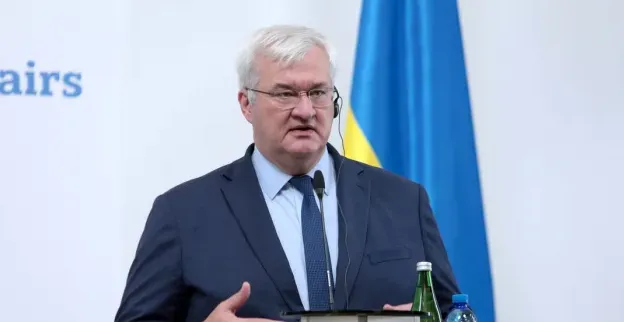
Russia is attempting to drive a wedge between Europe and the United States, intensify disputes between EU countries and NATO, and cause divisions within European nations. This was stated by Ukrainian Foreign Minister Andriy Sibiga during his address at the plenary session of the 78th session of the Nordic Council. In his view, the response to these attempts should be unity among allies at all three levels.
Andriy Sibiga called on Western allies to realistically assess Moscow’s objectives. According to the minister, Russia seeks not only to weaken ties between individual states but also to exacerbate disputes within the countries themselves. “We must assess what Moscow is striving for very realistically. According to our intelligence, Russia’s strategic goal is to divide us on three levels,” said the head of the Ukrainian Foreign Ministry.
The first level is relations between Europe and the United States. According to Sibiga, Moscow seeks to weaken cooperation between them and create conditions under which the allies will be unable to act jointly.
The second level involves relations among the European Union member states and NATO. Russia is attempting to deepen divisions among the states that work together on security and defense issues.
The third level is the domestic situation in European countries. According to the minister, Moscow seeks to cause divisions within societies, particularly in the run-up to elections. Sibiga noted that over the next year, citizens in more than half of the EU countries will be voting in elections.
The response must be unity among allies
The Ukrainian minister emphasized that such attempts must be countered at each of these three levels. To this end, it is important for Europe and the U.S. to maintain a common position, for EU and NATO countries to sustain cooperation, and for democratic states to prevent divisions that could weaken society. Separately, Sibiga emphasized the importance of cooperation among the countries of Northern Europe and the Baltic states, Poland, Ukraine, and NATO allies in the Black Sea region.
According to him, these states are united by shared views on freedom, security, and the future of Europe. The minister identified three key criteria for such cooperation: freedom as a core value, a realistic understanding of threats from Russia, and a belief in a strong and united Europe.
Sibiga believes that it is precisely through this vision that new opportunities for joint action can be found. In particular, this applies to supporting Ukraine’s aspirations to join the EU and NATO, as well as deepening practical cooperation within the Joint Expeditionary Force (JEF). “If we begin to view the political map of Europe through this lens, we will see many new opportunities—from recognizing the value of Ukraine’s membership in NATO and the EU to practical integration within the JEF today,” the foreign minister noted.
Ukraine Wants to Fully Join the JEF
Sybiga also stated that Ukraine hopes to become a full-fledged participant in this initiative as soon as possible. The Joint Expeditionary Force is a defense alliance led by the United Kingdom, comprising countries in Northern Europe, the Baltic states, and the Netherlands. It is designed to provide a rapid response to security threats. The minister emphasized that Europe must not only coordinate its actions but also develop its own defense capabilities. According to him, states must have the necessary means to ensure their own security, including defending their airspace and maintaining reliable communications. “Enough with the gray areas. Enough with the spheres of influence. Together, we must become a united force, responsible for our own destiny,” Sibiga stated.
He specifically mentioned air defense and satellite communications. In his view, Europe must be capable of meeting these needs on its own so that the security of its nations does not depend on decisions that may be made outside the region. “This means we must have our own means to protect our airspace and ensure communications, particularly satellite communications. So that no one can shut down our security, freedom, and future,” the Ukrainian foreign minister emphasized.
Sybiga thus called on European partners and the United States to strengthen cooperation, prevent internal divisions, and develop joint defense capabilities. In his view, coordinated action by allies must be the response to Russia’s efforts to weaken the West. He made these remarks during a speech at the plenary session of the 78th session of the Nordic Council.
U.S. President Donald Trump announced a meeting with Ukrainian President Volodymyr Zelenskyy and Russian President Vladimir Putin. According to him, it could take place soon.
Prior to this, Sibiga had called for a meeting between Zelenskyy and Putin to discuss peace.
German Chancellor Friedrich Merz stated that the U.S. and Russia would not be able to agree on ending the war without Ukraine’s participation.
Finnish President Alexander Stubb and Norwegian Prime Minister Jonas Gar Støre, during a phone call with Vladimir Putin, conveyed a message to him regarding upcoming negotiations to end the war in Ukraine. Russian Presidential Aide Yuri Ushakov claims that European leaders have reported Volodymyr Zelenskyy’s readiness for direct talks with the Kremlin leader.




