
St. Kitts and Nevis is ending its golden passport program after 42 years
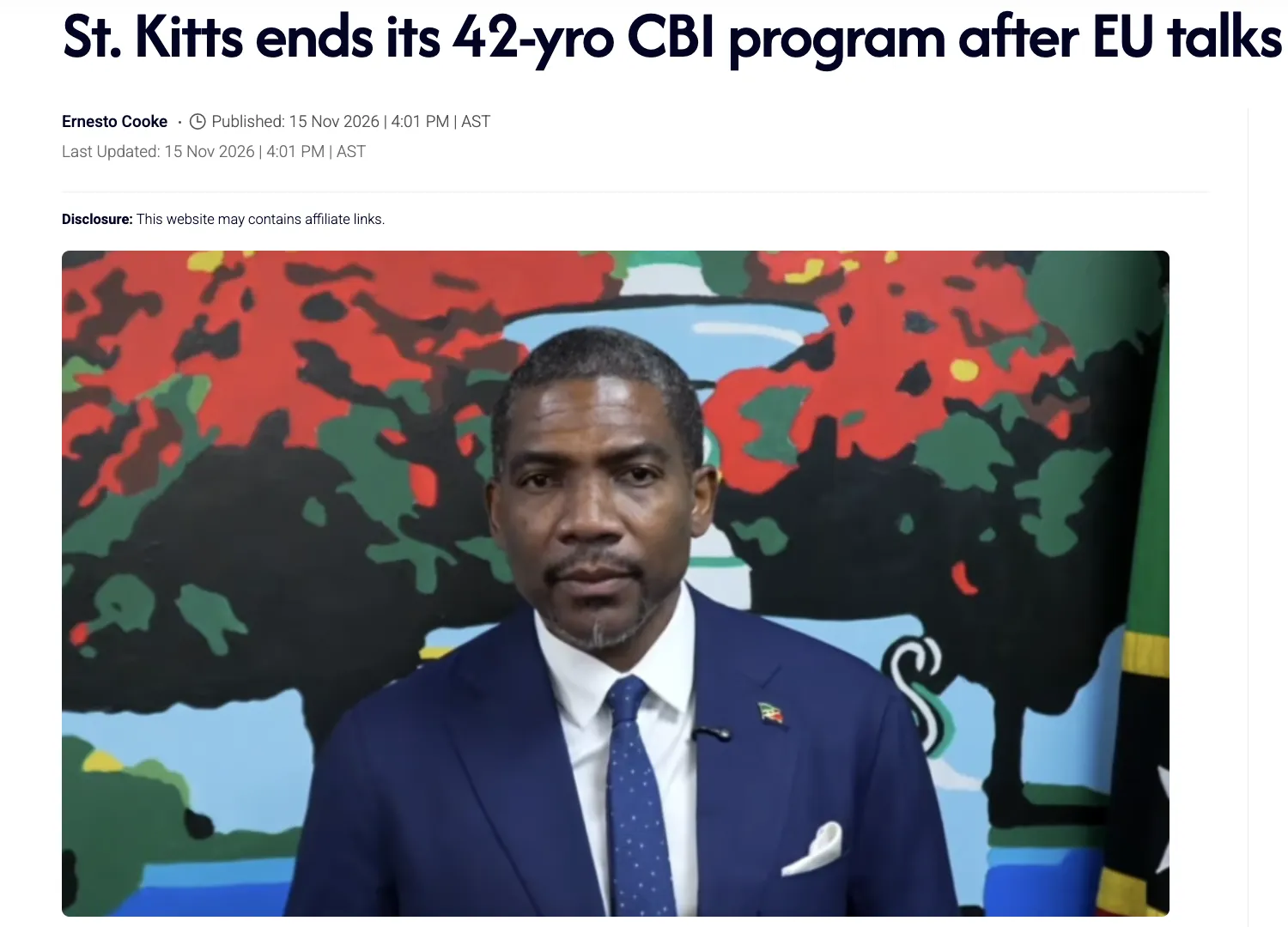
The government of St. Kitts and Nevis has decided to phase out the citizenship-by-investment program, which has been in place since 1984. Prime Minister Terrence Drew announced this on November 13, 2026, explaining that the decision was necessary to maintain international trust, visa-free access to other countries, and the stability of the national banking system.
According to the head of government, the country has already informed its European partners of its intention to discontinue the program. Its gradual phase-out will take place during a transition period agreed upon with the European Union. The St. Kitts and Nevis initiative was the world’s oldest program of its kind.
How “Golden Passports” Affected the Country’s Economy
The citizenship-by-investment program was launched after the country gained independence. Its legal basis was the 1983 Constitution and a law passed in 1984.
Initially, the initiative was limited in scope, but following the 2008 global financial crisis and the closure of the national sugar industry, its role in the economy grew significantly.
Between 2008 and 2025, the program generated approximately 6.5 billion East Caribbean dollars for the state. This accounted for roughly half of all federal budget revenues. The funds were directed toward the construction of roads, schools, and affordable housing; the building of a new high school in the capital, Buster; and economic recovery following the pandemic.
At the same time, as the program expanded, problems with oversight intensified. Prime Minister Terrence Drew stated that systemic violations and management failures had jeopardized the country’s reputation.
Widespread Violations and Attempts to Reform the Program
Among the problems, the head of government cited the aggressive underestimation of investment costs, which began in 2017, as well as abuses during the implementation of the prison construction project in 2021.
According to him, as part of this initiative, more than 5,000 citizenship quotas were illegally allocated at a price of $60,000 instead of the statutory minimum of $175,000. In addition, thousands of applications that had not undergone proper vetting were routed through international channels. This raised security concerns among foreign partners and posed risks to the preservation of the visa-free regime.
After taking office in August 2022, the Drew administration launched a large-scale reform of the system. The country established independent oversight bodies, introduced criminal liability for underreporting investment amounts, and raised the minimum investment threshold to $250,000.
A regulatory body for citizenship-by-investment programs in the Eastern Caribbean (SIRA) was also established. As part of the reforms, background checks on citizenship applicants were tightened, and the mandatory collection of biometric data was introduced. All individuals who obtained citizenship through this program must complete the required registration by July 2027.
These measures helped preserve visa-free travel to the United Kingdom and European countries, as well as partially restore visa-free access to Canada. However, subsequent changes in European legislation have cast doubt on the future of the program itself.
Why the Country Decided to Abandon “Golden Passports”
In December 2025, the European Union adopted new legislation under which the existence of citizenship-by-investment programs became grounds for revoking visa-free entry to the Schengen Area.
In June 2026, the European Commission officially proposed that St. Kitts and Nevis begin negotiations on the phased termination of this practice.
Prime Minister Terrence Drew emphasized that rejecting the EU’s proposal could pose an existential threat to the country’s economy. Maintaining the visa-free regime and the trust of international partners, he said, has become more important than the continued operation of the program, which for decades has provided a significant portion of budget revenue.
Source: St. Vincent Times
As a reminder, Argentina is preparing to sell citizenship for $500,000.
Renouncing a U.S. passport could result in a ban on entry into the United States.
In the U.S., the number of approved applications for citizenship during the first eight months of 2026 fell by 72% compared to the same period in 2025.




