
Territories, Guarantees, and a Ceasefire—Why the Abu Dhabi Talks Have Reached an Impasse
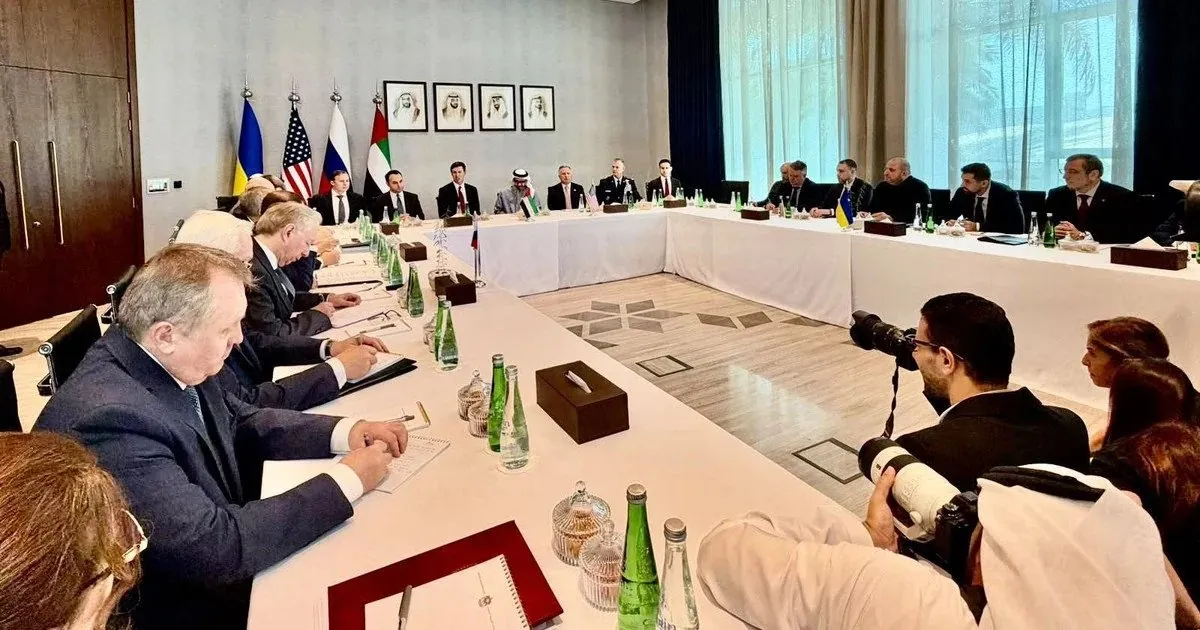
The two-day talks between Ukraine, the U.S., and Russia in Abu Dhabi concluded without any significant progress on the key issues related to ending the war. The parties were unable to bridge their differences regarding Ukrainian territories, future security guarantees, and a ceasefire. At the same time, the participants tentatively agreed on a large-scale exchange of prisoners of war.
The meetings took place on November 10 and 11 in the capital of the United Arab Emirates. According to Forbes, no agreement was reached on any of the three key issues—territorial matters, security guarantees, and the cessation of hostilities. Representatives from Ukraine, the United States, and Russia participated in the talks. The U.S. side was represented by U.S. Special Envoy Steve Witkoff and Jared Kushner. The Ukrainian delegation was led by Rustem Umerov, Secretary of the National Security and Defense Council, while the Russian delegation was led by Vladimir Medinsky, an aide to Vladimir Putin.
Representatives of European countries, the European Union, and NATO also held separate meetings with the American and Ukrainian sides. However, they did not participate directly in the trilateral talks. After the meetings concluded, Umerov acknowledged that significant differences remain between the parties’ positions. According to him, the participants were able to clearly state their demands, but there is still a great deal of difficult work ahead.
The territorial issue remains the main obstacle
One of the biggest points of contention is Moscow’s demands regarding Ukrainian territories. Russia continues to insist that Ukraine relinquish control over the Donetsk, Luhansk, Zaporizhzhia, and Kherson regions. This applies not only to territories occupied by the Russian army but also to areas that remain under Ukrainian control.
Kyiv does not agree to such conditions. The Ukrainian side insists that any decisions must respect the country’s sovereignty and territorial integrity. President Volodymyr Zelenskyy has previously emphasized that Ukraine cannot simply hand over its lands to Russia. During the negotiations, the Russian delegation showed no willingness to abandon its territorial claims. Consequently, the parties’ positions on this issue remain far apart.
Kyiv, for its part, advocates for a cessation of hostilities along the current front line. However, this approach does not imply recognition of the occupied territories as Russian. The very question of the future status of these lands remains one of the most complex issues in the negotiations.
Security guarantees—another unresolved issue
No agreement has been reached on how Ukraine should be protected after the war ends. Kyiv insists on reliable and legally binding guarantees that will help prevent a new Russian attack. Ukraine wants not just political promises, but concrete commitments from its partners. These commitments must specify what assistance the country will receive in the event of renewed Russian aggression and exactly how its allies will respond to the threat.
Zelenskyy has previously stated that U.S. security guarantees must remain in effect for at least 20 years. At the same time, Moscow opposes Ukraine’s accession to NATO and is advancing its own demands regarding the future security architecture in Europe. The U.S. has been trying to find a formula that could serve as the basis for an agreement. Among the approaches discussed was a model under which the allies would hold consultations in the event of a threat to Ukraine’s security. It resembles the mechanism provided for in Article 4 of the North Atlantic Treaty.
However, this time the parties did not agree on the specific nature of the guarantees or who would be responsible for their implementation. Therefore, the issue of Ukraine’s security after the war remains unresolved.
No ceasefire has been agreed upon yet
Another area where no progress was made is the cessation of hostilities. Moscow refuses to agree to a ceasefire without prior agreement on the next steps and the general conditions for ending the war. On November 10, Russian Foreign Minister Sergey Lavrov stated that Moscow does not want to agree to “yet another ceasefire” unless it understands what will happen afterward. He also insisted that future security guarantees must be defined first.
Past experience also offers no grounds to believe that Russia is prepared to honor agreements. In particular, Moscow violated the energy ceasefire agreement in March 2025 and the temporary Easter ceasefire agreement in 2026. Separately, the parties agreed to a local ceasefire in the area of the temporarily occupied town of Oleshky in the Kherson region. It was in effect from October 27 to November 1 and allowed for a humanitarian mission to assist civilians and evacuate those wishing to leave. However, efforts to extend this ceasefire were unsuccessful.
Thus, following the meetings in Abu Dhabi, no agreement on a general ceasefire was reached. Russia did not agree to proposals that could have served as the basis for halting hostilities.
The only concrete result was an agreement on a prisoner exchange
Despite the lack of a breakthrough on political and security issues, the talks yielded results on the humanitarian front. Ukraine, Russia, and the United States have tentatively agreed to a large-scale prisoner exchange. Among the possible options mentioned were “1,000 for 1,000” or even “1,500 for 1,500.” President Volodymyr Zelenskyy reported that the parties had discussed these figures as early as the first day of the meetings. The final number of people and the practical details of the exchange were to be agreed upon separately.
Both the head of the Ukrainian delegation, Rustem Umerov, and the Russian representative, Vladimir Medinsky, reported that an agreement in principle had been reached. U.S. envoy Jared Kushner also cited the future release of prisoners as one of the positive outcomes of the meetings. However, by the time the talks concluded, no specific date for the exchange or a final list of individuals had been made public. Therefore, this remains a preliminary agreement that still needs to be implemented.
What Comes Next After the Abu Dhabi Meetings
Following the talks, U.S. representatives Steve Witkoff and Jared Kushner traveled to Moscow, where they met with Vladimir Putin on November 12. They discussed the results of the Abu Dhabi meetings and next steps to continue the negotiation process. After the meeting, Witkoff announced an agreement to hold a new round of trilateral talks. According to him, representatives from European countries are expected to join the next meeting. This could mark a significant change in the format, as Europe has not previously participated directly in the main trilateral meetings.
After Moscow, the American envoys were scheduled to travel to Dublin, where a meeting with Volodymyr Zelenskyy is planned. They are to brief the Ukrainian president on the results of their conversation with Putin and discuss further diplomatic steps.
Thus, the talks in Abu Dhabi did not bring the parties any closer to an agreement on ending the war. Russia’s territorial claims, future security guarantees for Ukraine, and a ceasefire remain unresolved. So far, the only concrete result has been preliminary progress on the issue of prisoner exchanges, and the next round of talks should reveal whether Moscow is ready to change its position. Forbes reports on this.
During the talks in Abu Dhabi that took place the day before, the Russian side stated that it did not have the authority to discuss de-escalation in the Black Sea or a halt to strikes on Ukraine’s energy infrastructure. Instead, Russia intends to continue striking Ukrainian territory.
Zelenskyy summarized the results of the first day of the trilateral talks in Abu Dhabi.
Talks in Abu Dhabi: What security guarantees can Ukraine expect?
Talks in Abu Dhabi: What Will Be Discussed on the Second Day and What Results Are Expected.




