
Gun manufacturers are asking the government to change the reservation rules

Defense companies are warning of the risk of losing engineers, designers, and other specialists due to new conscription rules. The National Association of Defense Industry Enterprises of Ukraine (Naudi) has appealed to Prime Minister Serhiy Koretsky to change the procedure for granting deferments. Among the main demands are to automatically extend existing exemptions until February 1, 2027, and to allow certain defense industry enterprises to exempt up to 100% of their employees subject to military service.
Naudi has called on the government to immediately review the rules for reserving employees in the defense industry. The association believes that the new requirements create additional difficulties for enterprises that manufacture weapons and fulfill state defense contracts. The appeal was prompted by Cabinet of Ministers Resolution No. 1328 of October 23, 2026. It changed the procedure for designating enterprises as critically important and provided for the creation of a Coordination Center for the organization of reserving employees subject to military service.
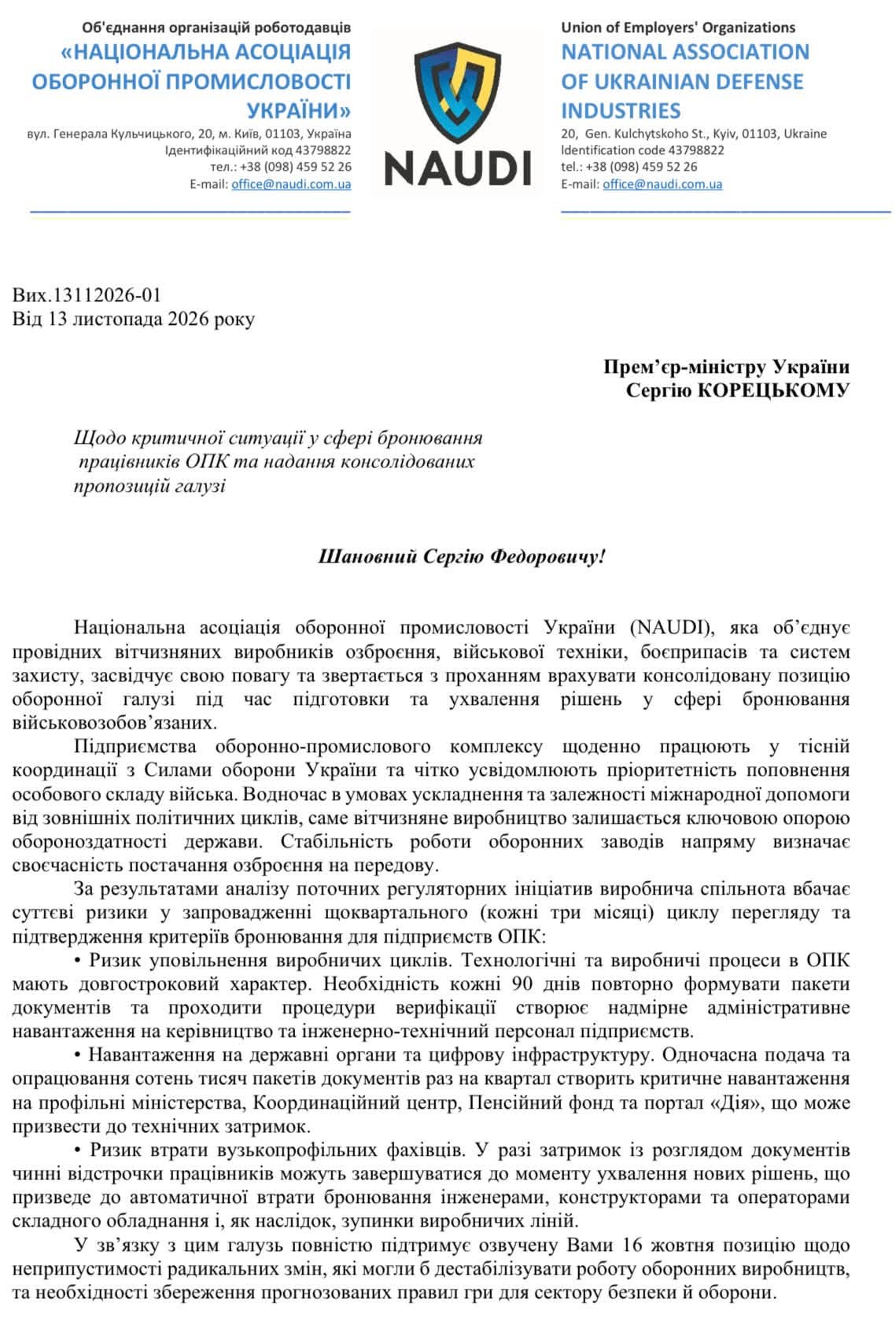
The association is requesting that a transition period be established so that companies can navigate the new procedures without the risk of losing employees. Specifically, it proposes automatically extending until February 1, 2027, the “critically important” status for enterprises whose current designation expires on or before December 31, 2026. Naudi proposes applying the same extension to deferrals for employees who have already been reserved through the “Diya” portal. This should help avoid a situation where the previous reservation period has already ended but a new decision has not yet been made.
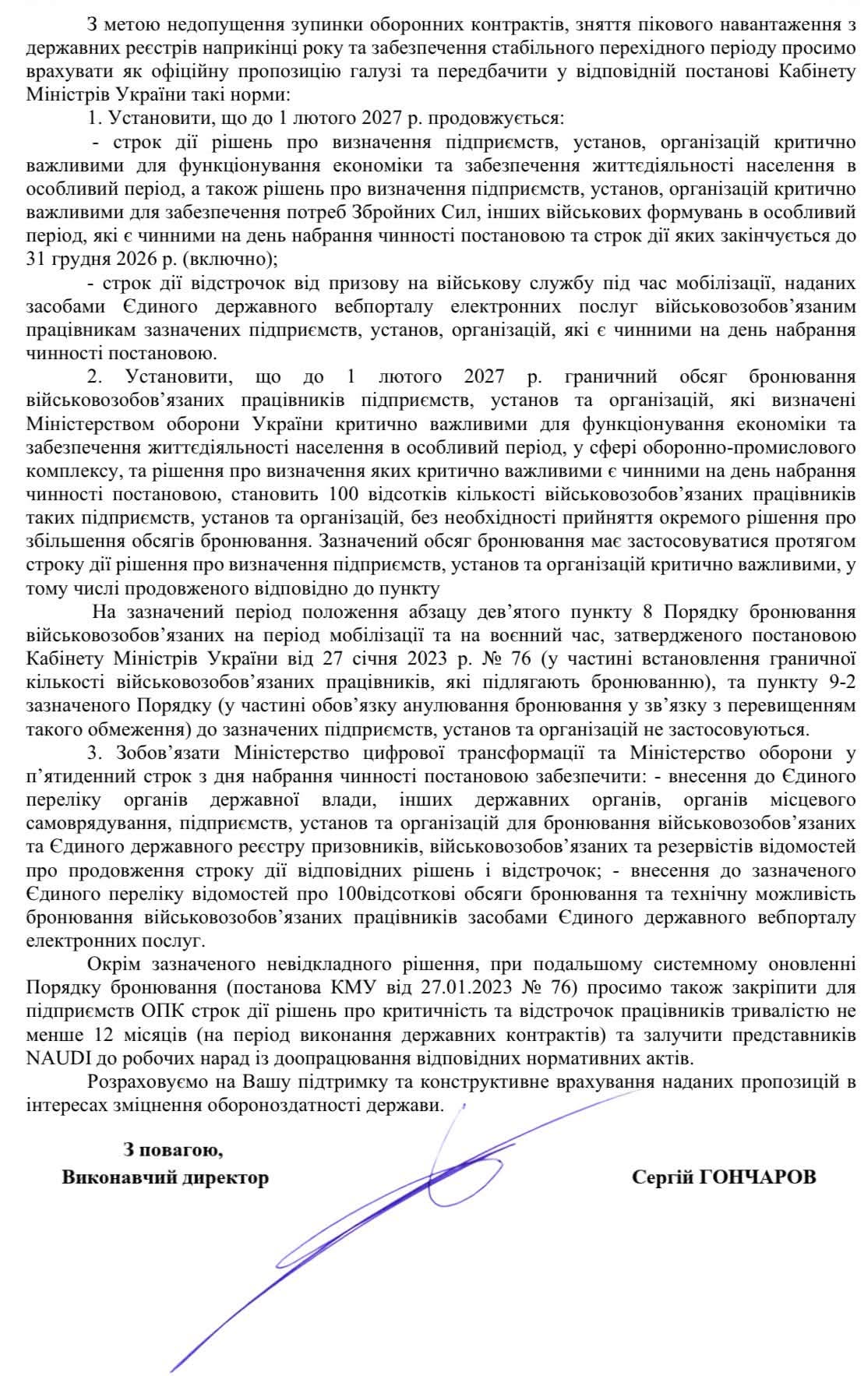
Another proposal concerns the number of employees that defense enterprises can reserve. Naudi insists that for defense industry companies designated as critically important by the Ministry of Defense, the reservation limit should be 100% of personnel subject to military service. According to the association’s proposal, such enterprises should be able to reserve all eligible employees without requiring additional approval to increase limits or undergo procedures to revoke deferrals due to quota overages.
In addition, arms manufacturers are proposing a revision of the general conscription procedure approved by Cabinet of Ministers Resolution No. 76. Specifically, they want the status of a critically important enterprise and the deferrals for its employees to remain in effect for at least 12 months. According to the association, this would make it possible to plan production and fulfill government contracts without the constant risk of personnel changes.
Why Defense Companies Are Concerned About the New Rules
One of Naudi’s main concerns is the need to regularly undergo procedures to confirm the status of a critical enterprise. The association explains that weapons production requires long-term planning, and the constant preparation of documents takes time away from managers, engineers, and other employees. Of particular concern is the requirement to resubmit documentation packages every 90 days. According to industry representatives, this creates an additional administrative burden and distracts staff from their core work.
Another risk is potential delays in the work of government agencies and digital services. If companies submit a large number of applications at the same time, the relevant ministries, the Coordination Center, the Pension Fund, and the “Diya” portal may not be able to process them in time. In that case, employees may not receive new deferrals on time. If the advance reservation period expires before a new decision is made, a person risks losing protection from mobilization.
The biggest problem, according to Naudi, is the potential loss of highly specialized professionals. This includes engineers, designers, and operators of complex equipment. Their work directly impacts production processes, and finding replacements for them quickly may be difficult. The association warns that if such employees lose their exemptions, certain production lines could come to a halt. This, in turn, would create the risk of delays in fulfilling government defense contracts.
What the Prime Minister Said Earlier
On October 16, Serhiy Koretskyi stated in the Verkhovna Rada that the government is reviewing the reservation system due to cases of abuse. According to him, the ability to reserve 100% of a company’s staff allows certain enterprises to artificially inflate their headcount and grant deferrals to people who do not, in fact, perform critically important tasks. At the same time, the prime minister assured that no radical changes are planned for truly critical enterprises in the defense and energy sectors. He emphasized that the government must strike a balance between the needs of the Armed Forces and the uninterrupted operation of industries vital to the state.
Naudi stated that it supports this approach. At the same time, the association is asking the government to take its proposals into account during further refinement of the rules. Manufacturers also want their representatives to be included in working meetings where changes to the reservation procedure will be discussed. Currently, Naudi’s proposals constitute a request to the government rather than adopted legislative amendments. The final decision on them must be made by the Cabinet of Ministers, according to Naudi.
The Cabinet of Ministers of Ukraine has prepared a draft act regarding a transition period for businesses in connection with the update to the rules for obtaining and confirming the status of a critically important enterprise. The document provides for the automatic extension of critical enterprise status until February 1, 2027, for those companies whose status expires in November–December 2026.
Earlier, Prime Minister Serhiy Koretskyi stated that the government would review the criteria for determining critical enterprises, and that 100% conscription would no longer be automatic, even for the energy and defense industries.
The Cabinet of Ministers of Ukraine established a Coordination Center for the mobilization of conscripts, clarified the definition of critical enterprises, and instructed officials to review sectoral and regional criteria. The government also updated the maximum mobilization quotas for certain categories of enterprises.




