
Russia has carried out nearly 5,800 attacks on Ukraine's power grid
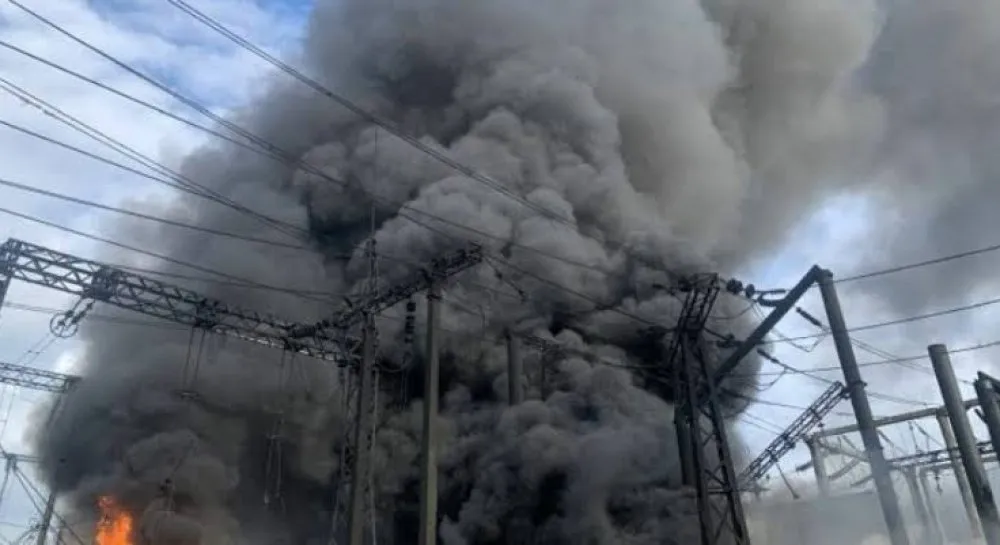
As of February 2026, Russia had carried out 5,796 strikes on Ukraine’s energy grid. These figures are cited in the Green Deal Ukraine report “Energy Resilience by Design: Ukraine’s Wartime Experience and Lessons for the EU,” presented during the organization’s annual conference in collaboration with the Kyiv Energy and Climate Lab.
According to the report, at the height of Russian attacks in the winter of 2025–26, available conventional generation capacity dropped to 10.5–12 GW, with an estimated peak load of approximately 18 GW. The report notes that despite widespread destruction, the Ukrainian power grid continues to function thanks to a combination of infrastructure protection measures, rapid restoration of damaged facilities, strategic equipment reserves, and the efforts of energy sector workers.
The authors of the report—Green Deal Ukraine project manager Susanna Nies, director of the Center for Energy Research Oleksandr Kharchenko, Vladislav Mikhnych, Director of the Kyiv Energy and Climate Lab; and Clemens Stieve, a consultant for Green Deal Ukraine—have identified 23 risks to the energy system based on Ukraine’s experience during a full-scale war. They also analyzed the extent to which the draft of the new EU regulation on energy security addresses these risks: the document fully addresses four of them, partially addresses eleven, and does not address seven. Another risk, related to financing the reconstruction of Ukraine’s energy sector, falls outside the scope of this document.
“The main focus of this study is to understand future challenges and how we can make both the European and Ukrainian energy systems and critical infrastructure more resilient and effective against various threats that may arise in the near future,” Kharchenko noted during the conference.
The report identifies six key areas for ensuring energy resilience: threat assessment and crisis management; critical infrastructure protection; strategic equipment reserves and rapid recovery; decentralization and the ability to operate in island mode; communication with the public; and funding for resilience-building measures.
Among the key challenges, the authors cite an insufficiently clear division of responsibilities for crisis management and the allocation of limited resources among sectors, the high cost and lengthy construction times for passive protection, as well as insufficient coordination between active and passive protection of critical infrastructure.
Particular attention is paid to the shortage of critical equipment, the long lead times for its manufacture and delivery, and the lack of qualified personnel. According to estimates by the interviewees, on which the report is based, the personnel shortage at critical infrastructure facilities stands at 25–30%.
The authors also emphasize the need to develop decentralized power generation and the ability of individual parts of the power grid to operate in island mode. Despite the advantages of distributed energy resources, their potential to support the resilience of the power system is not yet being fully utilized.
Based on Ukraine’s experience, the authors recommend that the EU and its member states strengthen crisis management coordination, develop approaches to protecting critical infrastructure in line with threat levels, establish strategic reserves of key equipment, and improve mechanisms for financing resilience-building measures.
In addition, they propose establishing a continuous exchange of expertise between Ukraine and the EU on energy resilience through existing cooperation mechanisms, in particular the EU Electricity Coordination Group, so that Ukraine’s experience is taken into account when improving European regulations.
Source: Interfax-Ukraine
Starting on the night of November 3, one of the largest Russian attacks on Ukraine’s energy infrastructure continued, further complicating the situation in the national power grid.
Russia launched an attack on the critical infrastructure of the Khmelnytskyi NPP, according to Shmyhal.
The Russian strike damaged a power facility critical to the Khmelnytskyi NPP—Sybiga.




