
There may be another Earth-sized planet hidden in the Solar System
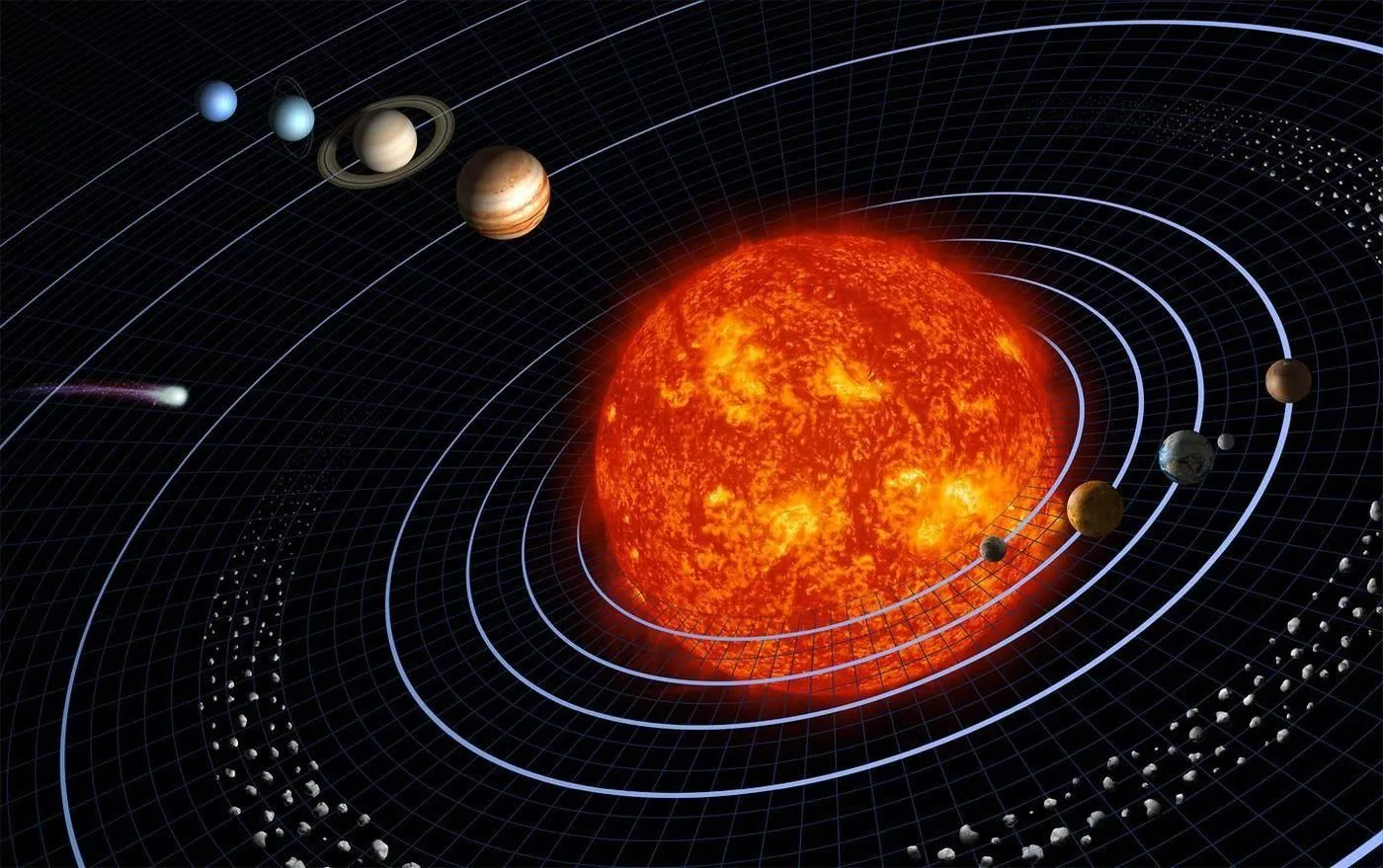
There may be an unknown planet on the outskirts of the Solar System, which researchers have named Planet X2. According to a hypothesis put forward by an international team of astronomers, its mass may be similar to that of Earth, and its gravitational influence could explain the unusual orbits of some icy objects beyond Neptune.
The study was published on November 23, 2026, in the journal Monthly Notices of the Royal Astronomical Society. Scientists suggest that Planet X2’s mass could range from one to two Earth masses, with the model best consistent with a mass of approximately two Earth masses.
According to calculations, the semi-major axis of the hypothetical planet’s orbit could be 350–500 astronomical units, and its closest point to the Sun—about 200 astronomical units. By comparison, Neptune is located about 30 astronomical units from the Sun. Thus, Planet X2 could be in a very distant and elongated orbit.
The researchers conducted computer simulations of the Solar System’s evolution over 4.5 billion years. The results showed that the gravity of such a planet could alter the trajectories of trans-Neptunian objects, cause significant inclinations in their orbits, and explain certain features of the motion of Sedna and the object 2012 VP113.
At the same time, the model does not account for all observations. In particular, discrepancies remain regarding the distribution of the semi-major axes of the orbits of distant objects recorded as part of the Dark Energy Survey. Therefore, the hypothesis requires further verification.
Planet X2 is also not identical to the hypothetical Ninth Planet, which astronomers have been searching for for a long time and which, according to preliminary assumptions, may be significantly more massive than Earth. The researchers acknowledge that both objects, only one of them, or neither may exist in the Solar System.
They plan to test the hypothesis using new observations from the Vera Rubin Observatory in Chile, which is designed to detect distant and faint celestial objects. In the future, the telescope could help not only confirm the predicted distribution of the orbits of icy bodies but also directly detect Planet X2, if it exists.
Source: a study in *Monthly Notices of the Royal Astronomical Society*.
In the U.S., NASA has issued a request for proposals to develop a 20-kilowatt nuclear reactor for the Moon, which is expected to be ready for launch by 2030.
The Hera spacecraft took the first close-up photos of the asteroid Dimorph after its collision with the DART spacecraft, which took place in 2022 at a distance of 194 million kilometers from Earth. At that time, NASA deliberately directed the spacecraft toward the celestial body, which was about 150 meters wide, to test the possibility of altering an asteroid’s trajectory.
The HiRISE camera aboard NASA’s Mars Reconnaissance Orbiter captured unusually orderly, curved rows of light-colored boulders in the Dedalia Planum region of Mars.




