
The Main Intelligence Directorate explained what types of aircraft Russia is using in the war and how it is making up for its losses
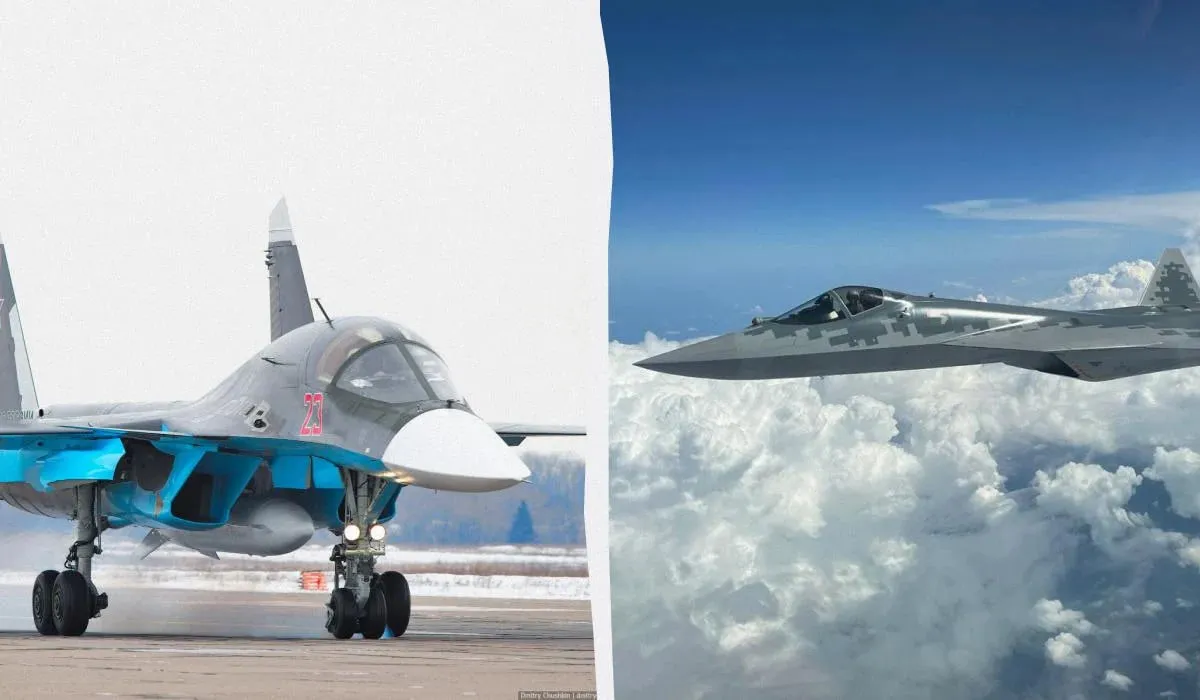
Russian combat aviation retains significant capabilities for carrying out combat missions; however, not all aircraft can be immediately deployed on combat sorties. Part of the fleet is undergoing repairs, being modernized, or has a limited service life.
According to the Main Intelligence Directorate of the Ukrainian Ministry of Defense, Russia may be expanding its fleet of modern tactical aircraft. At the same time, every irreplaceable loss of older bombers leads to a long-term reduction in its combat potential.
According to estimates by the Main Intelligence Directorate of the Ukrainian Ministry of Defense, as of the end of 2025, Russia had approximately 125 Cy-34 and Cy-34M aircraft, 140–145 Cy-30M2, Su-30SM, and Su-30CM2 aircraft, 135–140 Su-35S aircraft, and about 20 Su-57 aircraft.
"It is important to note that these figures reflect only estimates of the fleet, not the guaranteed number of aircraft that Russia can simultaneously deploy for combat missions. The exact current number of aircraft depends on deliveries and losses throughout 2026; this data is not currently being disclosed. Regarding losses of Russian military aircraft in 2026, we can speak of specific instances of aircraft being destroyed or critically damaged,” the intelligence agency noted.
According to the Main Intelligence Directorate, the confirmed incidents include:
the crash of a Tu-22M3 in the Irkutsk region on June 15;
the downing of a Su-35 in the eastern sector on July 8, as claimed by the Ukrainian military, which is corroborated by published materials showing aircraft debris;
- the downing of two Tu-95MS aircraft in Engels on July 17 and August 28. Regarding the first aircraft, critical damage to the tail section has been reported. The nature of the damage to the second aircraft suggests it is likely a total loss;
the crash of a Su-57 in the Moscow Region on July 23 and the collision of two Su-35S aircraft over the Kursk Region on September 7. Full official details regarding these incidents remain unavailable.
In addition, there are reports of several Su-57s and one Su-34 being hit at Shagol on April 25, as well as a Su-24 in Crimea on September 7. The current status of these aircraft is unknown, so it is premature to classify them as destroyed.
Aircraft Production in Russia
Intelligence sources have noted that Russia continues serial production of modern tactical aircraft, which allows it to partially offset losses and renew its fleet.
From 2022 to 2024, there was a continuing trend toward increasing the supply of Su-34 aircraft. Specifically, 8 aircraft were delivered in 2022, 11 in 2023, and 12–14 in 2024. However, while this trend indicates an increase in volume during that period, it does not confirm that the same pace is being maintained today.
It is likely that Russia can currently supply approximately 10–15 aircraft per year.
"For the Su-35S, the historical average delivery rate for 2021–2025 was approximately 11–12 aircraft per year. At present, this figure should be considered an approximate guideline rather than a fixed production volume for 2026. Production of the Su-30SM2 and Su-57 continues. It is currently impossible to determine reliable production rates. For the Su-30, it is also necessary to distinguish between the manufacture of new aircraft and the modernization of existing Su-30SMs. There is no serial production of new Su-24s, Tu-95s, or Tu-22MZs. The fleet of these aircraft is maintained through repairs and modernization,” the intelligence report states.
Thus, as emphasized by the Main Intelligence Directorate, the Kremlin has the ability to replenish its modern tactical aviation fleet, whereas for older bombers, every irreplaceable loss results in a long-term reduction in capability.
The main production facilities are concentrated at several enterprises
For example, the Su-34 is manufactured at the V. Chkalov Novosibirsk Aviation Plant, and the Su-30CM/CM2 at the Irkutsk Aviation Plant.
Production of the Su-35S and Su-57 is handled by the Yuri Gagarin Komsomolsk-on-Amur Aviation Plant (KnAAP). This facility serves as the primary assembly site for both types of fighters.
As for the Su-24, its serial production has not been confirmed; currently, they are only being repaired.
Russian Air Force Airfields
Intelligence sources explained that Russia uses an extensive network of airfields for permanent basing, training, testing, and temporary deployment of its aircraft. However, the redeployment of aircraft alters their actual composition at any given airfield.
For example, the main known airfields for the Su-34 are Baltimore in the Voronezh Region, Morozovsk in the Rostov Region, Shagol in the Chelyabinsk Region, and Khurba in the Khabarovsk Territory. The Su-30SM/SM2 is associated with Domna in the Trans-Baikal Territory, Millerovo in the Rostov Region, and Chernyakhovsk in the Kaliningrad Region.
For the Su-35S, known bases include Dzhemgi Airfield in the Khabarovsk Krai, Central Ugolova in the Primorsky Krai, Besovets in Karelia, and Khotilovo in the Tver Oblast.
For the Su-57, key locations remain Akhtubinsk, where testing is conducted, and the Dzhemgi factory airfield. The presence of these aircraft at Shagol is mentioned in reports from April 2026, but this does not confirm that they are permanently based there.
The Su-24 is associated with the airfields at Gvardeyskoye and Saki in occupied Crimea, as well as Monchegorsk in the Murmansk Oblast, particularly for reconnaissance variants.
Russian Air Force Weapons Inventory
Regarding the range of weapons used by Russian Armed Forces aircraft, Ukrainian intelligence reports that it depends on the aircraft variant, the installed equipment, and the level of modernization. Therefore, the capabilities of individual aircraft of the same type may vary.
Su-34s can deploy FAB-500 bombs, FAB-1500, and FAB-3000 bombs with UMPK glide and correction modules, as well as KAB-500/1500 guided bombs and Kh-29, Kh-31P, and Kh-59 missiles. R-73 missiles are used for self-defense; the internal armament consists of a 30-mm GSh-30 cannon; the Su-30SM/SM2 uses R-73, R-27, and R-77-1 air-to-air missiles. For appropriately modernized Su-30SM2s, the possibility of using the R-37M has been described. Strike armament includes missiles from the X-29, X-31, and X-59 families, as well as guided and unguided bombs. The aircraft are equipped with a GSh-30-1 cannon.
The Su-35S can employ the R-73, R-77-1, and R-37M missiles, as well as attack missiles from the Kh-29, Kh-31, and Kh-59 families, and guided and unguided bombs. The GSh-30-1 is a built-in weapon system.
For the Su-57, the announced and publicly described arsenal includes the P-74M2, P-77M, X-38M, X-69, X-58USHK, guided bombs, and a 30-mm cannon. The readiness of all these configurations for each production aircraft remains unconfirmed.
The Su-24M/M2 can use the X-25, X-29, and X-58, and, on appropriately equipped aircraft, the X-59. They also employ guided and unguided bombs, unguided missiles, and the 23-mm GSh-6-23 cannon. Reconnaissance Su-24MRs have a different mission and are considered separately.
This was reported by the Main Intelligence Directorate of the Ministry of Defense of Ukraine in response to a request from UNIAN.
The Main Intelligence Directorate revealed the foreign components of Russia’s Kometa navigation modules.
Previously, Ukraine’s military intelligence published information on 20 seagoing vessels that transport Russian oil, petroleum products, and liquefied natural gas (LNG) and provide bunkering services to the sanctioned fleet. All of them are subject to sanctions by the United Kingdom or Ukraine, and one of the vessels is also subject to U.S. restrictions.
The number of ships flying the Russian flag increased by more than a third from January 2025 to June 2026. This is happening against the backdrop of mounting international pressure and the fight against the so-called “shadow fleet,” according to a study by the Center for Energy and Clean Air Research.




