
Ukraine is expanding its fortifications, reducing Russia's chances of a rapid breakthrough — OSINT analyst

OSINT researcher Clément Molen notes that with each passing year of the war, it is becoming more difficult for Russian troops to break through into the operational area due to the expansion of Ukrainian defensive fortifications.
On his new map, he has marked fortifications from various periods of construction. Fortifications built by 2024 are shown in yellow. Russian troops have captured some of them, but now these fortifications are also hindering their further advance.
Orange indicates lines built in 2025, incorporating new approaches to fortification. According to the researcher’s assessment, Russian troops have not reached most of these lines. Red indicates fortifications built in 2026.
According to Molen, the main construction work is currently underway in the Pavlohrad, Izyum, and Kharkiv areas, as well as in the Chernihiv and Kyiv regions. In some sectors, construction has slowed due to the front line shifting or the high level of readiness of the defensive structures.
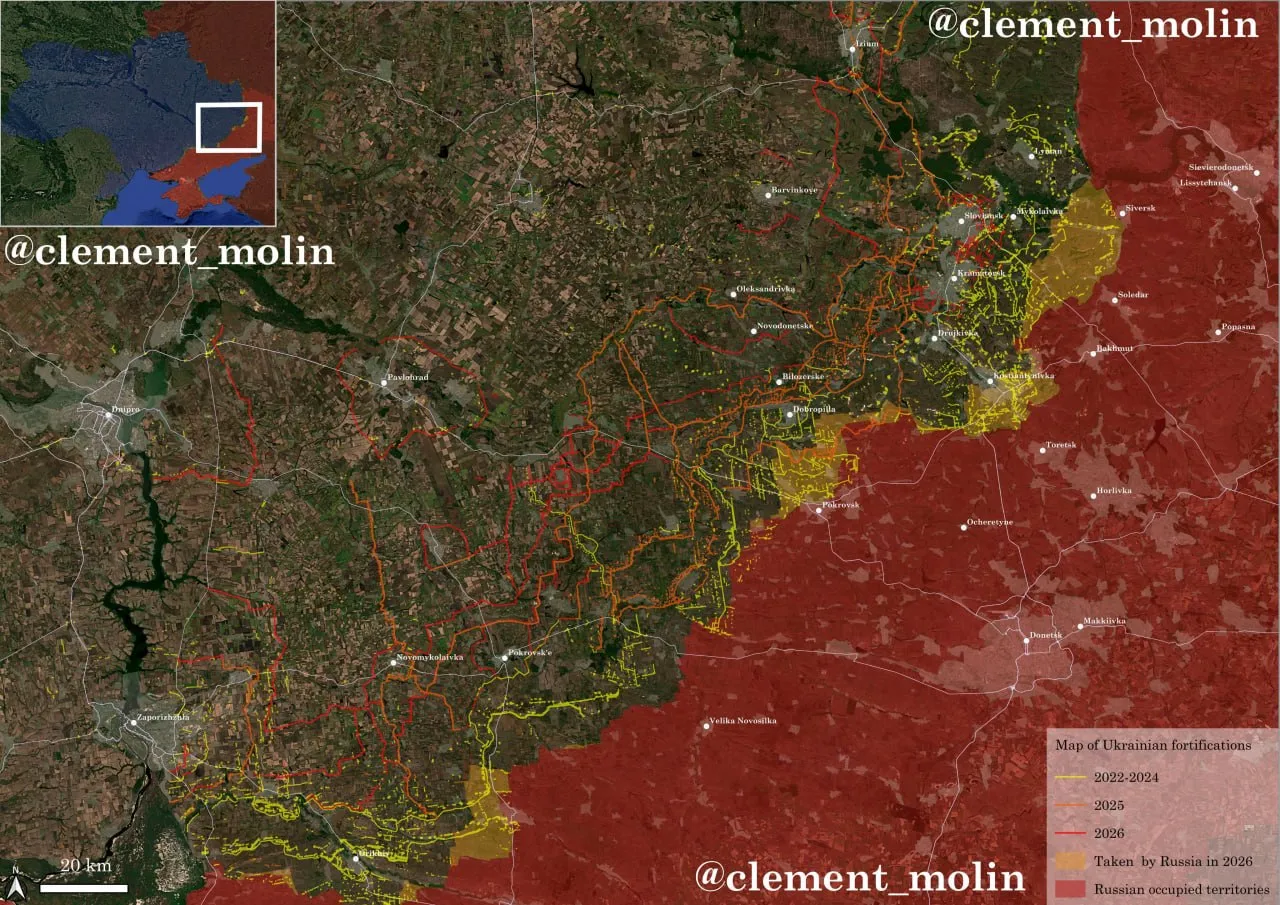
Near the front lines, Ukrainian troops are also setting up additional anti-personnel barriers made of barbed wire. At the same time, the researcher notes the absence of any noticeable similar work on the expansion of Russian fortification systems.
Source: Clément Molen / X
The Russian military is training specialized units to conduct combat operations underground. Meanwhile, fighters from the 13th Brigade of the Ukrainian National Guard, “Charter,” are already engaging Russian forces in old Soviet gas pipelines near Kupiansk in the Kharkiv region.
In addition, Russian occupation forces are advancing in the Donetsk region near two settlements—Rai-Oleksandrivka and Vilne.
Over the past 24 hours, on October 22, there were 165 combat engagements on the front lines. Among the specified sectors, Russian troops carried out the largest number of attacks in the Pokrovsk sector, where 15 assaults were recorded.




