
Russia is developing a new warhead for the Kinzhal missile
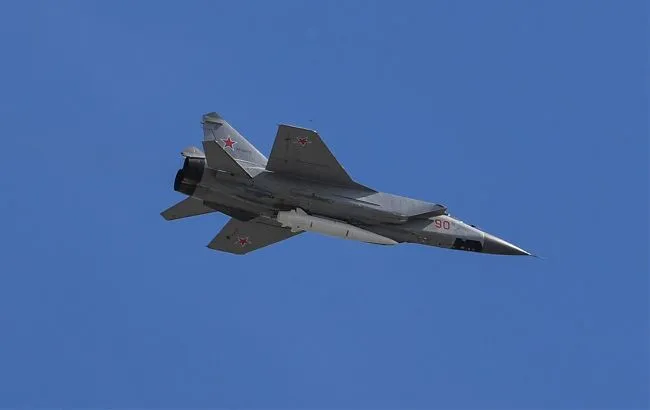
Russia is working on a new variant of the “Kinzhal” aeroballistic missile. They plan to equip it with a high-explosive fragmentation warhead. According to Ukrainian intelligence, these changes may be related to the missile’s accuracy issues and Russia’s limited capabilities to produce and launch such munitions.
Ukrainian intelligence has also published an interactive 3D model of the missile, information about its components, and the companies involved in its production. The materials were posted on the “War&Sanctions” portal.
The missile in question is the Russian 9-S-7760 aeroballistic missile, known as the Kh-47M2 “Kinzhal.” According to the Main Intelligence Directorate (GUR), it is a single-stage solid-fuel missile with an integrated warhead. In terms of components, it is approximately 90% identical to the 9M723 ballistic missile of the “Iskander-M” system.
How the “Kinzhal” Differs from the “Iskander”
Despite significant similarities, the “Kinzhal” has several differences. Among them are a tail fairing that separates after engine ignition, a radar homing seeker, and an active jamming unit.
In addition, the missile is equipped with an S-200 decoy launch system. These measures are designed to counter detection and interception systems.
Which warhead is they want to change
According to the Main Intelligence Directorate (GUR), the “Kinzhal” currently has two types of warheads. The first is a penetrating high-explosive warhead housed in a sturdy metal casing. It is designed to penetrate ceilings, concrete, and other fortified structures. The second type is a special warhead, which may be nuclear. Russia is now working on a variant with a high-explosive fragmentation warhead. Unlike the penetrating warhead, it is designed to destroy targets with an explosion and shrapnel.
The Main Intelligence Directorate (GUR) speculates that this change may be related to accuracy issues with the “Kinzhal.” Accuracy is particularly important for a penetrating warhead, as the missile must hit a specific fortified structure.
At the same time, intelligence reports indicate that in 2026, Russia significantly reduced the volume of its state defense order for the “Kinzhal.” According to the GUR, part of the production capacity, components, and raw materials were redirected toward the production of 9M723 ballistic missiles for the “Iskander-M” system.
Russia has limited capabilities for launching “Kinzhal” missiles
The GUR cites the limited number of aircraft capable of launching these missiles as another reason for the shift in production priorities. The primary carriers of the “Kinzhal” missiles are the MiG-31K and MiG-31I interceptor fighters. According to Ukrainian intelligence, the Russian aviation industry is not currently producing these aircraft.
Consequently, Russia’s decision regarding the continued production of “Kinzhal” missiles may be influenced by several factors at once: the missiles’ accuracy, the availability of components, and the capabilities of the aircraft from which they are launched. At the same time, the development of a new warhead does not in itself mean that Russia has already begun mass production of this variant. The Main Intelligence Directorate of the Ukrainian Ministry of Defense reported that Russia is working on a new variant of the “Kinzhal” missile.
In addition, Russian forces struck Dnipro. One person was killed in the attack, and the blast wave damaged the windows of a high-rise building.
Furthermore, Russian troops struck the logistics facilities of a postal operator in the south of the Odesa region. The attack damaged the building’s facade, windows, and equipment. According to preliminary reports, there were no casualties.
Over the past 24 hours, Russian forces carried out 817 strikes on 57 settlements in the Zaporizhzhia region. One person was wounded in Zaporizhzhia as a result of the enemy attack. There were also 47 reports of damage to residential buildings, vehicles, and infrastructure.
On the night of October 12, Russian troops launched several waves of attacks on Ukraine using rocket-powered drones. In Ivano-Frankivsk, three servicemen were killed as a result of the strike, and an infrastructure facility, an apartment building, and commercial premises were damaged.
Overnight, Russian troops attacked Izium in the Kharkiv region with S-8000 “Banderole” loitering munitions. As a result of the strike, one person was injured, and approximately 15 private homes and one apartment building were damaged. Power lines and internet connections were also damaged.
In Ochakiv, Mykolaiv Oblast, a 54-year-old woman was injured as a result of a Russian “Banderol” missile strike. Her condition is stable. A warehouse, four two-story apartment buildings, and one private home were also damaged.
In addition, three people were killed and nine others were injured as a result of a Russian missile strike on the outskirts of Kharkiv. Details regarding the circumstances of the attack and the condition of the victims have not yet been specified.
Earlier, Russia struck Kharkiv with KAB missiles, resulting in one fatality and several injuries.
On October 11, in the Bohodukhiv district of the Kharkiv region, Russian forces attacked a truck belonging to an agricultural enterprise with a drone. The driver was killed in the strike.
Russia also attacked Kharkiv and nine other settlements in the region, resulting in casualties.
As a reminder, search and rescue operations have been completed in Zaporizhzhia at the site of a Russian strike on a residential building that occurred on October 10. The attack killed 20 people, including four children, and injured 17 others.




