
British intelligence has assessed the consequences of Ukraine's three strikes on the Crimean Bridge

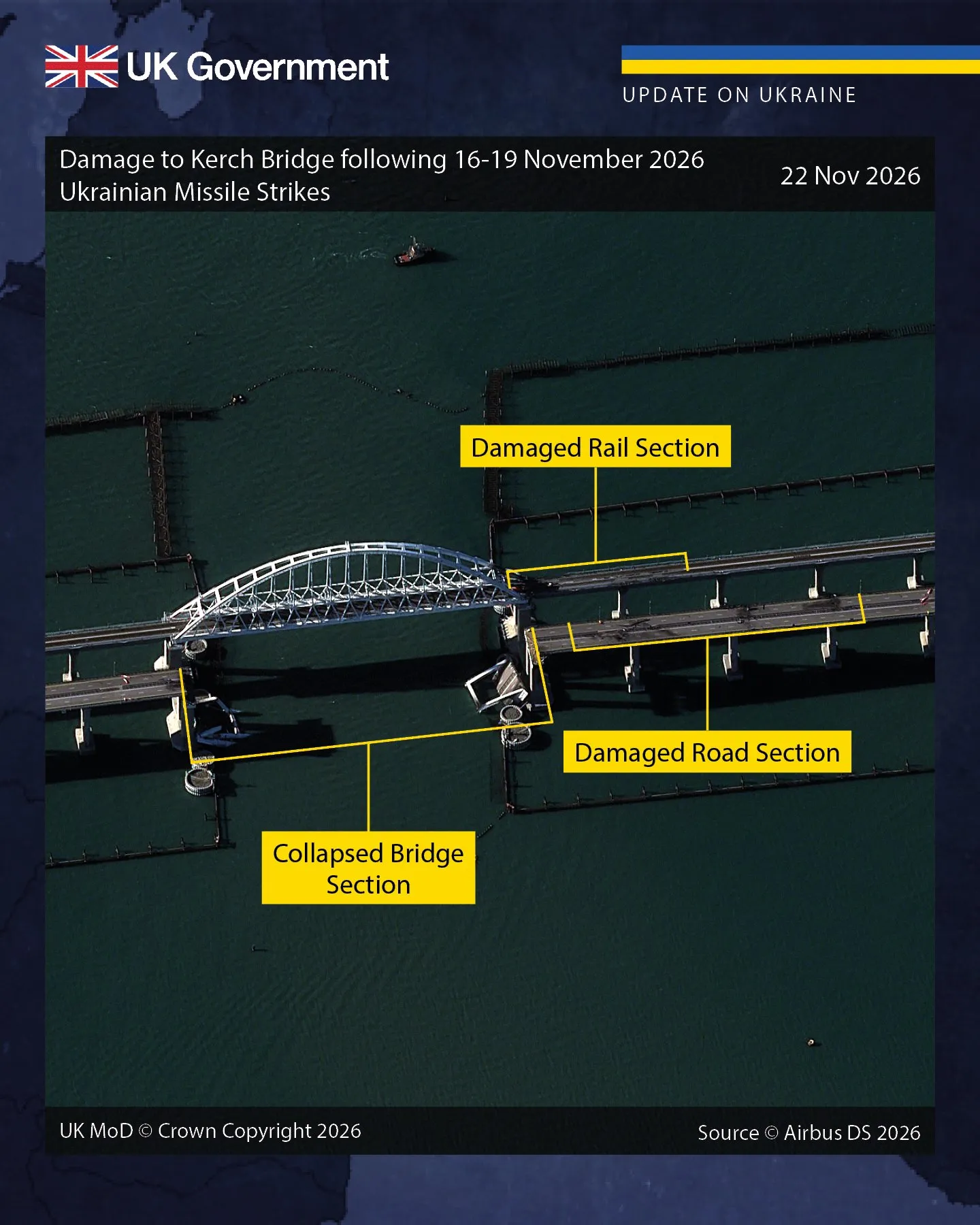
Ukrainian forces attacked the Crimean Bridge three times between November 16 and 19, 2026. As a result of one of the strikes, an arch section of the road bridge collapsed, which may also have blocked the passage of ships between the Azov and Black Seas.
According to British experts, the Ukrainian military used missiles and drones in the attacks. The road section of the bridge sustained the most serious damage on November 17 during the second strike. At that time, the arch section collapsed, rendering the bridge impassable to vehicular traffic. Crater marks were also found along a stretch approximately 200 meters long.
British intelligence notes that the collapse of the arch may have blocked passage for ships transiting between the Azov and Black Seas.
A third attack took place at midnight on November 19, this time targeting the railway section of the Crimean Bridge. Damage was recorded near the arch: the guardrails were damaged, and burn marks remained on the structure. At the same time, British intelligence suggests that one of the railroad tracks is likely still operational.
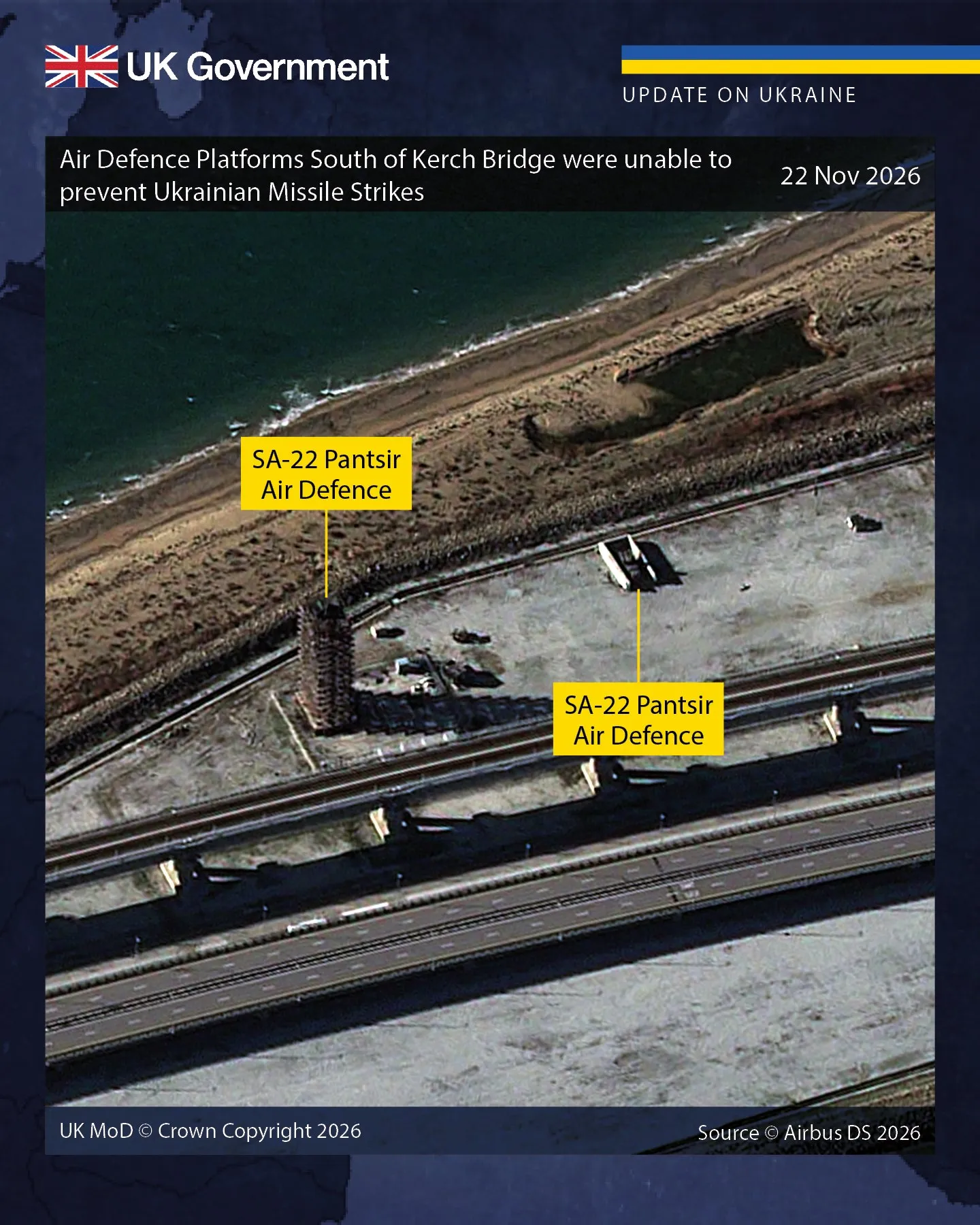
Despite measures to strengthen the bridge’s defenses, Russian air defenses were unable to prevent the Ukrainian strikes.
According to British intelligence, two “Pantsir” (SA-22) anti-aircraft missile and gun systems were deployed approximately 2.4 km south of the section of the road bridge that collapsed. However, they were unable to stop the attack.
The damage to the Crimean Bridge also affected Russian maritime transport. According to British intelligence estimates, the port of Azov has likely ceased operations due to Ukrainian strikes on two crossings.
These include the Crimean Bridge, as well as the crossing in Rostov-on-Don, which was struck on October 10, 2026.
“The blockade of sea routes to the Sea of Azov has restricted Russian maritime logistics. It is likely that ships in the Sea of Azov will not be able to transit directly to the Black Sea until the waterways are cleared,” British intelligence noted.
This is evidenced by British intelligence data.
Ukraine is seeking alternative satellite communication systems due to ongoing speed restrictions on Starlink. In particular, the Ukrainian military used the services of the Israeli provider HiSKY during the operation against the Crimean Bridge.
Ukrainian President Volodymyr Zelenskyy informed military commanders that he aims to completely destroy the Crimean Bridge. According to Western media reports, the Ukrainian Armed Forces have already carried out several strikes on the bridge, and Kyiv is preparing further attacks.
Repairing the Crimean Bridge during the winter is unlikely for Russian troops due to harsh weather conditions. At the same time, it is too early to predict whether the occupiers will be able to quickly begin repairs in the spring.
Approximately 6,000 metric tons of Russian steel ended up at the bottom of the Kerch-Yenikale Canal as a result of the destruction of the Crimean Bridge’s structures on the night of November 17. As a result, according to the author of the report, navigation between the Black Sea and the Sea of Azov is effectively blocked: outside the artificial channel, the strait is too shallow for large vessels to pass through.
On the night of November 17, the Crimean Bridge came under attack again. Sergey Aksyonov, the Gauleiter of occupied Crimea, reported the attack, noting that traffic across the bridge had been temporarily suspended.
On the night of November 17, the Crimean Bridge came under attack once again. OSINT sources report that the bridge’s road arch may have fallen into the water, while the Russian-appointed occupation authorities in Crimea announced the suspension of traffic across the bridge.
Robert Brovdi, commander of the Unmanned Systems Forces, with the call sign “Madyar,” published images of the drones used to strike the Kerch Bridge on November 17. He also revealed the units involved in the joint operation.
Russian dictator Vladimir Putin met with Transport Minister Dmitry Yadrov shortly after the drone attack on the Crimean Bridge, but did not inquire about the consequences of the strike. Instead, during the meeting at the Kremlin, they discussed the development of the transportation sector and improvements to rail transport, even though trains were delayed for several hours due to the attack.




